






























AI may appear weightless, but the data centres powering it consume water and electricity on an enormous scale. With global data-centre water consumption projected to reach 1.2 trillion litres annually by 2030 in the IEA’s base case, the real challenge is ensuring that technological expansion does not intensify pressure on already stressed water resources.
Executive summary
Artificial intelligence is often described as a weightless digital service. In practice, it depends on electricity-intensive physical infrastructure whose cooling systems and energy supply can place pressure on water resources. The International Energy Agency (IEA) estimates global data-centre water consumption at about 560 billion litres annually and projects approximately 1.2 trillion litres by 2030 in its base case [1].
These are system-wide estimates and a scenario, not direct measurements of every facility. Their policy significance lies not only in scale but in geography: a litre consumed in a stressed basin has different consequences from a litre consumed where water is abundant.
This article examines what can and cannot be inferred from headline figures, how water demand intersects with electricity generation and local public services, and what transparent, proportionate governance would look like. It argues that data-centre expansion should be assessed against local water conditions and competing needs without presuming that every facility or cooling technology has the same impact.
1. The physical infrastructure behind the digital promise
Computing requires physical resources
A request to an AI service travels through data networks and computing equipment housed in buildings that need reliable power, thermal management and maintenance. Heat must be removed from servers. Depending on design and climate, this can involve evaporative cooling, air-based systems, liquid cooling loops, hybrid designs or other approaches. The choice changes both electricity use and water demand. A facility that uses little water directly can still be linked to water consumption upstream through electricity production and hardware manufacturing [1, 2].
The local planning question
As AI investment accelerates, public debate tends to focus on computing capacity, jobs and grid connections. Water is less visible in planning announcements. Yet communities and utilities must manage water on the ground, within finite watersheds, seasonal conditions and existing legal rights. This makes water a governance question, not merely a corporate efficiency metric.
2. How much water do data centres need?
Global estimates and projections
The IEA’s 2025 Energy and AI report estimates that data centres worldwide consumed approximately 560 billion litres of water annually around 2023 and that consumption could reach roughly 1.2 trillion litres in 2030 under its base-case projection [1]. The implied increase is about 640 billion litres per year, or a little more than a doubling. These figures combine water-related impacts across the data-centre value chain and should not be described as cooling-tower withdrawals alone.
| Measure | Approximate value | Interpretation |
| Global annual water consumption, circa 2023 | 560 billion litres | IEA estimate; not a census of site meters |
| Global annual water consumption, 2030 | 1.2 trillion litres | IEA base-case projection, not observed consumption |
| Illustrative 100 MW hyperscale site | ~2 million litres/day | IEA example including indirect water consumption; not a universal facility rate |
Why a single facility cannot represent the sector
The IEA also describes a 100 MW hyperscale data centre in the United States consuming around two million litres of water per day when direct and indirect consumption are counted, with the indirect component accounting for more than 60% [1]. It would be misleading to multiply this illustrative rate by the number of facilities worldwide without knowing their operating profiles, cooling methods, grid mix and climate.
3. Withdrawals, consumption and indirect water use are not the same
Withdrawal versus consumption
Water withdrawal is water taken from a river, aquifer, municipal supply or other source. Water consumption generally refers to water not returned to the same source in an immediately available form, for example because it evaporates. These quantities can differ substantially. Some facilities withdraw more water than they consume; some cooling configurations require comparatively little on-site water. Reporting that omits these distinctions can make a large figure sound precise while obscuring what was actually measured [2, 3].
Direct and indirect accounting boundaries
A further distinction concerns the system boundary. Direct use covers water at the facility, including cooling and associated operations. Indirect use may arise in power generation and equipment supply chains. Policymakers should ask which boundary a reported number covers before comparing companies or jurisdictions. The IEA estimates that energy supply and electricity generation account for a substantial share of the sector’s overall water footprint [1].
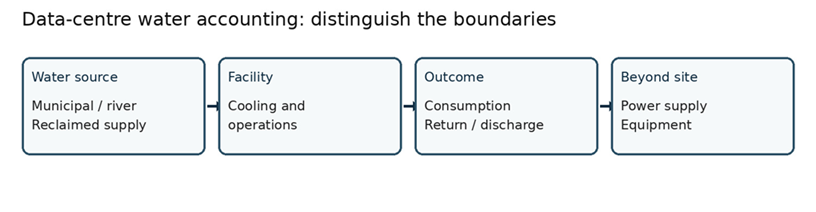
Figure 1. Data-centre water accounting: direct cooling demand, electricity-related impacts and the local water context.
4. Why the location matters more than the global average
Basin conditions change the risk
Annual global totals are useful for understanding scale but inadequate for determining local risk. A new site in a basin with secure, seasonally resilient supply is not equivalent to a new site in a region where households face restrictions, farmers compete for irrigation water or ecosystems depend on depleted flows. The timing of consumption also matters: summer cooling demand may coincide with drought and peak municipal demand.
What a site assessment must examine
Water stress is a relationship between demand and availability, not a property of data centres alone. A credible assessment should examine current and forecast basin conditions, the proposed source of water, seasonal variation, competing users, wastewater return flows and drought contingencies. It should also make clear who is responsible for checking those assumptions as conditions change.
5. The distributional question: who receives the benefits and who bears the costs?
Benefits and burdens are not distributed equally
AI services can generate economic value across countries, while a particular data centre concentrates some environmental and infrastructure burdens in one locality. A municipality may welcome construction jobs and tax revenue while also confronting pressure to expand water mains, treatment capacity and electricity infrastructure. The relevant policy issue is not whether digital development is good or bad in the abstract; it is whether the costs, benefits and risks are fairly assessed and openly allocated.
What communities need to know
Residents should be able to understand whether a proposed facility will use drinking-quality water, reclaimed water or another source; how demand might change during heatwaves; and what safeguards apply when supply becomes constrained. Where public funds support infrastructure upgrades, authorities should explain the expected public return and who pays for long-term maintenance.
6. Efficiency gains do not guarantee lower total demand
Efficiency is not the same as absolute demand
Water Usage Effectiveness (WUE) can help describe litres of water used per kilowatt-hour of IT equipment energy under a specified reporting methodology. It is not a measure of local water justice, basin resilience or total supply-chain water use. A facility can improve WUE while increasing its total water demand if its computing activity grows faster than efficiency improves. Likewise, shifting to low-water cooling may increase electricity demand under some conditions, transferring part of the environmental burden elsewhere [2, 3].
Minimum reporting information
Public reporting therefore needs both intensity and absolute values. At minimum, it should distinguish annual and seasonal water withdrawal, water consumption, water source, reclaimed-water share, WUE methodology and any relevant upstream estimates. Figures from different companies should not be compared as if they share identical accounting boundaries.
7. Reclaimed water: an opportunity with conditions
Reuse requires technical safeguards
Using treated municipal wastewater or other non-potable sources can reduce pressure on drinking-water supplies when the supply is dependable and fit for the intended cooling system. But reclaimed water is not automatically suitable. Salinity, scaling potential, corrosion, microbiological risks, treatment requirements, residual disposal and public-health safeguards must be assessed by qualified specialists [3, 4].
Evaluate the complete consequences
A reuse proposal should be judged by its complete environmental and operational consequences, including the electricity and chemicals needed for additional treatment. It must also respect other potential uses of reclaimed water. Reuse can be a valuable part of a water strategy without becoming a blanket permission for unlimited new demand.
8. India: a development opportunity and a governance test
Why India needs location-specific assessment
India’s expanding digital economy creates a strong rationale for new computing infrastructure. It also brings a diverse water context, from regions with relatively abundant supplies to cities and agricultural areas facing serious seasonal stress. A national approach that treats every location alike would miss the core risk. Siting, water-source selection and cumulative industrial demand should be considered alongside electricity reliability, land use and local development goals.
Policy opportunities and legal limits
For Indian policymakers, the immediate opportunity is to connect data-centre approvals with existing water-resource planning, state and municipal utility information, wastewater-reuse policies and transparent public consultation. This is a policy recommendation, not a claim that Indian authorities currently impose a uniform nationwide data-centre water rule. The feasibility of specific measures depends on applicable central and state law and local institutions.
9. What a transparent approval process should ask
Questions before approval
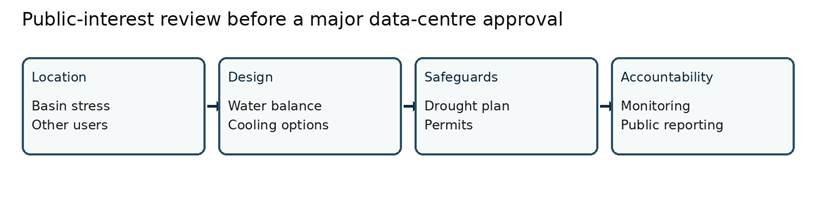
Before a major new facility or expansion is approved, public authorities and operators can ask a concise set of questions. Is the water source legally available and environmentally sustainable? What are the expected withdrawals and consumptive losses in ordinary and dry years? What cooling alternatives were examined? Are indirect energy-related impacts disclosed? How will competing community and ecological needs be protected? Who has authority to intervene if conditions materially change?
| Policy question | Evidence that should be made available |
| How much water? | Absolute withdrawals and consumption; seasonal demand; method and uncertainty |
| From which source? | Municipal, groundwater, surface or reclaimed water; relevant permissions |
| What happens in drought? | Defined contingency and demand-management arrangements |
| Who is affected? | Cumulative basin demand and competing community/ecological needs |
| Who checks compliance? | Named authority, monitoring schedule and public reporting process |
These are not claims that one universal checklist can replace water permits, engineering assessments or local law. They are a practical minimum for making consequential decisions intelligible to the public.
Figure 2. Practical governance questions before approving a data-centre project, from water source and demand to disclosure and monitoring.
10. Accountability beyond sustainability reports
Independent review matters
Corporate environmental reports can provide valuable data, but reporting alone does not determine whether a proposed increase in local demand is acceptable. Independent review, public access to material assumptions and meaningful mechanisms for responding to new evidence are necessary where projects have significant water implications. Municipalities should not be left to infer operational risks from global corporate averages.
A credible accountability system should also identify uncertainty. Water forecasts, climate conditions and industrial operating requirements can change. Rather than presenting every projection as a fact, decision-makers should disclose assumptions and explain when reassessment would be required.
11. A proportionate policy agenda
Five practical priorities
First, require project-level disclosure of water withdrawals and consumption using clear boundaries and consistent definitions. Second, evaluate local water stress and cumulative demand during siting and permitting. Third, examine lower-water cooling and suitable reclaimed-water options without assuming that any one technology is universally superior. Fourth, publish drought-response arrangements where water scarcity presents material risk. Fifth, ensure that local communities can review the evidence and that operators and regulators have defined responsibilities.
Governments can also encourage research on the interaction between cooling design, electricity demand and water use. The objective should be measured outcomes, not claims of environmental benefit based on technology labels alone. Where incentives are offered, they should be linked to verifiable public benefits and transparent reporting.
12. The question AI policy cannot avoid
Infrastructure decisions shape future demand
The infrastructure supporting artificial intelligence will continue to expand. Its water footprint will be shaped by decisions about location, cooling, power supply, demand growth and governance. The IEA’s projected increase in global water consumption makes these decisions more urgent, but no global estimate can replace the local evidence needed for an individual project.
Who decides, and on what evidence?
The central public question is straightforward: when a digital service depends on a shared physical resource, who decides whether the additional demand is acceptable, on what evidence, and with what accountability to the people who depend on that resource? Technological progress and water security need not be enemies. But their coexistence must be planned, measured and governed rather than assumed.
India: a national policy question, not merely a technology question
Capacity is not a water measurement
India’s data-centre expansion brings economic opportunities, including digital services, infrastructure investment and computing capacity. Yet a project’s announced megawatts do not reveal how much freshwater it will use. Site-specific demand depends on utilization, weather, cooling design, water source, hours of operation and the electricity system supplying the facility. Public decision-making must therefore examine the proposed facility and its catchment, not extrapolate mechanically from a single international average.
Emerging policy proposals
In October 2026, reporting on India’s emerging national data-centre policy highlighted concerns about electricity demand and the possibility that consumers could bear additional infrastructure costs. A separate account of NITI Aayog’s proposed evaluation framework emphasized the need to establish power and water readiness before approving projects. These are reported policy developments, not evidence that a binding nationwide water-use limit is already in force. [8]; [9]
Different cities, different water conditions
Three Indian locations illustrate distinct questions. Mumbai and Navi Mumbai are major expansion corridors, making cumulative infrastructure impacts relevant. Chennai raises the issue of long-term water resilience in a coastal metropolitan setting. Hyderabad’s growing digital-infrastructure sector similarly requires project-level disclosure and local water-balance assessment. These are location-based policy comparisons, not claims that particular facilities have breached limits.
India case study: Navi Mumbai and the cooling-design question
Announced design versus measured performance
Colt Data Centre Services and RMZ announced construction of a 64 MW AI-ready facility, Mumbai 3, in Navi Mumbai in October 2026. Reporting describes a hybrid architecture combining air and direct-to-chip liquid cooling and a closed-loop approach intended to minimize wastewater. The stated 64 MW is a power-capacity figure, not a water-consumption measurement. No verified annual withdrawal, potable-water share or catchment impact can be calculated from the announcement alone. [10]
The public-interest test is therefore straightforward: before commissioning, disclose expected annual withdrawals by source, peak-day requirements, treatment and discharge arrangements, drought contingencies and actual monitored performance after operation begins. A closed loop within the chip-cooling circuit does not establish that the entire facility has zero water demand.
India case study: Chennai and infrastructure expansion
Public claims and evidence gaps
CapitaLand’s Chennai 01 project in Ambattur has been reported as a 53 MW gross-capacity development with 34 MW designated for IT loads, with completion targeted for the end of 2026. The public account describes environmental ambitions but does not provide an independently verified operating water footprint. The appropriate conclusion is not that the facility consumes a particular number of litres; it is that environmental claims need measurable water indicators as well as energy indicators. [11]
For a coastal urban area, a responsible assessment should distinguish potable water, reclaimed municipal water, possible desalinated supply and groundwater. Each option has different environmental and energy implications. Desalination, for example, is not a free water source: its electricity demand, brine management and distribution infrastructure must be considered.
United States case study: Microsoft and zero-evaporation cooling
Cooling innovation and its limits
Microsoft described a next-generation design in December 2024 that recirculates coolant in a closed loop and avoids water evaporation for cooling. The company estimated that the design could avoid more than 125 million litres of water per year per datacentre relative to its reference configuration, and reported a global fleet water usage effectiveness of 0.30 litres per kilowatt-hour in fiscal 2024. These are company-reported figures, not independently verified results for every facility. [12]
The distinction matters: ‘zero water for cooling’ refers to a particular operational cooling mechanism, not zero water throughout construction, electricity generation, sanitation or the supply chain. Microsoft also acknowledges a potential electricity trade-off when evaporative cooling is replaced. Regulators should ask for both water and energy impacts, with consistent system boundaries.
United States case study: Phoenix and operational improvement
Reported improvement versus local impact
In June 2026, Microsoft reported that operational adjustments at its Phoenix, Arizona, datacentres produced a 23% year-on-year improvement in water usage effectiveness in fiscal 2025. The company attributes improvement to controls, auditing and optimization, while describing continued use of several cooling technologies across its portfolio. This is a reported operator performance change; without independently disclosed absolute withdrawals and local supply data, it cannot by itself establish a corresponding 23% reduction in watershed pressure. [13]
The policy lesson is that retrofitting existing facilities can matter alongside the design of new ones. Relative efficiency, total demand and local water stress should be reported separately.
European Union case study: reporting as public infrastructure
EU disclosure requirements
The European Union has taken a different route by creating a common reporting framework. The Energy Efficiency Directive and Commission Delegated Regulation (EU) 2024/1364 establish reporting of data-centre sustainability indicators, including water input and potable-water input, for facilities within scope. This does not amount to a universal ban on water-intensive cooling or a single performance limit. It creates a more comparable evidence base for regulators and the public. [14]; [15]
The EU example is important because technical comparisons are unreliable when operators use different definitions. Annual site-water input, water consumption, IT electricity, reclaimed-water share and local scarcity should not be merged into one promotional headline.
Comparing approaches without promoting a single model
Comparing engineering trade-offs
Evaporative cooling can reduce electricity needed for heat rejection in suitable conditions but consumes water. Dry air cooling can lower direct water demand while increasing electricity use or reducing thermal efficiency in hot conditions. Direct-to-chip liquid cooling can improve heat removal for dense AI hardware, but the environmental result depends on how heat is ultimately rejected. Reclaimed-water systems may reduce demand for drinking-quality water, yet still require reliable quality control, infrastructure and safe residual management.
Avoiding misleading comparisons
Facility assessment frameworks should therefore compare water usage effectiveness (WUE), power usage effectiveness (PUE), annual withdrawal and consumption, potable-water share, basin stress, operational reliability and life-cycle costs. The EU reporting model, company cooling designs and proposed Indian infrastructure-readiness framework are different kinds of interventions: a disclosure regime, engineering approaches and a planning tool. They should not be treated as interchangeable or ranked without comparable measured outcomes.
The author’s separate research on water and AI governance is not used as evidence of field-validated savings in this article. No implementation claim, proprietary decision rule or unpublished performance result is asserted.
A practical agenda for Indian and international policymakers
A measurable policy agenda
First, make a site-specific water balance a standard part of large data-centre applications: annual and peak-day withdrawals, water sources, discharge, reclaimed-water share and drought operation. Second, require a cumulative assessment where multiple developments draw on the same utility or watershed. Third, publish actual operating data at a useful level of aggregation while protecting legitimate security-sensitive information.
Fourth, assess electricity and water together, including the indirect water consequences of power generation where credible data exist. Fifth, require claims such as ‘water positive’ or ‘zero-water cooling’ to specify their accounting boundary, baseline and verification status. Sixth, create meaningful public consultation before approvals in water-stressed areas, with an identified authority responsible for enforcement.
These are policy recommendations, not a claim that every jurisdiction currently imposes these obligations. They should be adapted to applicable law, basin conditions and public-health safeguards.
References
[1] International Energy Agency (2025). Energy and AI. https://www.iea.org/reports/energy-and-ai
[2] Mytton, D. (2021). Data centre water consumption. npj Clean Water, 4, Article 11. https://doi.org/10.1038/s41545-021-00101-w
[3] U.S. Department of Energy, Federal Energy Management Program. Water Efficiency for Data Centers. https://www.energy.gov/femp/water-efficiency-data-centers
[4] U.S. Environmental Protection Agency. Water Reuse and Recycling. https://www.epa.gov/waterreuse
[5] Shehabi, A., et al. (2024). 2024 United States Data Center Energy Usage Report. Lawrence Berkeley National Laboratory. https://doi.org/10.71468/P1WC7Q
[6] OECD (2015). OECD Principles on Water Governance. https://www.oecd.org/en/topics/sub-issues/water-governance/the-oecd-principles-on-water-governance-and-implementation-strategy.html
[7] World Bank (2025). Scaling Water Reuse: A Tipping Point for Municipal and Industrial Use. https://www.worldbank.org/en/topic/water/publication/scaling-water-reuse
[8] Reuters (14 October 2026), India to roll out data centre policy as concerns grow over power use. https://www.reuters.com/world/india/india-roll-out-data-centre-policy-concerns-grow-over-power-use-2026-10-14/
[9] Express Computer (October 2026), India’s data centre race gets a readiness test: NITI Aayog wants power, water and payoffs proven first. https://www.expresscomputer.in/news/indias-data-centre-race-gets-a-readiness-test-niti-aayog-wants-power-water-and-payoffs-proven-first/139950/
[10] Express Computer (October 2026), Colt DCS and RMZ begin construction of 64MW AI-ready data centre in Mumbai. https://www.expresscomputer.in/news/colt-dcs-and-rmz-begin-construction-of-64mw-ai-ready-data-centre-in-mumbai/140028/
[11] Express Computer (October 2026), CapitaLand Investment reaffirms long-term commitment to Tamil Nadu with new Chennai data centre. https://www.expresscomputer.in/news/capitaland-investment-reaffirms-long-term-commitment-to-tamil-nadu-with-new-chennai-data-centre/140096/
[12] Microsoft (9 December 2024), Sustainable by design: Next-generation datacenters consume zero water for cooling. https://www.microsoft.com/en-us/microsoft-cloud/blog/2024/12/09/sustainable-by-design-next-generation-datacenters-consume-zero-water-for-cooling/
[13] Microsoft (24 June 2026), Inside Microsoft’s two-decade push to cut water intensity while scaling for growth. https://blogs.microsoft.com/blog/2026/06/24/inside-microsofts-two-decade-push-to-cut-water-intensity-while-scaling-for-growth/
[14] European Commission, Energy performance of data centres. https://energy.ec.europa.eu/topics/energy-efficiency/energy-efficiency-targets-directive-and-rules/energy-efficiency-directive/energy-performance-data-centres_en
[15] European Commission Delegated Regulation (EU) 2024/1364. https://eur-lex.europa.eu/eli/reg_del/2024/1364/oj
Disclaimer: The views, thoughts, and opinions expressed in this article belong solely to the author, and do not necessarily reflect the values, positions, or official policy of gfiles or its editorial board.

Maria Kollia
Maria Kollia is an independent researcher based in Greece and Co-Chair of the STANAIC Global Advisory Board. She studied Statistics and Actuarial-Financial Mathematics at the University of the Aegean. Her research focuses on AI governance, responsible AI, evidence-based oversight, institutional accountability, and sustainable digital infrastructure, including water and resource governance for data centres. Her continuing professional education includes more than 20 training credentials and certifications, including programmes associated with the University of Helsinki, University of Oxford, UNESCO and NASA, and qualifications relating to ISO/IEC 42001, ISO/IEC 27001, ISO/IEC 20000 and ISO 9001. The exact issuing organisations and certification levels should be checked against the original credentials. She researches the ZERO Framework and circular AI infrastructure and serves as Strategic Advisor to AIUE. LinkedIn: https://www.linkedin.com/in/maria-kollia-64520a245
Disclosure of interests
The author is Co-Chair of STANAIC and Strategic Advisor to AIUE. She also conducts independent research on resource governance, including AQUA-EXEC and ZERO. Neither framework is presented here as a field-validated data-centre solution. No payment was received for this editorial contribution. Operator claims are identified as such.
Leave a comment