


































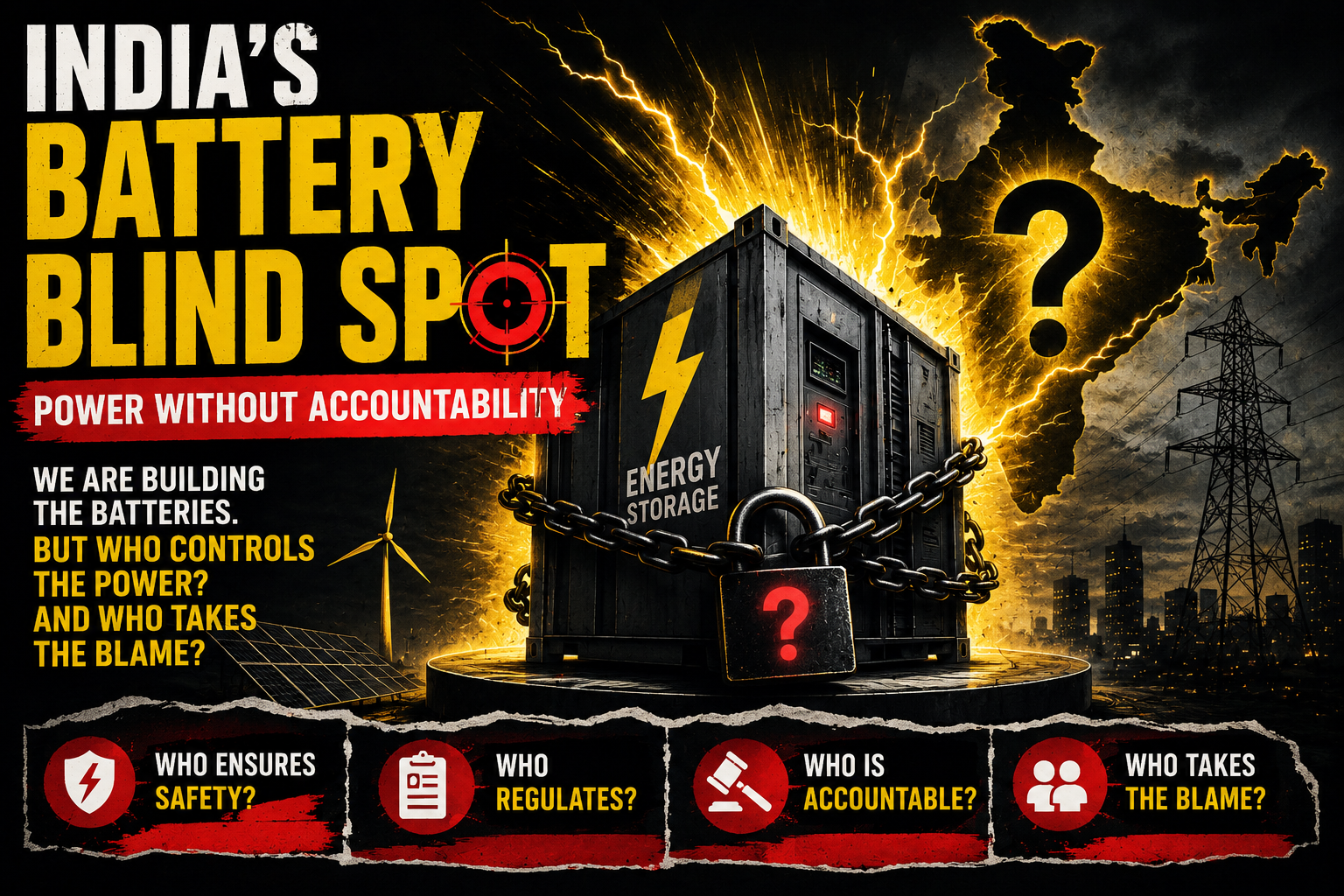
As India moves towards more than 43 GWh of publicly supported battery storage, the next policy challenge is to ensure that every material decision can be traced to a legitimate role, verified information, a defined system version, effective human authority and a measurable result.
| A high-performing storage system moves energy. A trustworthy storage system can explain who moved it, under which authority, on what basis and with what effect. |
India is building one of the most consequential energy systems of the twenty-first century. Renewable generation, intelligent grids, smart meters and large-scale battery energy storage systems are no longer separate policy fields. They are converging into a digitally coordinated infrastructure in which electricity is forecast, stored, released, priced and balanced through increasingly automated processes.
The scale of the current commitment is substantial. In June 2025, the Ministry of Power approved an additional Viability Gap Funding programme for 30 GWh of battery storage capacity, supported by INR 5,400 crore from the Power System Development Fund and expected to mobilise approximately INR 33,000 crore of investment.[1] An earlier programme, supported by INR 3,760 crore, expanded from an initial 4,000 MWh to approximately 13,200 MWh as storage costs declined.[2] Government information published in February 2026 confirms approximately 13,220 MWh under that first programme alongside the additional 30-GWh programme.[3]
Together, these initiatives represent more than 43 GWh of publicly supported storage capacity. That is not merely an engineering programme. It is the construction of a new class of critical infrastructure whose behaviour will be shaped by public mandates, private technology, market incentives, operational data, software updates, forecasting models and human decisions.
The decisive policy question is therefore no longer only how much electricity a battery can store. It is whether the system can explain who used that energy, when, under which authority, on what information basis, through which technical configuration, for what purpose and with what actual effect.
The next bottleneck is institutional
A modern grid-connected battery is not a passive container. It receives grid and market signals, processes forecasts, responds to state-of-charge and safety data, applies technical rules, may participate in several revenue mechanisms and can be reconfigured through software. The same storage capacity may support renewable-energy integration, peak-load reduction, reserve provision, congestion management, market arbitrage, emergency response or combinations of these functions.
That flexibility is valuable, but it creates conflicts that cannot be resolved by technical optimisation alone. A commercially attractive discharge may reduce reserve capacity needed later for grid security. Holding capacity in reserve may improve resilience while limiting short-term revenue. Intensive cycling may increase utilisation while accelerating degradation. An algorithm may recommend an operational action that is technically plausible but based on incomplete data, an outdated model version or a mandate that is no longer valid.
India’s specific administrative challenge is to convert distributed institutional competence and fragmented technical records into a single event-specific chain of accountability. Formal responsibilities may be defined across ministries, regulators, utilities, project entities, operators, technology providers, investors and insurers. Yet after a critical event, it may still be difficult to determine which person or system acted, what information was available, whether the data had been checked, which software version was active, whether a qualified human could intervene and whether the intended effect was achieved.
This is the difference between asset management and accountability management. Asset management asks whether the battery is available, safe and performing. Accountability management asks whether each material use of the battery was legitimate, reviewable, correctable and connected to its actual consequences.
Why familiar solutions do not close the gap
Traditional regulation remains indispensable. Licences, grid codes, technical standards, market rules and reporting obligations define the legal environment. Their limitation is not a lack of authority but the distance between formal authority and operational evidence. Regulation can identify the competent institution, yet still leave an auditor reconstructing a decision from separate reports, emails, control-system logs and vendor records. Digital monitoring systems improve visibility. Battery-management systems, SCADA platforms, data historians and dashboards can show alarms, performance, maintenance status and technical behaviour. But data visibility does not by itself prove legitimate use. A dashboard may show that a discharge occurred without showing whether the acting role was authorised for that specific purpose, whether a restriction had expired, whether the decision relied on approved data or whether the operator had real power to stop the action.
Artificial intelligence can improve load forecasting, renewable-generation forecasting, charging and discharging optimisation, predictive maintenance, anomaly detection and battery-ageing analysis. A 2025 systematic review of AI in power systems nevertheless identifies operational reliability, sustainability, trust, regulatory issues and economic concerns as central fields of attention. It specifically highlights transparency, explainability, privacy, cybersecurity and accountability, and points to the unresolved question of how much operational autonomy AI systems should exercise.[7]
AI therefore addresses the performance problem, but not automatically the legitimacy problem. A model can be accurate and still be deployed outside its approved scope. It can use data that were not authorised for the decision. It can produce a recommendation that no qualified person has time or authority to challenge. It can achieve an unintended outcome that is never systematically compared with the original objective. The solution is not to choose between regulation, monitoring and AI. India needs an architecture that connects all three at the level where responsibility actually materialises: the operational event.
The smart-meter debate already shows what is at stake
Smart meters illustrate the broader governance problem because they connect national infrastructure with the daily lives of households and businesses. Meter data may support billing, network planning, demand forecasting, tariff design and operational decisions. As the temporal resolution of those data increases, their value grows – and so do the risks associated with purpose drift, unauthorised access, insecure processing and opaque decision-making.
A 2025 analysis by the Prayas Energy Group examined smart-meter regulation in eleven Indian states. Five of the regulatory instruments reviewed contained no specific data-security clause. Others contained general requirements but did not refer to a uniform standard or directly to the cybersecurity guidelines of the Central Electricity Authority.[8] An earlier Prayas study proposed a sector-specific governance model with clearly defined processing purposes, differentiated roles for distribution companies and service providers, security and response plans, consumer rights, complaint mechanisms and periodic reporting on privacy and security incidents.[9]
The lesson is relevant to battery storage. Infrastructure can scale faster than the governance needed to make its data and decisions trustworthy. Once systems are deployed across multiple states and vendors, retrofitting common accountability structures becomes expensive and politically difficult. The governance layer should therefore be designed before fragmentation becomes the operating model.
The Battery Passport is necessary – but it is not sufficient
Europe’s Battery Passport provides an important point of reference. Regulation (EU) 2023/1542 establishes a digital battery passport from 18 February 2027 for specified battery categories, including industrial batteries with a capacity above 2 kWh. The passport links a physical battery to digital information concerning identity, technical characteristics, performance, sustainability and lifecycle. Access is differentiated by role and authorisation.[4]
This is a significant advance because it makes the battery a traceable product across manufacturing, operation, repair, second-life use, recovery and recycling. It can identify the manufacturer, model, serial number, chemistry, production site, technical specifications, ownership, operator, location, maintenance history, software updates, safety events and lifecycle changes.
But the Battery Passport primarily answers the question: What is this asset, and what has happened to it over its lifecycle?
Critical infrastructure requires a second question: Who may use this asset now, for which purpose, within which limits, on which information basis and with which authority to intervene?
The first question concerns persistent identity. The second concerns event-specific legitimacy. They should be connected, but they should not be collapsed into one record.
The Participation Twin: a governance layer for legitimate use
The Participation Twin is proposed as the missing governance layer. It is a context-specific digital representation of the roles, rights, purposes, restrictions, decision powers and expected effects associated with a particular use of an infrastructure asset. The concept forms part of my independent Participation Plus research framework.
The Battery Passport documents the asset. The Participation Twin documents its legitimate use.
For a battery-storage event, the Participation Twin would identify the participating institutions and authorised persons, the purpose of the action, the applicable restrictions, the validity period of the authority, the permitted data basis, the software and model versions, the required human review, the person or role holding Human Override authority and the effect that the action is intended to produce.
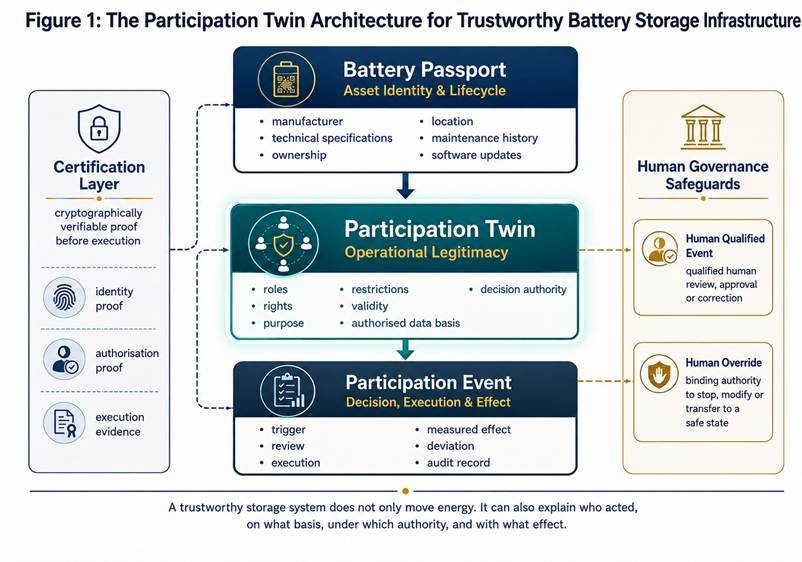
The architecture connects asset identity, operational legitimacy and measurable effect through a three-layer accountability model.
Source line:
Source: Author’s own conceptual framework, AI-assisted visualisation.
The Battery Passport documents the asset. The Participation Twin documents its legitimate use.
For a battery-storage event, the Participation Twin would identify the participating institutions and authorised persons, the purpose of the action, the applicable restrictions, the validity period of the authority, the permitted data basis, the software and model versions, the required human review, the person or role holding Human Override authority and the effect that the action is intended to produce.
This is not a proposal for a new central database containing all raw operational data. The architecture can be federated. Utilities, operators, regulators and technology providers may retain their source systems. The Participation Twin requires a common structure for verifiable claims, references, time stamps, versions and evidence locations. It connects systems without demanding that every sensitive data point be copied into one platform.
Its principal advantage is therefore integrative. Traditional regulation establishes formal competence. Monitoring provides technical visibility. AI supports prediction and optimisation. The Participation Twin connects those functions to event-specific authority, human intervention and measurable outcomes.
| Dimension | Battery Passport | Participation Twin |
| Primary purpose | Technical identity and lifecycle documentation | Operational legitimacy and responsibility allocation |
| Core question | What is the asset? | Who may act, for what purpose and under which authority? |
| Main information | Manufacturer, specifications, ownership, lifecycle data | Roles, rights, restrictions, validity, authorised decision context |
| Time perspective | Product lifecycle | Event-specific operational validity |
| Decision relevance | Provides technical evidence | Provides legitimacy for action |
| Human role | Limited to lifecycle processes | Defined review and intervention authority |
| Outcome | Traceable asset history | Traceable decision and effect chain |
Table 1: Battery Passport and Participation Twin – Complementary Layers of Trustworthy Infrastructure
Source: Author’s own conceptual comparison based on the proposed accountability architecture.
The operational event is the real unit of accountability
The Participation Twin becomes operational through a Participation Event. A Participation Event is a time-defined and legitimised event in which a battery is charged, discharged, reserved, maintained, blocked, updated, transferred into a safe state or returned to service.
Consider an evening demand peak. A forecasting system predicts a regional constraint. The control platform evaluates available storage assets. One battery is selected for discharge. Before execution, the system should be able to establish the trigger, the data available at that moment, the quality status of those data, the applicable rules, the software and model versions, the authorised operational role, the need for qualified human review, the available override path and the expected grid effect.
After execution, the same event record should capture the energy delivered, the actual timing, the remaining reserve capacity, the observed grid effect, deviations from the forecast and any corrective action. The decision and its consequence must remain part of the same evidentiary chain.
This event-level structure closes several common gaps at once: the identity gap between the physical battery and its records; the authority gap between formal competence and actual action; the information gap concerning what was known at the time; the version gap concerning software, rules and configuration; the human-control gap; the effect gap; and the audit gap caused by manual reconstruction across organisations.
A Participation Event can also become a billing, funding, insurance or learning event. Public support can be linked to demonstrated effects. Insurers can distinguish technical failure from data failure or organisational failure. Regulators can determine whether the correct role acted under the correct version of the rules. Operators can analyse why an expected outcome differed from the actual result.
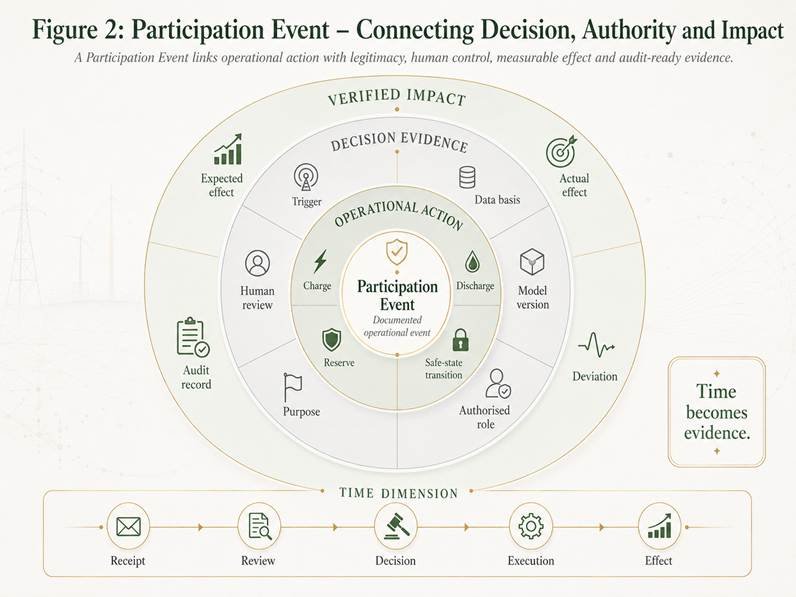
Each operational event is documented through a structured sequence: trigger, readiness assessment, authorised decision, qualified human review where required, execution, effect measurement and audit record. This creates a continuous evidence chain between infrastructure operation and measurable outcome.
Source line:
Source: Author’s own conceptual framework, AI-assisted visualisation.
Human oversight must mean the power to intervene
Many technology programmes promise ‘human oversight’ without defining how it will work under operational pressure. A person may be shown a recommendation, asked to click an approval box and later held accountable for a process they did not meaningfully understand or control. That is not effective oversight.
Within the proposed architecture, a Human Qualified Event is a documented point at which an authorised and professionally competent person assesses, approves, corrects or rejects a system recommendation. The record should show the person’s role, the information available, the time allowed for review, the reasoning, any deviation from the recommendation and the required escalation.
Human Override is the binding authority to stop, modify or transfer an automated action into a defined safe state. It requires more than a policy statement. The responsible role needs technical access, sufficient training, organisational protection and a tested escalation path. The system must record when the override was used, why it was used, what safe state was reached and under which conditions normal operation resumed.
The Participation Twin makes human oversight testable. A pilot can determine whether the reviewer received relevant information, had sufficient time, understood the consequence, possessed authority to deviate and could actually reach the safe state. Human accountability should never be assigned where human agency does not exist.
Why India can test this architecture now
India does not need to create an entirely new institution before testing the model. The National Smart Grid Mission already provides multi-level decision, project, monitoring, review and verification structures.[5] Its State Level Project Management Units are chaired by the relevant Power Secretary or an equivalent state authority and can bring together distribution companies, regulatory bodies, energy and finance departments, academic institutions and other stakeholders. The Mission lists such units for 19 states or Union Territories.[6]
This creates a practical institutional host. A pilot could be established under one State Level Project Management Unit and limited to an existing or already-procured grid-connected battery. The first use case should be narrow and valuable – for example peak-load support, reserve provision or a safety-related transition. The battery asset and major grid hardware should not be part of the pilot budget; the objective is to test the accountability overlay.
A serious pilot would require a small multidisciplinary programme rather than a large new bureaucracy. The core team should include the state authority or SLPMU secretariat, the relevant utility or storage operator, control-room and engineering staff, architecture and systems-integration specialists, cybersecurity and data-governance experts, an assurance or certification function, legal and procurement support, training personnel and an independent evaluator.
| Phase | Timeline | Main Objective | Key Outputs |
| Phase 1: Preparation | Months 0–6 | Governance design and baseline assessment | Stakeholder mapping, use case definition, responsibility model |
| Phase 2: Integration | Months 7–12 | Technical and organisational configuration | Participation Twin setup, interfaces, evidence structure |
| Phase 3: Validation | Months 13–18 | Controlled testing | Shadow operation, data validation, audit reconstruction |
| Phase 4: Pilot Operation | Months 19–24 | Live deployment | Documented Participation Events and KPI measurement |
| Phase 5: Evaluation & Scaling | Months 25–30 | Assessment and replication strategy | Independent evaluation, scaling recommendations |
Caption:
Table 2: Proposed 30-Month Implementation Roadmap for an Indian Battery Storage Pilot
Source: Author’s proposed implementation model.
The implementation sequence should be deliberately staged over approximately 30 months. The first three months would establish the public mandate, site, use case, project board and procurement route. Months four to six would map the existing process, establish baseline times and costs, define roles, event categories, evidence requirements and audit questions. Months seven to twelve would cover integration, Participation Twin configuration, version evidence, time synchronisation, certification, user roles and override logging.
Months thirteen to eighteen would use shadow mode and limited live operation to validate data quality, safe states, user authority and audit reconstruction. Months nineteen to twenty-four would run the live pilot and compare results with the baseline. The final six months would assess interoperability, legal implications, standardisation options and the case for scaling.
The cost of the pilot – and the cost of doing nothing
For a standard single-site, multi-stakeholder pilot, the current planning assumption is an indicative envelope of INR 10-16 crore. This excludes the underlying battery asset, major grid hardware, routine utility staffing and full replacement of existing control platforms. A lean overlay with limited interfaces may be feasible at approximately INR 6-9 crore, while an enhanced multi-site pilot with advanced resilience and interoperability testing may require INR 18-30 crore. These figures are policy-design assumptions, not vendor quotations, and require site-specific validation.
The main cost categories are process and legal design, architecture configuration, software development, interfaces to battery-management and control systems, certification, cybersecurity, assurance, training, controlled operation, independent evaluation and contingency for legacy-system integration.
The benefit case should not be reduced to a narrow software return-on-investment calculation. The principal proposition is lifecycle cost avoidance and institutional value. A coherent event record can reduce audit and incident-reconstruction time, manual reconciliation of data and approvals, liability uncertainty, repeated coordination, and the cost of proving which system version was active.
It can also improve investor and insurer confidence, strengthen public-funding control, make escalation faster, improve technology procurement and create structured learning from failed Readiness Checks, overrides and deviations between forecast and effect.
The counterfactual matters. Without an accountability layer, the cost of fragmentation will be distributed across regulators, utilities, vendors, insurers, investors and citizens. Because those costs sit in different budgets, they are easily underestimated. They reappear as delayed approvals, duplicated audits, disputed liability, slow incident response, vendor lock-in, manual rework and declining trust.
What a credible pilot should measure
A policy pilot must be judged against a baseline, not against the quality of its presentation. It should measure whether the architecture makes real decisions easier to reconstruct, review and correct. Documentation volume alone is not a success indicator.
Proposed pilot thresholds include at least 95 per cent of sampled in-scope Participation Events being fully reconstructable; 100 per cent evidence completeness for critical safety, override and high-impact dispatch events; a complete standard audit package within four hours; at least a 30 per cent reduction in manual reconciliation effort; and at least a 20 per cent reduction in decision-handover time where safety is not adversely affected.
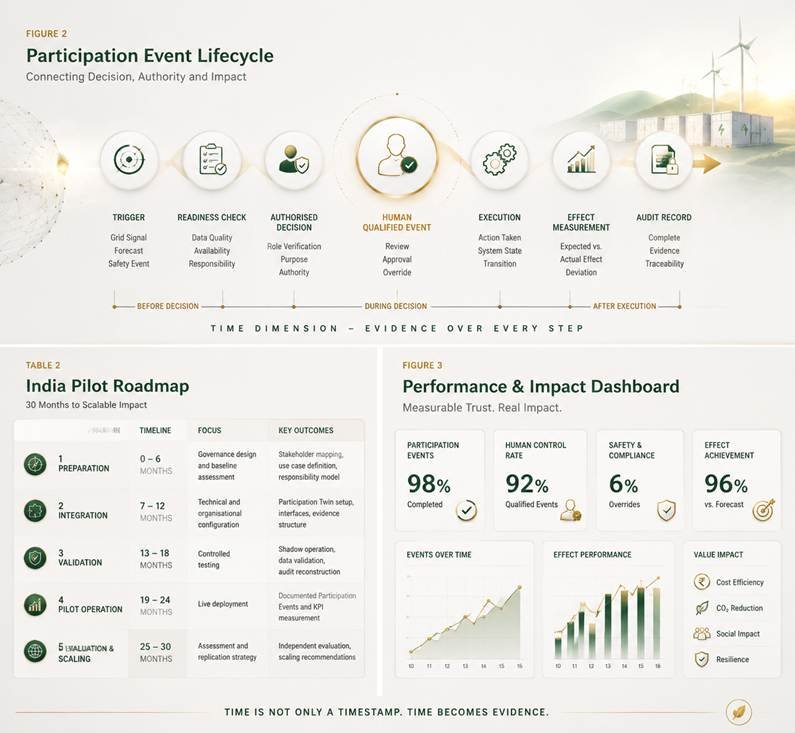
The conceptual dashboard illustrates how operational performance, human control, data quality, safety, efficiency and measurable impact can be monitored within a pilot evaluation environment. The time dimension connects evidence generation with evaluation, accountability and potential performance-based remuneration.
Source line:
Source: Author’s own conceptual framework, AI-assisted visualisation.
Override functionality should succeed in 100 per cent of acceptance tests and exercises. Defined critical data defects should be detected by the Readiness Check in at least 95 per cent of seeded or known cases. Forecast-to-effect deviation should be measured rather than hidden, and the system should demonstrate whether deviations are improving or are technically justified.
These are proposed planning thresholds, not empirical findings. They should be adjusted after baseline measurement, safety review and operational consultation. No efficiency target may override legal duties or safety requirements.
The most important qualitative measure is whether operators, regulators and staff believe the architecture improves clarity without creating an unmanageable documentation burden. Evidence should be proportionate and, wherever possible, captured automatically.
Procurement must specify accountability outcomes
India’s procurement documents should not describe only what the technology must do. They should also specify what the system must be able to prove.
Minimum requirements should include persistent asset identity, event-specific authority, purpose and validity, source-data references, software and model versions, Human Qualified Event, Human Override, expected effect, actual effect, time stamps and an audit-export function. Interfaces should be vendor-neutral. Evidence structures should be portable. Safe-state access should be contractually protected.
This does not require the regulator to prescribe one platform, one vendor or one AI model. Regulation can remain technology-neutral by defining minimum accountability outcomes. Suppliers can compete on implementation, performance and cost while being held to a common evidentiary standard.
Funding arrangements can also evolve. Participation Events may provide a future basis for milestone-based release of public funds or performance-related remuneration, provided the evidence rules are transparent, appealable and auditable. Public funding should never depend on an opaque automated score that cannot be reconstructed.
Critical success factors
The first requirement is a clear public mandate with one identified accountable authority. The second is a bounded use case. Attempting to govern every battery function in the first pilot would create overengineering, delay and weak adoption.
Data readiness must be assessed before the final software design. Time synchronisation, source-system quality and version evidence are not minor technical details; they determine whether the event record can be trusted. Vendor neutrality is equally important because a public accountability standard must remain portable across storage technologies and control platforms.
Cybersecurity and privacy must be built into the architecture. Verification should not become an unnecessary central repository of sensitive operational or consumer data. The model should use minimal disclosure, role-based access, federated evidence and offline-verifiable proofs where resilience requires them.
Independent evaluation is essential. The party implementing the architecture should not be the sole judge of success. The pilot should publish non-sensitive findings, including failed events, implementation burden and unresolved limitations. Scaling should occur only after the pilot demonstrates interoperability, acceptable cost, real human control and measurable public value.
India’s strategic opportunity
India has a particular opportunity because it combines infrastructure scale with institutional learning capacity. It is expanding battery storage through major public support programmes, operates a national smart-grid mission with state-level structures and has extensive experience in building digital public infrastructure.
A successful pilot would not impose a European model on India. The European Battery Passport would serve as a reference for persistent product identity. India could extend that logic by developing a governance layer for legitimate operational use. The result would be a distinct Indian contribution to global standards for trustworthy digital energy infrastructure.
The architecture is also compatible with federal diversity. States do not need identical operational processes. They need a common minimum method for proving identity, authority, purpose, versions, intervention and effect. State-specific rules can remain visible inside that structure.
The wider relevance extends beyond batteries. The same event-level logic can support smart meters, distributed energy resources, charging infrastructure and other critical systems in which physical assets, digital decisions, public authority and human consequences converge.
From battery capacity to trustworthy infrastructure
India’s battery-storage programmes are building more than megawatt-hours. They are creating a new layer of digitally coordinated critical infrastructure. The quality of that infrastructure will depend not only on response time, efficiency and technical availability, but also on whether decisions remain legitimate, attributable, reviewable and correctable.
The Battery Passport can establish the persistent identity and technical lifecycle of the asset. The Participation Twin can represent the event-specific rights, roles, purposes and restrictions governing its use. Participation Events can connect the trigger, data basis, software and model versions, qualified human review, override, execution and measured effect.
This proposal is intentionally evolutionary. It does not require India to replace existing institutions or build a new national platform before testing value. One battery, one use case and one State Level Project Management Unit are sufficient to begin.
A high-performing storage system moves energy. A trustworthy storage system can also explain who moved that energy, when, on what basis, for what purpose, through which technical configuration and with what actual effect.
Sources and further reading
1. Press Information Bureau, Government of India, Ministry of Power. “Shri Manohar Lal: Big Push for Battery Energy Storage”, 10 June 2025, Release ID 2135450.
2. Press Information Bureau, Government of India, Ministry of Power. “Viability Gap Funding for Battery Energy Storage Systems”, 3 April 2025, Release ID 2118325.
3. Press Information Bureau, Government of India, Ministry of New and Renewable Energy. “Government Takes Multi-Pronged Steps to Scale Up Energy Storage Capacity in the Country”, 3 February 2026, Release ID 2222473.
4. European Parliament and Council. Regulation (EU) 2023/1542 of 12 July 2023 concerning batteries and waste batteries, particularly Chapter IX and Article 77.
5. National Smart Grid Mission, Ministry of Power, Government of India. “National Smart Grid Mission Framework”, official institutional framework; accessed 2 August 2026.
6. National Smart Grid Mission, Ministry of Power, Government of India. “State Level Project Management Units”, official institutional description; accessed 2 August 2026.
7. Henao, Felipe; Edgell, Robert; Sharma, Ambar et al. “AI in power systems: a systematic review of key matters of concern”. Energy Informatics, Vol. 8, Article 76, 2025. DOI: 10.1186/s42162-025-00529-1.
8. Apte, Apoorva; Kulkarni, Shweta. “Behind the Smart Meter: Regulatory Drivers of India’s Smart Meter Rollout”. Prayas Energy Group, Power Perspectives, 7 October 2025.
9. Pai, Narendra; Chunekar, Aditya; Kulkarni, Shweta; Mandal, Manabika. “Handling smart meter data: privacy concerns, preparedness and safeguards”. Prayas Energy Group, Power Perspectives, 22 February 2021.
Research contribution and transparency
Research Contributor – Source Research and Compilation: Rohan Patil researched and compiled the Indian primary and specialist sources, institutional comparison points and case material used in this column.
Technical Review and Validation: Technical Review and Validation – Ilyes T. Mazari
The architecture described in this article maps to a three-layer trust model. The Battery Passport provides the certified identity and lifecycle record of the physical asset. The Participation Twin provides the transaction-specific authorization and responsibility layer, identifying who was authorized to act, within what declared scope, and for what period of validity. A separate certification layer provides cryptographically verifiable proof of that authorization before execution. This distinction preserves the separation between permanent asset identity and event-specific authority. For battery storage and digital energy infrastructure, the most directly relevant certification domains are Predictive and Time Series AI, Industrial and Manufacturing AI, and Smart Cities and Public Infrastructure AI. Together, these layers can support a verifiable chain from asset identity through authorized decision-making to the resulting operational effect, while detailed implementation mechanisms remain protected.
Ilyes.T. Mazari
Management and IT Consultant.
Researcher & Inventor.
Founder and CEO, Y.I.N. Technologies LLC,Delaware,USA.
Free tier available at certification.yintechnologies.com
Authorial Research Contribution: Participation Plus, Participation Twin, Participation Event, Human Qualified Event, Human Override, Readiness Check and the resulting audit-ready accountability architecture form part of Ulrike Palm’s independent research project.
Transparency Notice: The substantive architecture and German conceptual work were developed by the author. This English column was prepared with AI-assisted translation, restructuring and editorial support and subsequently reviewed and approved by the author. Source evaluation, substantive responsibility and final approval remain with the author.

Ulrike Palm
Ulrike Palm is an independent researcher and technical writer certified under EU standards.
She has many years of experience in crisis management, procedural support and the analysis of complex institutional processes.
Since 2021, she has developed the Participation Plus research framework for human-centred and audit-ready system architecture.
Her core concepts include the Participation Twin, Participation Events, Human Qualified Events, Human Override and Readiness Checks.
Her work examines how technical performance can be linked to legitimate authority, clearly defined roles and verifiable effects.
In 2026, she filed two provisional US patent applications relating to human-centred evolutionary system architecture and federated participation networks.
She has also applied for the EU trademark HESA LPT – Human-Centered Evolutionary System Architecture – Legitimate Participation Tokenization.
A special focus of her research is the transfer of these architectures to public administration, energy systems, battery storage, smart grids and AI-supported decision-making, including in the Indian context.