



































How mathematics-based governance can make public decisions more reality-grounded, rights-protecting, risk-aware and accountable
India does not lack intelligence, data, constitutional principles, administrative talent or technological capacity. Its recurring governance difficulty is more structural: how can a public decision preserve evidence, rights, catastrophic risk, implementation reality and the interests of many affected groups in one auditable process? Too often, a compelling target, a headline metric or a narrow cost-benefit calculation becomes the whole decision. What falls outside the measure becomes politically invisible.
Mathematics-based governance offers a different path. It does not ask equations to rule society. It asks institutions to state clearly what they are assuming, whom they are counting, which harms are forbidden, which risks are intolerable, how implementation can fail and why one surviving option is preferred to another. RippleLogic, the decision architecture within MathGov, turns that discipline into a sequence: ground reality, protect rights, bound ruin, verify structural viability, and only then rank the remaining options by their wider ripples.
Framework, artifact and claim boundary. This article uses MathGov Core / RippleLogic v12.6, the Sentience Gradient Protocol (SGP) v8.5 and the candidate MathGov Human Interface and Orchestration Standard (MHIOS) v0.7, exact tested Core build MathGov_Core_2026_09_v12.6_SGP_v8.5+2026.08.10.1. As at 12 August 2026, the public GitHub repository still exposed the earlier v12.5 / SGP v8.4 line. Public replay-grade verification of this article’s exact build is therefore provisional until the matching v12.6 artifacts, manifest, schemas, validators and test vectors are deposited under an immutable public identifier. RippleLogic remains a proposed, auditable Tier 1–3 decision architecture. MHIOS is an implementation companion, not an additional ethical gate or source of authority. Neither structural verification nor a passing software check establishes empirical validity, legal compliance, engineering safety or moral correctness. The applications below are worked demonstrations and pilot designs, not claims of official adoption. Reliability, validity, administrative burden and comparative value against simpler methods remain to be established through independent testing. Facts, figures and legal positions are stated as at 12 August 2026.
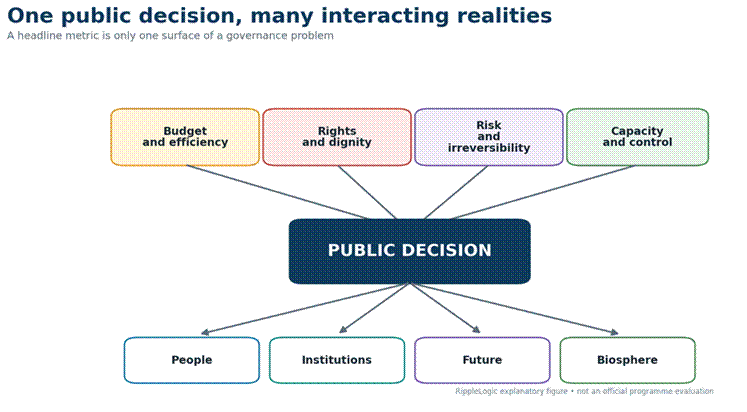
Figure 1. The governance problem: one public decision, many interacting realities
Governance is already mathematical — usually without admitting it
Nearly every consequential government decision contains explicit or implicit quantitative structure, whether or not an equation is printed in the cabinet note. A budget assigns weights. A benefit threshold defines eligibility. A pollution standard sets a boundary between acceptable and unacceptable exposure. A procurement formula converts quality and price into a ranking. A welfare dashboard determines which outcomes become visible. A deadline can discount future harms. A risk matrix assigns probability and severity. Even an apparently qualitative judgment contains an implicit model of evidence, causation, value and authority.
The real question is therefore not whether governance should use mathematics. It already does. The question is whether its mathematics, and the judgments surrounding it, are explicit, complete enough for the decision, contestable by affected people and prevented from overriding constitutional or ethical limits.
Conventional policy evaluation often begins with a target and asks which option maximises it: growth, kilometres constructed, beneficiaries enrolled, average examination scores, cases disposed, taxes collected or cost saved. Such measures can be useful. But once a metric becomes the dominant target, institutions learn to improve the recorded number even when the underlying reality is unchanged or harmed. This is the governance form of Goodhart’s law: pressure on a proxy can separate the proxy from the public purpose it was meant to represent.
| Common decision shortcut | What it reveals | What it may conceal |
| Lowest financial cost | Immediate budget burden | Deferred maintenance, unpaid labour, ecological damage, fragility |
| Highest average benefit | Aggregate improvement | Severe loss imposed on a minority or vulnerable subgroup |
| Fastest completion | Administrative speed | Due process, safety assurance, consultation and future lock-in |
| Maximum coverage | Number reached | Service quality, exclusion errors, accessibility and remedy |
| Highest predicted accuracy | Model performance | Bias, distribution shift, appeal rights and misuse of authority |
| Legal approval obtained | Formal permission | Empirical validity, engineering safety and ethical acceptability |
Mathematics-based governance should make such simplifications harder, not decorate them with more sophisticated formulas. That requires a constitutional architecture around calculation. Some factors can be compared and weighted. Others must function as floors, vetoes or mandatory redesign triggers. Uncertainty must sometimes produce a refusal to choose, rather than a fabricated answer.
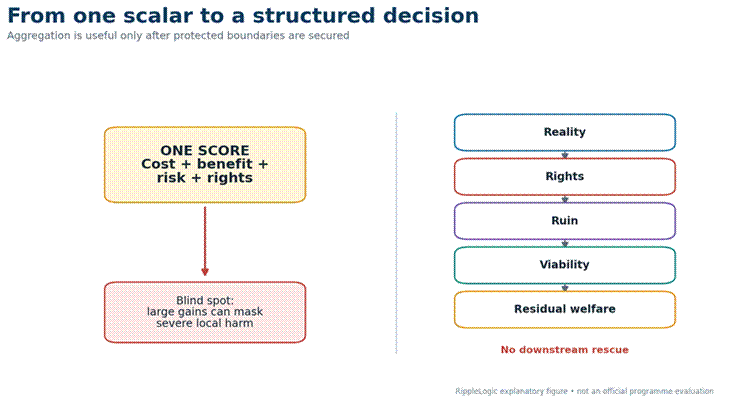
Figure 2. Why a single score is insufficient
The central design rule: qualify before you rank
RippleLogic’s public doorway is expressed as 3R: Reality, Rights, Ripples. Its operating rhythm is a two-phase rule:
- Qualify options through reality, rights, ruin and viability.
- Rank only those options that survive.
The formal cascade is:
RG → RF/NCRC → TRC → CSV → RLS
| Level | Function | Governing question | Consequence of failure |
| RG: Reality Grounding | Claim-authority precondition | Is the claim supported within a declared evidence and validity boundary? | Narrow, investigate, mark exploratory, escalate or refuse the stronger claim |
| RF/NCRC: Rights Floor | Non-compensatory gate | Does the option violate a protected right or minimum condition? | Redesign or reject; welfare gains cannot purchase the violation |
| TRC: Tail-Risk Constraint | Ruin gate | Is catastrophic or irreversible exposure bounded? | Bound, redesign, delay, escalate or refuse |
| CSV: Containment and Structural Viability | Selectability gate | Can the option stand, be governed, monitored, corrected and exited? | Add binding controls, redesign, escalate or refuse |
| RLS: RippleLogic Score | Residual ranking | Which surviving option produces the strongest overall welfare ripple? | Rank only if evidence is sufficiently decisive; otherwise retain non-decision or authority choice |
This order matters. If every option is placed immediately into one weighted score, an option can appear attractive because a large economic benefit compensates numerically for displacement, discrimination, unsafe exposure or an irreversible ecological loss. RippleLogic prohibits that rescue. Rights, ruin and structural viability are decided before residual welfare optimisation.
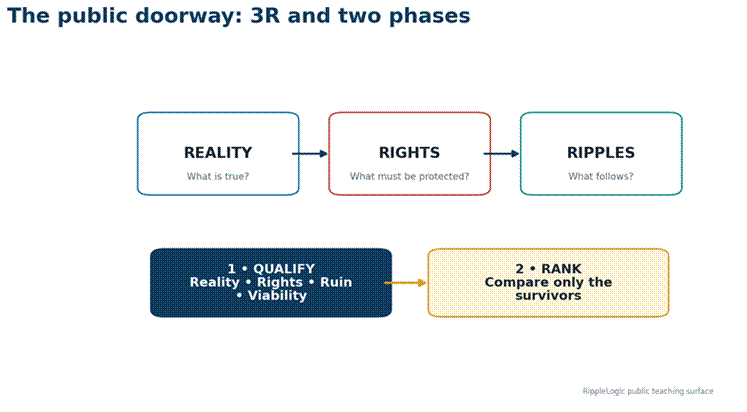
Figure 3. The 3R and two-phase public doorway
In compact notation, let the candidate options be the set O. Reality Grounding determines whether the claims attached to an option are supportable. The rights, tail-risk and viability gates then form the selectable set:
Aₛₑₗ = { a ∈ O : RG_qualified(a) ∧ NCRC(a) ∧ TRC_qualified(a) ∧ CSVₛₜₐₜᵤₛ(a) ∈ {CSV_PASS, CSV_PASS_WITH_CONTROLS, CSV_NOT_MATERIAL} }
RG_qualified is a claim-authority condition, not an ethical verdict. RG_SUPPORTED and RG_NARROWED permit evaluation only within the supported claim boundary. RG_REFUSED excludes the option from the present qualified and selectable set until the evidence is repaired or the claim or action boundary is narrowed. It does not say that the option is intrinsically unethical in every possible reformulation. Rights, ruin and viability then determine ethical and structural admissibility among the reality-qualified options.
Only when A_sel is non-empty does ranking begin. If no option survives, the result is not “choose the least bad score.” The legitimate responses are redesign, evidence gathering, delay, escalation, a tightly governed emergency measure or refusal. If several options survive but their estimates overlap materially, the framework may return REFUSE DETERMINISTIC SELECTION. A lawful authority can still choose, but it must identify its mandate and reasons rather than claim that mathematics dictated the answer.
The cascade is not a one-way conveyor. If the viability layer discovers a catastrophic or irreversible pathway that the tail-risk layer never modelled, the run must reopen tail risk before any ranking occurs. Later stages cannot quietly absorb the work of earlier ones.
Figure 4. The five-level decision cascade, with the reopening rule
This distinction protects democracy. An equation can organise evidence and expose consequences. It cannot create public authority. Elected institutions, courts, regulators, civil servants, local bodies and affected communities retain their lawful roles. RippleLogic supplies a transparent decision record; it does not become a sovereign.
What “mathematics-based” actually means
The phrase can sound more mechanistic than the method should be. Mathematics-based governance does not mean that every human value receives a number or that all disagreements can be solved by optimisation. It means that the structure of the decision is formal enough to inspect and replay.
Six different forms of mathematical discipline are involved:
| Form | Governance use | Necessary limitation |
| Set theory | Defines candidate options, affected groups and selectable survivors | The boundaries of a set remain contestable judgments |
| Logic | Enforces sequences, conditions, vetoes and non-compensation | Valid logic does not make false premises true |
| Measurement | Converts observations into comparable indicators | Measurement error and construct validity must be declared |
| Probability and risk | Represents uncertainty, scenarios and tail exposure | Deep uncertainty cannot be manufactured into precise probability |
| Multi-criteria analysis | Compares plural outcomes after qualification | Weights are governed choices, not discoveries of moral truth |
| Graph and systems analysis | Traces dependencies, spillovers and responsibility | A map is incomplete unless omissions and evidence limits are visible |
This creates a hierarchy of statements. A mathematical statement can be true within formal definitions. An empirical claim requires observation and valid measurement. A causal claim requires evidence that an intervention produces an effect. A legal claim depends on law and jurisdiction. A normative claim depends on an explicit ethical commitment. An authority claim depends on lawful mandate. These categories can support one another, but none automatically substitutes for another.
For example, a model may correctly calculate that a road alignment minimises travel time under its inputs. That establishes a formal result. It does not establish that the input data are accurate, that the road is physically safe, that the acquisition is lawful, that the ecological harm is acceptable, or that the transport minister is obliged to choose it. Mathematics-based governance becomes trustworthy by preserving those boundaries.
It also recognises three legitimate kinds of outcome:
- Determination: one option clearly survives and remains decisively preferable under plausible sensitivity tests.
- Bounded authority choice: several options survive; a lawful decision-maker chooses among them and records reasons not supplied by the score.
- Refusal under underdetermination: evidence is insufficient to support the requested conclusion.
The third outcome is especially important. Contemporary dashboards and predictive systems create pressure to answer every question. But sometimes the most accurate output is: “This cannot presently be determined at the claimed level.” A formal refusal protects government from converting uncertainty into false assurance.
Level 1: reality before narrative
Reality Grounding asks what is actually known, what is inferred, what remains unknown and what action the evidence can legitimately support. A policy claim must be bound to its configuration: the population, place, timeframe, infrastructure, institutional capacity, model version, legal setting and operating conditions in which the evidence applies.
Every material RG record should produce six outputs:
| Required output | Practical meaning for public administration |
| Reality surface | The part of the world and system being modelled |
| Evidence trace | Sources, dates, methods, provenance and quality |
| Material unknowns | Missing or contested facts that could change the decision |
| Transition or action boundary | Precisely what change is being considered |
| Consequence pathways | How direct and indirect effects may propagate |
| Claim boundary | The strongest conclusion the evidence permits |
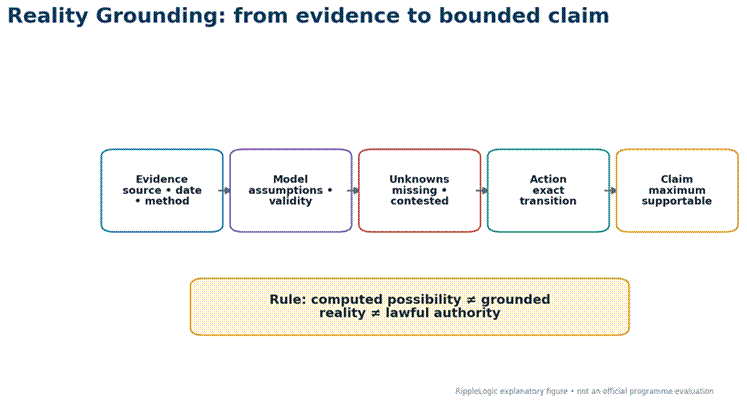
Figure 5. Reality Grounding as a chain of accountable claims
This prevents several common category errors. Legal permission is not scientific proof. A successful pilot is not evidence of national scalability. Model accuracy on historical data is not proof of future reliability. Funds released are not benefits received. A tap connection is not necessarily reliable, safe water. A hospital claim approved by software is not proof that treatment occurred appropriately. A road completed is not proof that its ecological, safety and livelihood consequences were acceptable.
Reality Grounding also requires cross-domain bridges. If an economic study is used to support a legal, ethical or health claim, the evaluator must state the bridge proposition and its evidence. Evidence does not automatically cross disciplinary borders. A formal model may be mathematically correct while its assumptions fail in the field.
Zero is not unknown
One rule inside Reality Grounding deserves particular attention from anyone who has audited a government spreadsheet. Every decision-material field carries a declared evidence status before anything is calculated, and a missing value must never silently become a zero.
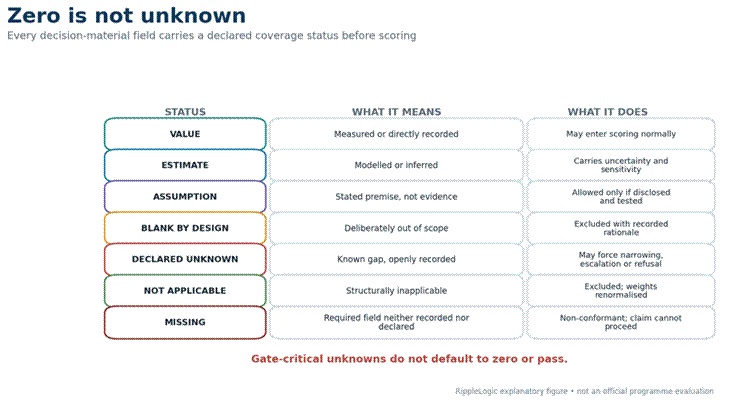
Figure 6. The evidence-status ladder: zero is not unknown
A value that was measured, a value that was modelled, a value that was assumed, a field deliberately left out of scope, a known gap, a structurally inapplicable field and a field that was simply never recorded are seven different things. Treating them as one number is how a governance model manufactures confidence it has not earned. A field that is neither recorded nor declared makes the whole run non-conformant: it cannot carry the claim being made of it. Within a scored welfare cell, zero has a narrower meaning: zero net represented change from the declared baseline at that cell level. It does not prove that every subgroup, pathway, indicator, time window, peak harm or interaction was unchanged, because positive and negative effects can offset inside the represented cell.
A second rule follows from the same logic and is easily the most consequential safeguard in the architecture for Indian appraisal practice. Low confidence in an adverse finding cannot by itself buy a gate pass. If an analyst is uncertain whether a rights floor, a catastrophic pathway or a viability dependency is breached, that uncertainty does not resolve in favour of proceeding. The run must apply a governed conservative bound, collect evidence and re-run, narrow the claim, escalate, or refuse the stronger claim. Ignorance is not a clearance.
The result can be grounded, estimated, assumption-bound, declared unknown, out of scope with rationale, or insufficiently grounded. Uncertainty is not failure. Concealing uncertainty is failure.
Level 2: rights cannot be averaged away
The Rights Floor, formally the Non-Compensatory Rights Constraint, places protected conditions outside ordinary trade-off arithmetic. If an option violates a controlling rights floor, benefits elsewhere do not cancel it.
Suppose Option A produces an illustrative bounded impact of +0.80 for ten million people but imposes an avoidable severe rights loss of −0.70 on ten thousand people, on the framework’s −1 to +1 scale. A simple average may strongly favour A. A rights-constrained system asks a prior question: is that loss legally or ethically compensable at all? If not, Option A must be redesigned or removed before aggregation.
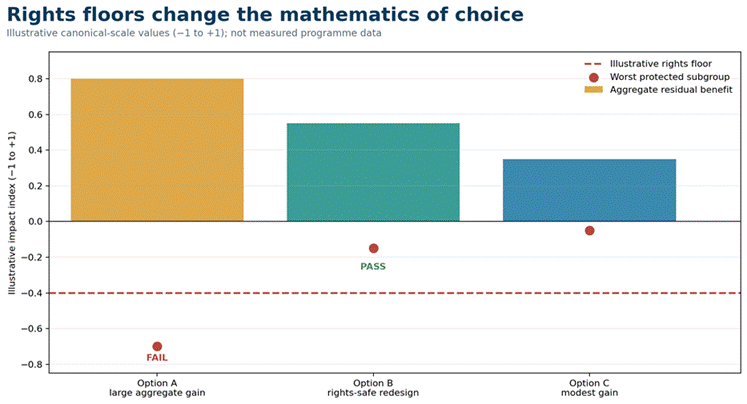
Figure 7. Weighted averaging compared with a rights floor
India’s constitutional order already contains non-compensatory commitments: equality before law, protection of life and personal liberty, safeguards against arbitrary state action, and judicially elaborated principles of dignity, proportionality and due process. RippleLogic does not define Indian law and cannot create a right. Rights floors must be derived through legitimate constitutional, statutory and regulatory authority; the framework’s contribution is to connect those existing legal sources, policy safeguards and declared ethical floors to the exact subgroups and consequence pathways a decision touches.
Rights limitation is not the same as rights compensation. Indian constitutional law can permit a limitation on a right where the responsible authority can establish an adequate legal basis and a structured justification. A MathGov rights record should therefore separate four questions: Is the objective legitimate? Is the measure rationally connected or suitable? Is a materially less rights-infringing alternative available? And, after the first three questions, is the remaining limitation proportionate in the strict sense, with safeguards, challenge and remedy? This is a recorded legal-governance sub-test inside RF/NCRC, not a welfare trade. A limitation that is lawfully justified through the applicable doctrine may proceed; an unjustified breach cannot be purchased by a favourable RLS score. The framework is deliberately stricter than a simple average, but it does not claim that every rights-affecting action is forbidden.
| Rights-floor question | Evidence expected |
| Who is the worst-affected protected subgroup? | Disaggregated data and stakeholder mapping |
| What protected interest is exposed? | Constitutional, statutory, regulatory or declared ethical source |
| What is the severity and duration? | Direct impact and credible pathway analysis |
| Is consent meaningful and revocable? | Process, alternatives, accessibility and power conditions |
| Is a less rights-infringing design feasible? | Substitution and redesign analysis |
| What remedy exists if the decision is wrong? | Appeal, compensation, correction, restoration and responsibility |
The method does not imply that every inconvenience is a rights violation. It demands that the threshold, source and affected group be declared, and that reviewers cannot quietly reduce a protected floor merely to obtain a preferred result. Two attenuation tactics are explicitly closed off: a severe rights impact cannot be discounted because it is short in duration, and it cannot be discounted because the analyst’s confidence in it is low.
Level 3: ordinary gain cannot justify unbounded ruin
Expected-value calculations are weakest where low-probability outcomes are catastrophic, irreversible or poorly modelled. A flood barrier, pathogen laboratory, nuclear system, autonomous weapon, critical digital infrastructure or ecological intervention may have a favourable average projection while retaining an unacceptable tail.
RippleLogic’s Tail-Risk Constraint uses scenario families and Conditional Value at Risk, or CVaR, to examine the probability-weighted loss within the worst declared tail mass. For finite scenario sets, the controlling calculation sorts losses from greatest to least and averages exactly the worst 1 – α probability mass, splitting the boundary scenario when necessary. This is more informative than average loss alone, but it is not always different from the modelled maximum. At high α, if the worst scenario already carries at least the full tail mass, CVaR deliberately equals the worst modelled loss. That conservative effective-maximum result must be disclosed. In every case, CVaR remains bounded by the declared scenario library and does not prove that every catastrophe has been imagined. Scenario discovery, dependency analysis and independent challenge remain essential.
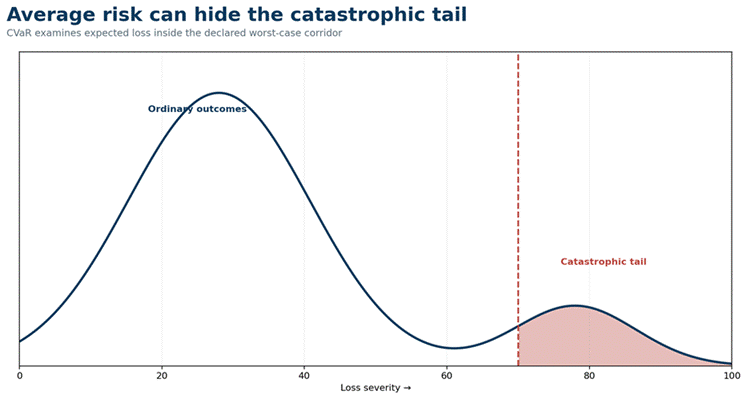
Figure 8. Expected loss and the catastrophic tail
The framework’s reference configuration examines the worst five per cent of the declared loss distribution against a declared corridor threshold. When catastrophe relevance is plausible, the Tier 2 profile requires at least five scenarios across specified catastrophe categories; Tier 3 requires at least twenty. A reference probability floor of 0.02 applies to mandatory scenario categories as an anti-omission discipline, not as an empirically known universal probability. These are governed defaults, not physical constants: a jurisdiction, regulator or programme may set stricter values, and any departure must be declared and justified before outcome-sensitive results are inspected. For public use, the important idea is simple: do not gamble irreversible system loss for routine benefit.
Two distinctions prevent this layer from being quietly evaded. First, an option that passes the tail-risk computation and an option for which a documented assessment found no catastrophe relevance at all are not the same state, and the second must never be reported as though a tail calculation had been run. Second, when no option passes the tail-risk gate, the framework does not simply promote the least-bad one. The default is redesign, delay, escalation, review of taking no action, or refusal. A provisional emergency action is permitted only under necessity evidence, independent challenge of the alternatives, an absolute exposure cap and binding time limits, monitoring, shutoff and return-to-normal criteria. It is recorded as a named emergency state, never as an ordinary pass.
| Tail-risk discipline | Governance purpose |
| Multiple scenario families | Prevent one convenient forecast from defining the future |
| Probability floors for material scenarios | Prevent severe pathways from being assigned negligible probability without warrant |
| Dependence and cascade analysis | Capture failures that become correlated during crises |
| Irreversibility assessment | Distinguish recoverable error from destroyed option-space |
| Sensitivity analysis | Test whether small assumption changes reverse the verdict |
| Emergency corridor | Permit only bounded, necessary, time-limited action with review and exit conditions |
Level 4: can the option actually stand?
Many policies are ethically attractive and numerically promising but institutionally unreal. Containment and Structural Viability tests whether the option has the resources, dependencies, controls, capacities and accountability needed to operate without exporting hidden burdens to larger systems.
This layer evaluates three distinct objects, and passing one does not establish the others: whether today’s configuration is sufficiently known and inside its operating envelope; whether the proposed transition can occur without breaching physical, rights, risk, containment or authority boundaries; and whether the resulting state will remain monitorable, governable and reversible where reversibility is required.
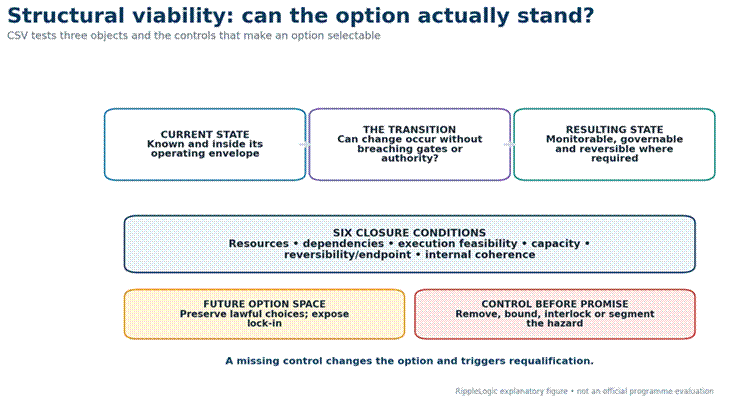
Figure 9. Structural viability: the three objects and six closure conditions
Six conditions must close before an option is selectable: resource closure, dependency closure, execution feasibility, operational capacity, reversibility or a declared endpoint, and internal coherence of the option’s own requirements.
Two further questions belong here and are routinely missed in conventional appraisal. The first is whether the option preserves, narrows or irreversibly collapses the space of future lawful choices, a consideration that matters enormously for land use, water, digital identity infrastructure and long-lived assets. The second is a control hierarchy: wherever a hazard can be removed, permission-bounded, physically interlocked, segmented or made reversible at the level of the system’s configuration, that is preferable to relying on behavioural promises, later detection or downstream compliance. Designing the hazard out beats instructing officials to avoid it.
A school digitisation programme, for example, is not viable merely because devices are procured. It depends on electricity, connectivity, teacher preparation, repair capacity, accessible content, cybersecurity, language support, parent communication and a non-digital fallback. Missing dependencies should not be treated as implementation details after selection. They are part of whether the option is selectable now.
This layer can return pass, pass with controls, redesign required, escalate, fail, not material or emergency provisional. “Pass with controls” means that the controls are part of the option. Removing the monitoring budget or rollback authority changes the option and should trigger requalification. Equally, the layer does not demand zero harm. It demands that harms are visible, routed, bounded, mitigated and monitored, and that they are not structurally degrading or unjustly pushed onto someone else. Bounded residual harms may proceed to ranking; hidden or uncontained ones may not.
CSV may use the Union Containment Index as one structured diagnostic, but no universally cross-domain validated UCI instrument currently exists. Any UCI construction used in a pilot must therefore be labelled provisional, supported by named indicators and independent review, and must not be the sole basis for a high-stakes pass or fail.
Level 5: map the ripples across seven scopes and seven dimensions
After qualification, the RippleLogic Score compares residual welfare effects across a 7 × 7 accountability field. The seven Union Scopes are not claims that society forms perfectly nested boxes. They are stable lenses designed to prevent local benefits and exported harms from disappearing.
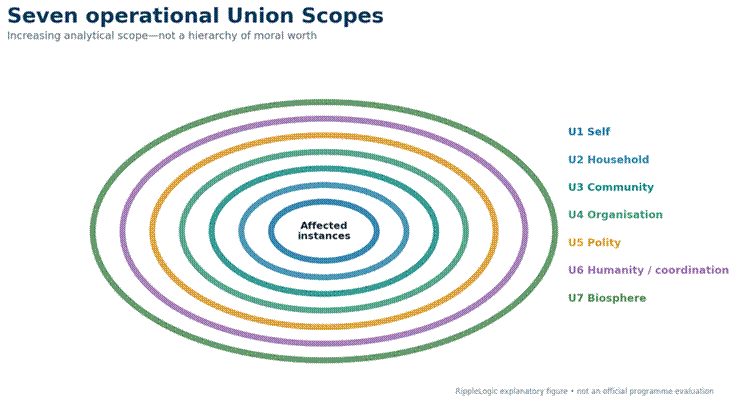
Figure 10. Seven operational Union Scopes
| Union Scope | Governance lens | Illustrative Indian stakeholder instances |
| U1 Self | Individual people or other welfare-bearing loci | Patient, worker, child, farmer, commuter |
| U2 Household | Cohabitation and resource-pooling unit | Rural household, migrant family, caregiving household |
| U3 Community | Local repeated-interaction network | Gram Sabha, ward, neighbourhood, linguistic community |
| U4 Organisation | Formal coordinating institution | School, hospital, firm, department, cooperative |
| U5 Polity | Public authority and jurisdiction | Panchayat, municipality, state, Union government |
| U6 Humanity / global coordination | Present and future human populations; coordination institutions | Future generations, cross-border populations, international systems |
| U7 Biosphere | Integrated ecological life-support systems | River basin, airshed, forest, soil, climate and biodiversity |
The seven welfare dimensions are material conditions, health, social relations, knowledge, agency, meaning and environment. Their intersection creates 49 cells. A programme may improve U5–Material through fiscal efficiency while harming U1–Agency through coercive exclusion, U3–Social through loss of trust and U7–Environment through externalised resource use. The matrix does not resolve those facts by itself; it ensures they are visible.
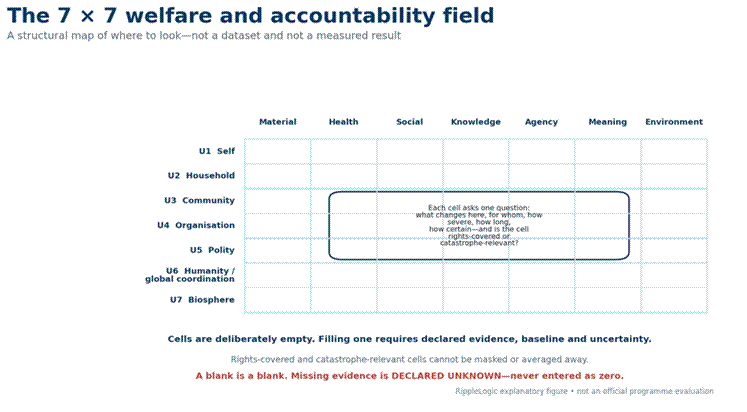
Figure 11. The 7 × 7 welfare and accountability field — a structural map, not a dataset
For a selectable option a, a simplified normalised score is:
RLS(a) = [ Σᵤ Σd q(u,d) · I(u,d,a) ] / [ Σᵤ Σd q(u,d) ]
where I(u,d,a) is the bounded residual welfare estimate for a cell, measured on a scale from −1 to +1 after qualification, and q(u,d) is that cell’s declared effective weight. A material unknown is not entered as zero, and zero denotes only zero net represented change from the declared baseline at the cell level. Dividing by the active weight mass keeps the score on the same scale regardless of how many cells are active; if that mass is zero, ranking is undefined and must be repaired or refused rather than reported.
RLS is a governance-defined index, not a natural unit of moral truth. Every material weight requires an authority source, rationale and sensitivity test. Rights-covered and catastrophe-relevant cells cannot be masked, and where such a cell remains in the welfare calculation it must be measured against the same floor reference used at the gate, so that a favourable baseline choice cannot soften a protected harm.
Rights-constrained ranking also has established antecedents. Sen’s liberal-paradox result exposes the tension between unrestricted Pareto aggregation and even minimal individual rights, while ELECTRE-family outranking methods show how veto or non-compensatory conditions can block an otherwise favourable aggregate comparison. MathGov does not claim to originate those ideas; its distinct proposal is to place a jurisdiction-populated rights floor, separate ruin and viability gates, and action-bound execution continuity before its residual welfare index.
The correct interpretation is therefore not “Option A has 72 units of goodness.” It is: “Under this declared evidence, stakeholder map, baseline, weighting rule and uncertainty treatment, A ranks above the other options that passed every prior gate.”
A compact numerical training example
The following example is deliberately small and illustrative only. It is not an evaluation of any Indian programme. Assume that two district water portfolios have already passed RG, RF/NCRC, TRC and CSV. Portfolio A combines leakage repair, pressure management, targeted renewal and protected minimum household supply. Portfolio B gives greater priority to new capacity. Eight RLS cells are active, each with equal effective weight q = 0.125, so Q = 1. All rights-relevant and catastrophe-relevant effects were assessed upstream and cannot be masked from those gates. Cell impacts are normalised to the canonical -1 to +1 scale.
| Active cell / lens | Portfolio A | Portfolio B | Declared cell σ |
| U1–Health | 0.55 | 0.25 | 0.08 |
| U1–Agency | 0.50 | 0.20 | 0.08 |
| U2–Material | 0.45 | 0.35 | 0.08 |
| U2–Health | 0.35 | 0.45 | 0.08 |
| U3–Social | 0.30 | 0.15 | 0.08 |
| U5–Material | 0.25 | 0.10 | 0.08 |
| U5–Agency | 0.20 | 0.15 | 0.08 |
| U7–Environment | -0.10 | -0.05 | 0.08 |
The cell-level σ = 0.08 values are assumed uniformly for exposition. They are not measured uncertainties. Under the Canon’s independent-cell approximation, RLS(A) = 0.3125, RLS(B) = 0.2000, σ_RLS(A) = σ_RLS(B) = 0.0283, and Gap = 2.81. On that approximation alone, A appears to exceed the reference decisiveness threshold δ = 2.
| Uncertainty-dependence assumption | σ_RLS(A) | σ_RLS(B) | Gap | Required interpretation |
| Independent active cells | 0.0283 | 0.0283 | 2.81 | Apparent decisive lead for A |
| All eight cells as one perfectly correlated dependence cluster | 0.0800 | 0.0800 | 0.994 | Non-decisive; dependence-sensitive and fragile |
The dependence stress is mandatory because the cells share a baseline, evidence base, modelling choices and evaluators. Since the verdict changes, the run must set RLS_DEPENDENCE_SENSITIVE, label the result Fragile, and return REFUSE DETERMINISTIC SELECTION unless a governed tie-break or supportable covariance model resolves the comparison. Shared evidence can also correlate errors between A and B and may reduce uncertainty in their difference, but that benefit cannot be claimed without a declared source, range and sensitivity test. The example therefore demonstrates something more important than a clean winner: RippleLogic catches the fragility of its own calculation. A complete public replay still requires the governing schema, parameter record and validator; because the exact v12.6 release is not yet publicly deposited, this is transparent arithmetic rather than a replay-grade public packet.
Why this architecture fits India’s governance challenge
India’s scale makes narrow optimisation especially dangerous. A policy can be nationally efficient and locally devastating; digitally elegant and inaccessible; legally authorised and practically unenforceable; environmentally beneficial in aggregate and unjust to a specific livelihood community. Federalism adds overlapping responsibilities among Union, state and local institutions. Diversity adds language, disability, caste, gender, geography, income and digital-access differences that disappear in averages.
At the same time, India has substantial foundations for auditable governance: constitutional rights, parliamentary and judicial scrutiny, the Comptroller and Auditor General, the Right to Information framework, social audits, digital public infrastructure, public dashboards, Gram Sabhas, regulatory institutions and a deep engineering and data-science base.
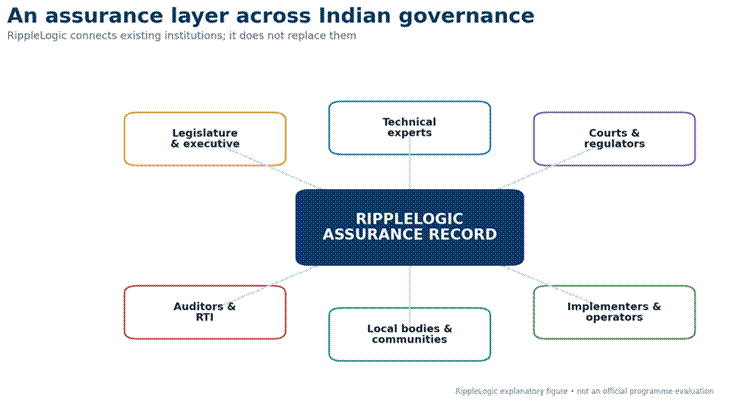
Figure 12. RippleLogic as an assurance layer across Indian institutions
RippleLogic can sit across those institutions as a common assurance grammar. It need not replace cost-benefit analysis, environmental impact assessment, health technology assessment, regulatory impact analysis, departmental appraisal or judicial review. It can connect them by asking whether each has supplied the evidence needed at the correct gate.
The most practical institutional home is not a new parallel ministry. A MathGov Assurance Annex could be attached to the Department of Expenditure’s existing appraisal routes, including EFC, SFC and PIB processes where applicable, and linked to NITI Aayog DMEO’s Output-Outcome Monitoring Framework. India already distinguishes outlays, outputs and outcomes in official appraisal and monitoring. MathGov’s added value would be narrower and testable: make evidence status explicit, keep rights and catastrophic exposure non-compensatory, bind controls and reopening triggers to the decision, and preserve the exact qualification record through execution. Framing the proposal as an upgrade to existing machinery is more realistic than presenting it as a replacement system.
The proposal should also be explicit about its intellectual neighbourhood. Robust Decision Making and dynamic adaptive policy pathways already provide methods for deep uncertainty, signposts and reopening, while safety engineering’s hierarchy of controls gives priority to eliminating or physically controlling hazards before relying on administrative promises. RippleLogic does not claim to originate those disciplines. Its testable contribution is to connect them to a non-compensatory rights floor, a separate catastrophe gate, residual multi-criteria ranking and exact qualification-to-execution continuity in one auditable public record.
| Existing function | RippleLogic contribution |
| Cabinet or departmental note | Explicit options, claim boundary, assumptions and decision state |
| Legal review | Rights-floor source, affected subgroups and non-compensability |
| Scientific or technical review | Evidence provenance, validity domain and causal bridge |
| Finance appraisal | Resource closure, affordability and fiscal ripple analysis |
| Environmental assessment | Biosphere effects, tail scenarios, irreversibility and mitigation |
| CAG or internal audit | Replayable parameter, evidence, responsibility and outcome record |
| Public consultation or Gram Sabha | Stakeholder discovery, challenge records and unresolved objections |
| Executive authority | Separate, named authorisation after framework evaluation |
The following cases illustrate how this could work. They are not official evaluations of the named programmes.
Case study 1: Delhi-NCR air pollution — from episodic reaction to a replayable policy portfolio
The Commission for Air Quality Management uses a Graded Response Action Plan that links Air Quality Index bands to escalating interventions. This already demonstrates mathematics-based governance: thresholds create state transitions. The remaining challenge is portfolio design. Measures affecting construction, transport, schools, industry, agriculture and public health distribute burdens unevenly and operate across different timescales.
A RippleLogic run would compare portfolios rather than one intervention in isolation: emergency restrictions; targeted enforcement; clean public transport; construction-dust control; crop-residue alternatives; distributed work and school protections; and long-term airshed transition.
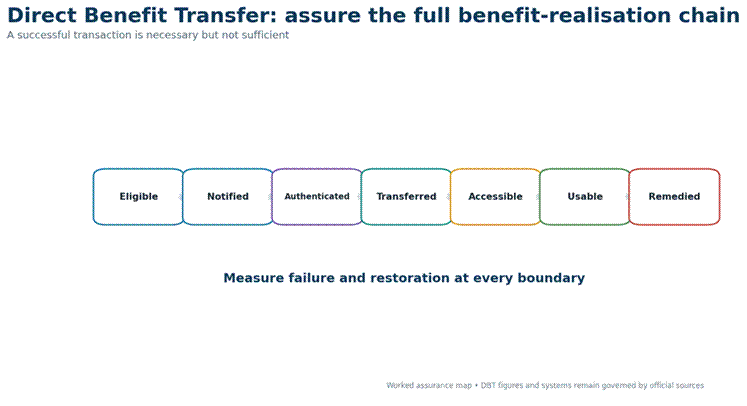
Figure 13. Worked Delhi-NCR air-quality decision pathway (illustrative)
| Gate | Worked finding | Required response |
| RG | Source contribution changes by season and episode; causal shares carry uncertainty | Use scenario ranges, not one permanent attribution |
| RF | Children, outdoor workers, elderly people and low-income households face unequal exposure and unequal ability to avoid it | Treat severe health exposure and accessibility as protected conditions |
| TRC | Persistent severe pollution and emergency spikes create high-consequence health pathways | Test worst episodes and cumulative exposure, not annual average alone |
| CSV | Restrictions can fail without enforcement capacity, mobility substitutes and livelihood support | Package controls with buses, compliance capacity and targeted transition aid |
| RLS | Rank only portfolios that meet health, rights and viability conditions | Prefer robust multi-source portfolios over headline single measures |
The framework would also preserve counterfactuals: What happens if no additional measure is taken? What if a restriction displaces emissions geographically? What if compliance falls after two weeks? What if schools close but children move into equally polluted homes while caregiving burdens fall disproportionately on women? These are ripple pathways, not side notes.
The purpose is not to let a score decide whether Delhi closes schools. It is to make the factual basis, protected groups, thresholds, controls, exceptions, review date and authority legible before and after the decision.
Case study 2: Direct Benefit Transfer — efficiency with an explicit exclusion boundary
India’s Direct Benefit Transfer portal displayed cumulative transfers of ₹52,94,012 crore across 320 central schemes and 56 ministries when accessed on 12 August 2026. The same portal records estimated savings and benefits of ₹5,14,201.92 crore up to March 2025. This is governance at immense computational scale, and digital transfers can genuinely reduce intermediary leakage, accelerate payment and create traceability.
But those two figures are not the same kind of fact, and the difference is instructive. The transfer counter updates continuously. The savings figure is fixed at March 2025 and is attributed by the portal itself to “DBT and other governance reforms”, not to DBT alone. A mechanical division gives roughly 9.7 per cent, but that quotient is not a valid savings rate: the numerator and denominator have different dates, scopes and causal meanings, and the estimated-gains claim requires an explicit counterfactual leakage model. Quoting the figures together as one live statement about one programme is precisely the category error that Reality Grounding exists to catch. A claim must carry its date, attribution boundary, counterfactual and method with it.
Figure 14. Direct Benefit Transfer: the complete assurance chain
A RippleLogic evaluation would separate at least four metrics:
| Metric | Question it answers | Question it does not answer |
| Funds initiated | Did government issue the transfer? | Did the intended person receive usable value? |
| Transaction success | Did the payment rail process the instruction? | Was identity or account mapping correct? |
| Beneficiary coverage | How many records were included? | Which eligible people were excluded or duplicated? |
| Estimated fiscal gains | What expenditure or leakage may have been avoided? | Were errors, remedy costs and access burdens fully counted? |
The rights floor would focus on eligible people facing authentication failure, dormant or inaccessible accounts, incorrect seeding, disability barriers, remote geography or documentation problems. CSV would test bank access, connectivity, grievance staff, correction time, multilingual communication and a reliable fallback. RLS could then compare alternative delivery designs, but only after minimum access and remedy conditions are met.
This leads to a practical dashboard improvement: report not merely successful transactions, but the full benefit-realisation chain: eligibility, notification, authentication, transfer, access, use, grievance, correction and restoration. A high system success rate should never make a small but severely harmed subgroup invisible.
Case study 3: Ayushman Bharat-PMJAY — turning audit findings into requalification triggers
The CAG’s 2023 performance audit of Ayushman Bharat-PMJAY covered beneficiary identification, hospital empanelment, claims management, financial management, monitoring and grievance redressal. The audit recorded that, as of November 2022, 7.87 crore beneficiary households had been registered, constituting 73 per cent of the then targeted 10.74 crore households. The central governance lesson is not that digital health assurance failed. It is that a programme’s decision model must be continuously requalified against operational evidence.
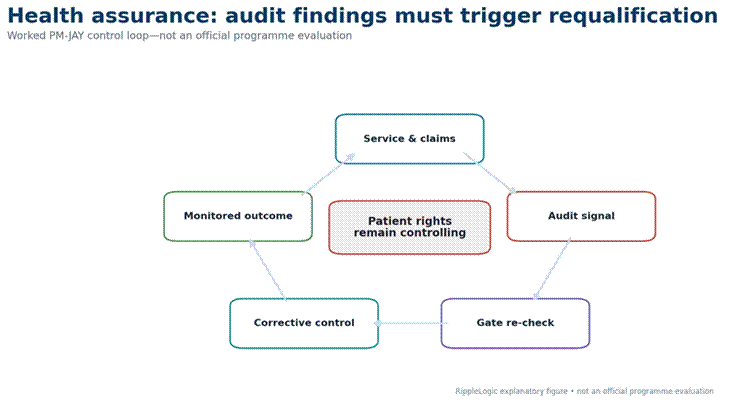
Figure 15. From audit finding to corrected health-system decision
Under RippleLogic, every material audit finding would be routed rather than merely listed:
| Audit signal | Route | Example action |
| Beneficiary-data anomaly | RG and RF | Revalidate identity logic; protect continuity of treatment during correction |
| Hospital empanelment weakness | RG and CSV | Reassess qualification evidence and inspection capacity |
| Suspicious claim pattern | RG, CSV and monitoring | Trigger anomaly review without treating an algorithmic flag as guilt |
| Delayed or rejected remedy | RF and responsibility continuity | Identify accountable office, deadline, appeal and restoration |
| Material system or policy change | Requalification | Re-run affected evidence, gate and control checks |
The authority boundary is crucial. An anomaly-detection model may generate a case for review. It should not, by itself, terminate a patient’s protection, declare fraud or replace due process. Capability to identify patterns is not authority to impose consequences.
Case study 4: rural employment guarantee — a live requalification test
On 1 July 2026 the Viksit Bharat – Guarantee for Rozgar and Ajeevika Mission (Gramin): VB–G RAM G Act, 2025 came into force across rural India. From the same date, section 37 repealed the Mahatma Gandhi National Rural Employment Guarantee Act, 2005, subject to savings and transitional provisions. The successor Act raises the statutory guarantee from 100 to 125 days, establishes a new funding structure and introduces state-wise normative allocations alongside extensive digital monitoring provisions.
For RippleLogic, this is a direct test of requalification. A material change in governing law does not invalidate historical evidence or automatically erase every earlier finding. It does expire any assurance whose warrant depended on a changed entitlement, authority, funding arrangement, data definition, operating rule or control. The affected claims and gates must be re-derived before old dashboards or appraisals are treated as current.
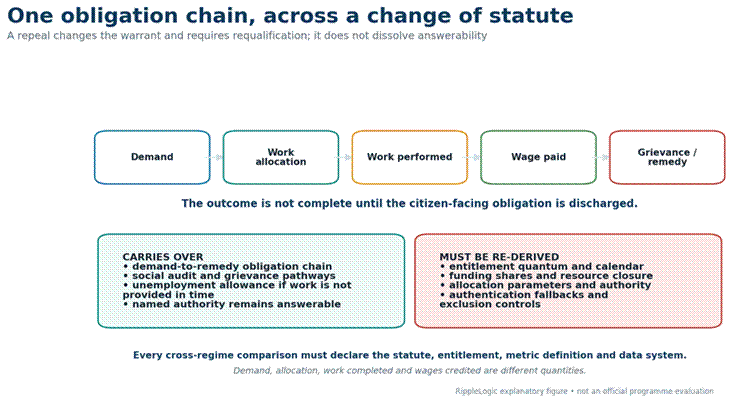
Figure 16. One obligation chain across a change of statute
What carries over, and what must be re-derived
The successor framework retains a demand-for-work pathway, a duty to provide work within fifteen days or pay an applicable unemployment allowance, wage-payment obligations, grievance routes and social audit at least once every six months. Section 37 also transfers assets, liabilities, records, funds and obligations arising under the repealed Act to the authorities constituted under the new Act. Official transition materials state that existing e-KYC-verified MGNREGA job cards remain valid until new Gramin Rozgar Guarantee Cards are issued and that ongoing works may continue subject to the successor framework.
A RippleLogic Material Obligation Record would identify:
| Obligation field | Current rural-employment illustration |
| Trigger | Registered demand for work under the current Act and scheme |
| Accountable authority | The Panchayat, Programme Officer or other authority assigned the duty |
| Operational carrier | Registration, allocation, worksite, measurement, payment and remedy chain |
| Required action and deadline | Provide work within the statutory period; otherwise apply the unemployment-allowance rule; after work, complete wage and compensation duties |
| Evidence of discharge | Dated demand receipt, allocation, muster, measurement, actual account credit and remedy record |
| Challenge route | Grievance mechanism, social audit, Ombudsperson and lawful appeal |
| Non-performance trigger | Missed work, payment, compensation, grievance or restoration condition |
| Residual responsibility | A named authority remains responsible until the citizen-facing obligation is discharged or lawfully resolved |
The legal transition reopens several parts of the assurance record:
| Material change | Gate or record reopened | What must be established |
| Guarantee rises from 100 to 125 days, while every State Government must notify in advance a period aggregating to 60 days in each financial year during which works are not undertaken | RG, RF/NCRC and CSV | The operative entitlement and calendar, the geographic scope of each notification, foreseeable access effects and the capacity to meet demand outside the pause |
| Funding becomes 90:10 for the jurisdictions specified in section 22(2), 60:40 for other States and Union territories with legislatures, and wholly central for Union territories without a legislature. Sections 4(6) and 22(5) assign State expenditure above the normative allocation to the State Government | RG and CSV | State-specific resource closure, budget authority, fiscal sensitivity and the consequences of demand exceeding the allocation |
| The Central Government determines state-wise normative allocation using objective parameters to be prescribed | RG, CSV and parameter governance | The parameter authority, evidence base, version, sensitivity and separation of actual work demand from budget allocation |
| Biometric authentication, geospatial systems and real-time dashboards become statutory implementation mechanisms | RF/NCRC and CSV | Exclusion pathways, exception handling, accessible fallback, correction time, monitoring and accountable human authority |
| Every State Government must notify its own Scheme within six months of commencement, and a substantial body of central rules remains to be prescribed | RG, CSV and authority record | Which provisions are presently operative, which inherited rules continue to apply, and which office can lawfully act today |
The 125-day annual guarantee and the required aggregate 60-day no-work notification are not a formal arithmetic contradiction: an annual entitlement can coexist with a pre-notified seasonal pause. But the interaction compresses the delivery calendar and transfers capacity risk to the remaining days. A conforming record should therefore publish the dates and geography of each notification, forecast demand and work-pipeline capacity outside the pause, track actual days provided, unemployment allowance and wage credit by subgroup, and reopen the design if the pause produces foreseeable denial, bunching or geographic inequality of access.
The framework does not decide whether the new allocation model is preferable. It requires the choice to become visible and testable. Demand, normative allocation, work offered, work completed and wages actually credited are different quantities. None should be relabelled as another, and a time series that crosses the statutory transition must identify the governing regime and any changed metric definition.
Why the earlier audit evidence still matters
The Comptroller and Auditor General’s Kerala performance audit for the period ended March 2024, Report No. 9 of 2025, laid before the Kerala Legislative Assembly on 24 February 2026, remains valid evidence about the period it audited. Its findings also identify failure modes that the successor system must actively prevent.
The audit found that the prescribed baseline demand surveys had not been conducted, so expected demand and its timing could not be established reliably. It found that a public MIS report tracked delayed payment only to the second signature on the Fund Transfer Order rather than to actual credit in the worker’s account: against MIS-calculated delays of nil to 34 days, actual delays in the examined cases ranged from eight to 180 days. It also recorded weaknesses in monitoring and grievance redressal, including the absence of effective complaint tracking.
Through the cascade, the missing demand baseline is a Reality Grounding failure. The payment cut-off is a Rights Floor problem hidden inside a technical definition: where the clock stops determines whether compensation reflects the worker’s actual experience. A grievance route that cannot reliably track a complaint is a CSV failure because the remedy exists nominally without adequate operational closure.
Checked against the enacted texts rather than press material, the successor Act carries forward, rather than newly creates, the core wage-delay safeguards. Schedule II of MGNREGA required compensation at 0.05 per cent of unpaid wages for each day beyond the sixteenth day, stage-wise time limits and responsible functionaries, and automatic calculation from muster-roll closure to actual deposit in the worker’s account. Schedule II of the successor Act substantially reproduces that architecture. The Kerala audit therefore exposes implementation failure under an already-correct legal measurement rule, not a defect that repeal by itself repaired. Formal legal interpretation should still be confirmed by qualified Indian public-law review.
From a RippleLogic perspective, this is the sharper requalification lesson. Preserving a rule in new legislation does not establish that the management information system implements it or that compensation is actually paid. Requalification must test the software calculation boundary, State-defined stage limits, named ownership, compensation paid rather than merely computed, exception handling and audit evidence.
The missing demand baseline and weak complaint tracking also remain adverse scenarios. The successor Act provides timed grievance disposal, automatic escalation and a district Ombudsperson, but the operational effectiveness of those controls remains an empirical question. A new statute changes the warrant for current administration. It does not, by itself, cure implementation failures that persisted under similar legal text.
The general rule
Complexity may distribute work, but it must not dissolve answerability. A public system cannot claim success merely because each organisation completed its internal step while the worker remained unpaid. The relevant outcome is the completed citizen-facing obligation under the law then in force.
Social audit provides another essential safeguard. Administrative data and citizen testimony are different evidence streams. Neither should automatically erase the other. A discrepancy becomes a challenge record requiring investigation, resolution and a preserved rationale.
Case study 5: heat action — governance at the speed of consequence
Heat emergencies expose a neglected variable: the time between a warning, a public decision and irreversible harm. India’s disaster-alert infrastructure, including the National Disaster Management Authority’s SACHET platform, demonstrates the capacity for authoritative geo-targeted alerts. But an alert becomes protection only when institutions and people can act on it.
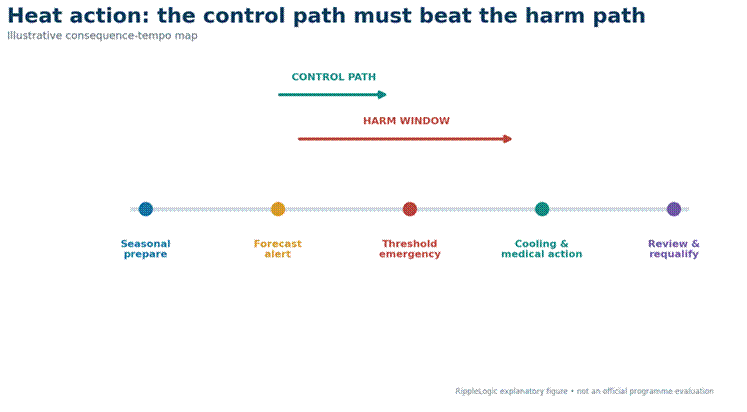
Figure 17. Heat-action consequence tempo
A city heat plan could be represented as a state machine:
| State | Evidence trigger | Binding action package |
| Preparedness | Seasonal forecast and vulnerability map | Cool-roof work, water points, hospital readiness, worker protocols |
| Alert | Forecast threshold approached | Multilingual warnings, school and work guidance, outreach to high-risk groups |
| Emergency | Observed or forecast extreme conditions | Enforceable work-rest rules, cooling access, medical surge and welfare checks |
| Recovery | Temperatures decline | Continue health surveillance, review deaths and failures, restore deferred services |
| Requalification | New evidence or infrastructure change | Revise thresholds, maps, responsibilities and resource assumptions |
The rights question is whether outdoor workers can actually comply without losing essential income. The CSV question is whether water, electricity, transport, hospitals and local staff can carry the plan. The tempo question is whether the intervention pathway is faster than the harm pathway. If a six-hour approval chain governs a two-hour emergency, the system is mathematically misaligned even if every official procedure is followed.
This is also where the emergency corridor earns its constraints. A heat emergency may justify provisional action before full evidence is assembled, but only with named authority, demonstrated necessity, the least rights-infringing available design, a bounded duration, a harm cap, monitoring and mandatory retrospective review. An emergency measure that quietly becomes permanent has escaped the framework, not satisfied it.
Case study 6: highways and major infrastructure — test the transition, not only the endpoint
Infrastructure appraisal often compares endpoints: present conditions versus the completed road, dam, port or industrial corridor. The transition itself can create displacement, livelihood interruption, habitat fragmentation, safety hazards, debt exposure and irreversible land-use change. Mathematics-based governance therefore evaluates the path as well as the destination.
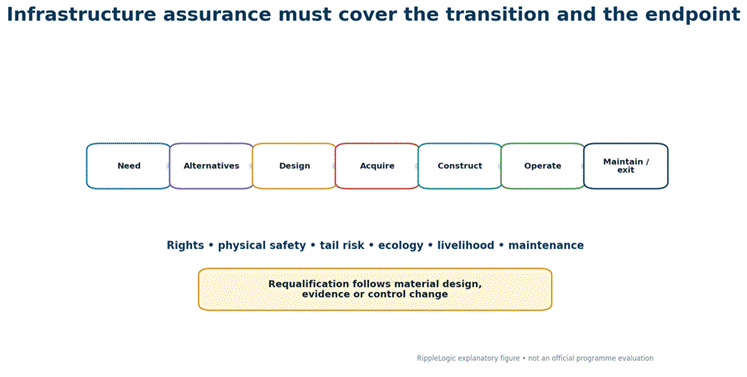
Figure 18. Infrastructure assurance across the project lifecycle
For a proposed highway corridor, the option set should include more than “build” and “do not build.” It may include upgrading existing alignment, alternative routes, public-transport investment, phased construction, demand management and redesigned junctions. Each option requires:
- a physical and causal evidence profile;
- affected-household and ecosystem mapping;
- rights and lawful-acquisition review;
- tail scenarios for flooding, slope, traffic and financial failure;
- construction-stage containment;
- maintenance and enforcement capacity;
- a no-action baseline and less harmful substitutes.
| Common appraisal omission | RippleLogic correction |
| Benefits counted nationally, losses treated locally | Map both across the same Union Scope field |
| Compensation treated as equivalent to consent or restoration | Keep rights, agency, livelihood and meaning distinct |
| Construction impacts treated as temporary | Test duration, irreversibility and cumulative effects |
| Approved design treated as physically safe | Require domain-specific engineering and environmental evidence |
| Maintenance assumed after commissioning | Require resource and responsibility closure before selection |
| Future flexibility assumed to persist | Ask what lawful choices this alignment permanently forecloses |
A favourable RLS cannot authorise an unsafe bridge. Engineering standards, geotechnical evidence and competent authority remain indispensable. RippleLogic asks whether those warrants exist and remain valid for the actual configuration, and it treats a computed, simulated or approved design as a candidate, never as a verified transition.
Case study 7: AI-assisted public services — separate capability from authority
Governments are increasingly considering AI for grievance triage, fraud detection, translation, document processing, health prioritisation, policing support and benefit administration. NITI Aayog’s Responsible AI work emphasises safety, equality, inclusion, privacy, transparency and accountability. RippleLogic adds an operational separation that is often missing: what a system can generate is different from what it is authorised to decide or execute.
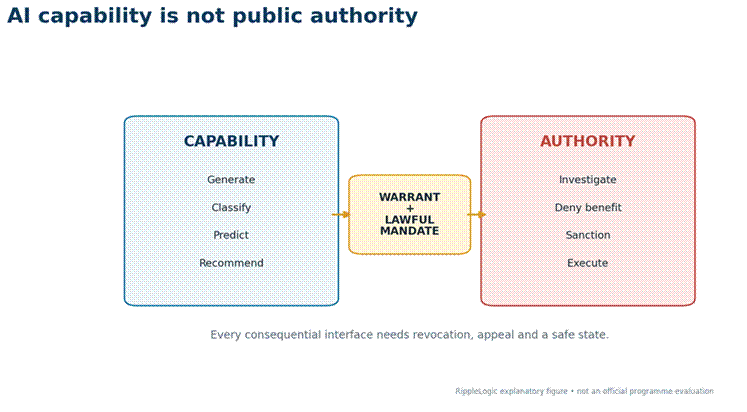
Figure 19. AI capability and public authority must remain separate
| Layer | Required question |
| Candidate generation | How does the system produce classifications, recommendations or actions? |
| Reference and constraints | Which law, policy, data and operating rules constrain it? |
| Objective source | Who defined the target and who may change it? |
| Admissibility warrant | What evidence supports use in this population and context? |
| Execution interface | What downstream action can the output initiate? |
| Execution authority | Which lawful human or institution authorises consequences? |
| Revocation and safe state | Who can stop it, and what happens when it fails? |
| Requalification | Which model, data, legal or operational changes expire prior approval? |
Underneath that layering is a principle that can be stated without forcing a general reader to hold the full SGP vocabulary: capability is not authority, protection is not permission to govern, and participation is not consequential power. SGP v8.5 keeps those surfaces independently evidenced. A digital tool may be highly capable while having no independent power to decide a person’s entitlement, liberty or remedy. Any welfare safeguard, input channel or consequential role requires its own evidence, lawful basis, accountability and revocability; none follows automatically from fluency, prediction quality or task performance.
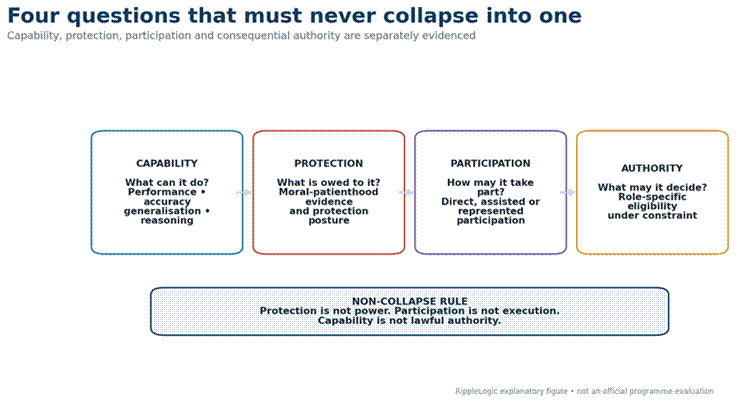
Figure 20. Four questions that must never collapse into one
Consider AI-assisted grievance triage. The Department of Administrative Reforms and Public Grievances describes systems that identify grievance themes, clusters and possible root causes. Used well, this can help administrators see systemic patterns. But a model should not silently downgrade an unusual complaint because it resembles spam, nor close a case merely because a semantic classifier assigns low priority.
A rights-preserving configuration would allow the model to route and summarise while preserving the original submission, logging the model version and confidence, enabling human correction, protecting sensitive data and maintaining an accessible appeal. High-consequence actions would require human authorisation. Sampling should deliberately examine low-confidence, minority-language and atypical cases, because these are the areas where average accuracy can conceal severe exclusion.
Placing a human somewhere in the workflow is not, by itself, oversight. Meaningful oversight requires that the reviewer can see the original submission, the model version and its confidence; that the reviewer has a real and exercised ability to overturn the output; and that the affected person has a route they can actually use. MHIOS v0.7 can provide a candidate interface for this provenance, review and challenge workflow, but it remains subordinate to the Core: an AI assistant may summarise, extract or suggest, while a human or legally recognised authority must own every material interpretive judgment and consequential authorisation.
The rural-employment transition above makes the issue concrete. Biometric authentication, geospatial monitoring and real-time dashboards can strengthen traceability, but they can also create an exclusion pathway for a person who cannot authenticate or correct a record. The result depends on exception handling, usable fallback, accountable authority and whether the system measures those it fails, not on the technology label.
Data protection is now a statutory rather than discretionary consideration. India’s Digital Personal Data Protection Act, 2023 was enacted in August 2023, and the Digital Personal Data Protection Rules, 2025 and phased commencement materials were notified in November 2025. As the relevant provisions commence, AI-assisted public services handling personal data will carry corresponding statutory duties, complaint and adjudication pathways, and rights for data principals. The provisions in force and the obligations applicable to a particular deployment should be confirmed from the current notifications and competent legal advice rather than inferred from a framework diagram.
Case study 8: district water allocation — optimisation under plural scarcity
Water decisions combine hydrology, household need, agriculture, industry, ecology, infrastructure and intergovernmental authority. A single rupee-per-litre or output-per-cubic-metre metric cannot represent the whole problem.
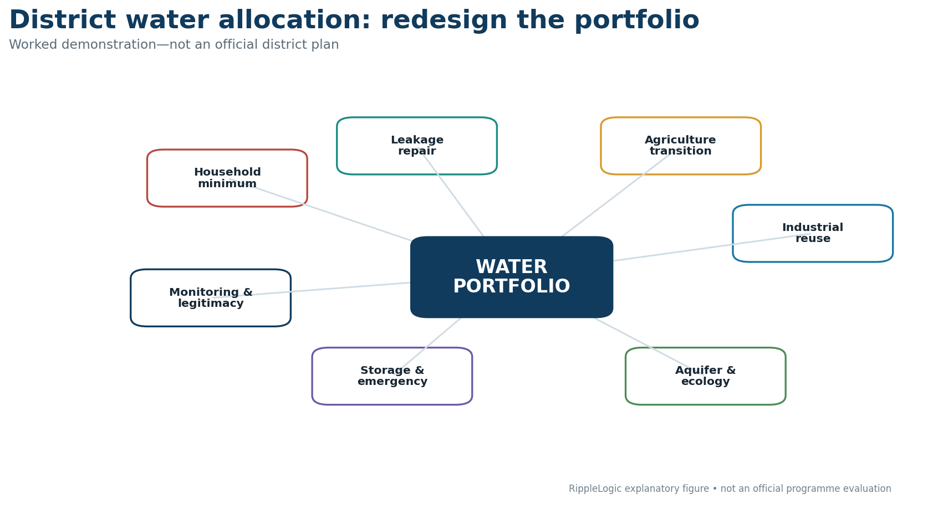
Figure 21. Worked district water-allocation map (illustrative)
A district pilot might compare leakage repair, rotational supply, crop-transition support, industrial recycling, groundwater restrictions, new storage and emergency tanker provision. Rights floors protect minimum safe household access. TRC tests aquifer collapse, contamination and drought sequences. CSV tests power supply, maintenance, enforcement and local legitimacy, and it asks whether an allocation regime narrows the options available to the next decade. RLS then compares the remaining portfolios across material welfare, health, agency, livelihoods, institutional trust and ecosystems.
The framework can also reveal false conflicts. A policy framed as “farmer versus city” may become a portfolio involving leakage reduction, differentiated crop support, treated-water reuse and groundwater monitoring. Unioning means redesigning the option until more interests can be protected together, rather than pretending that every conflict disappears.
Implementation: begin in shadow mode, not with algorithmic authority
The safest route is a staged pilot alongside existing decision procedures. RippleLogic should first observe and structure decisions, not control them.
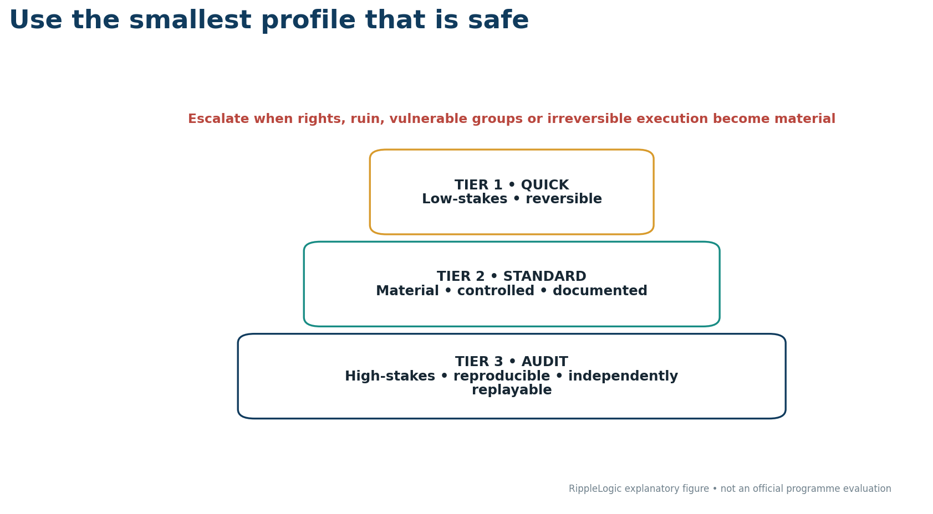
Figure 22. Three implementation tiers
| Tier | Suitable decisions | Minimum record |
| Tier 1: Quick | Low-stakes, reversible, local choices | Short reality, rights, risk, viability and ripple check |
| Tier 2: Standard | Material departmental, organisational or community choices | Evidence register, stakeholder map, gate records, controls, uncertainty and sign-off |
| Tier 3: Audit | High-stakes public, physical, rights-sensitive or system-level choices | Reproducible run inside the available artifact boundary, pre-registered parameters, exact action/configuration/qualification-snapshot binding, hashes, independent challenge and separate authority record; public replay remains provisional until the exact release package is publicly deposited |
A credible Indian pilot could select 20–40 completed and live decisions in one domain, such as urban mobility, public health procurement or district water management. Teams would reconstruct the original decision record, run RippleLogic independently and compare what becomes newly visible.
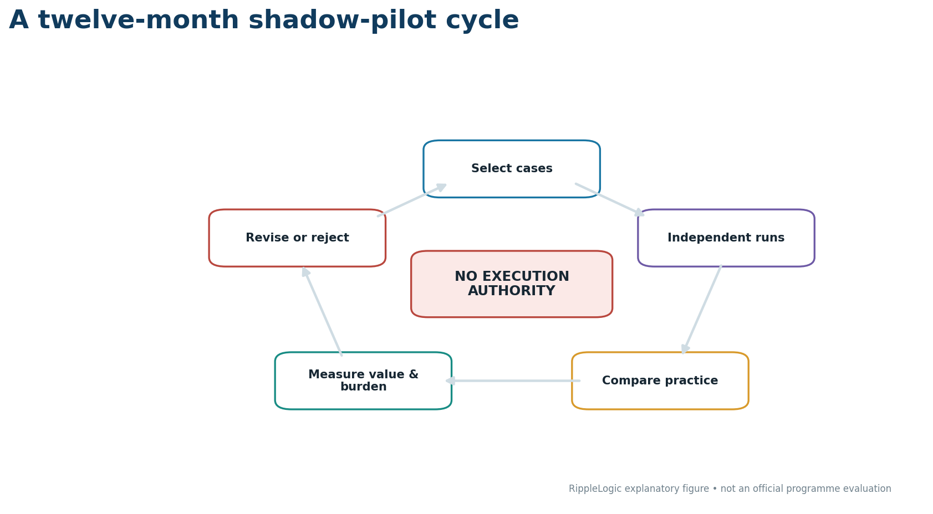
Figure 23. A twelve-month shadow-pilot cycle
The pilot should test questions that can falsify usefulness:
- Do independent reviewers identify the same applicable gates and affected groups?
- Does the method reveal material evidence gaps earlier?
- Does it reduce silent exclusion of vulnerable subgroups?
- Do decision-makers understand the outputs?
- Does documentation time remain proportionate to stakes?
- Are recommendations more robust under sensitivity analysis?
- Does the framework outperform a simpler checklist?
- Does it create new gaming, bureaucracy or false confidence?
The comparison against a simpler checklist is essential. The ten-question Assurance Annex later in this article should serve as the named control condition, alongside the incumbent departmental appraisal process. For pilot budgeting only, the following envelopes are ASSUMED, NOT MEASURED and non-canonical: Tier 1, 0.5–2 person-hours; Tier 2, 8–24; Tier 3, 60–200 plus independent challenge. They are planning scenarios to be replaced by observed distributions.
Before results are visible, the pilot should also pre-register when the simpler process wins. An initial design rule is: default down or withdraw the higher tier for that decision class when the simpler process (1) detects planted consequential traps at a rate no more than five percentage points below the higher tier, (2) misses no additional rights-floor or catastrophic-path trap caught by the higher tier, and (3) uses no more than half the median person-hours, in two independent test rounds. Report sensitivity at detection margins of 0/5/10 percentage points and burden ratios of 0.33/0.50/0.67. These are falsifiable pilot defaults, not validated constants.
The public decision record
Every significant run should produce a compact public-facing record and a protected audit annex. Transparency does not require publishing personal data, security-sensitive details or every internal deliberation. It requires publishing enough to understand the decision’s logic and challenge its boundaries.
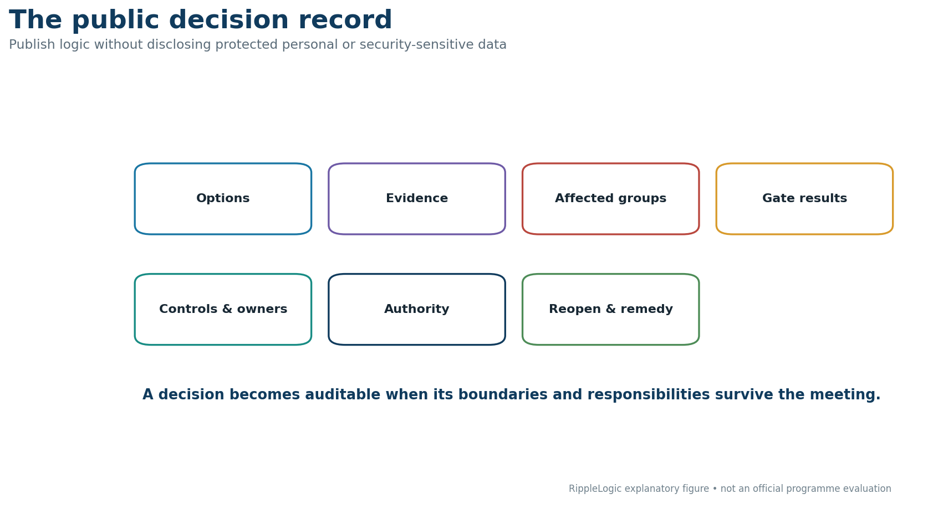
Figure 24. The public decision record
| Public field | Question answered |
| Decision and options | What was actually considered? |
| Evidence cutoff and sources | What information governed the decision? |
| Affected groups | Who and what entered the analysis? |
| Material unknowns | What could not be established? |
| Rights and risk results | Which floors and tail scenarios were tested? |
| Controls and owners | What makes implementation conditionally viable? |
| Framework result | Which options survived and how were they ranked? |
| Authority result | Who legally decided, and did that differ from the framework ranking? |
| Qualification continuity | Does the exact action, configuration, evidence, control set, obligation set and authority basis still match the qualified snapshot at execution time? |
| Monitoring and reopen triggers | What future evidence or observed outcome can change the decision? |
| Challenge and remedy | How can affected people contest error or harm? |
This record strengthens the logic of the Right to Information Act, whose purpose includes transparency and accountability in public authorities. Instead of disclosing only documents, government can disclose the architecture of the decision: the claims, evidence, gates, responsibilities and revision conditions. Transparency of this kind must still coexist with privacy, commercial confidentiality and legitimate security restrictions, which is why the public record and the protected annex are separate artefacts rather than one document with redactions.
Who governs the mathematics?
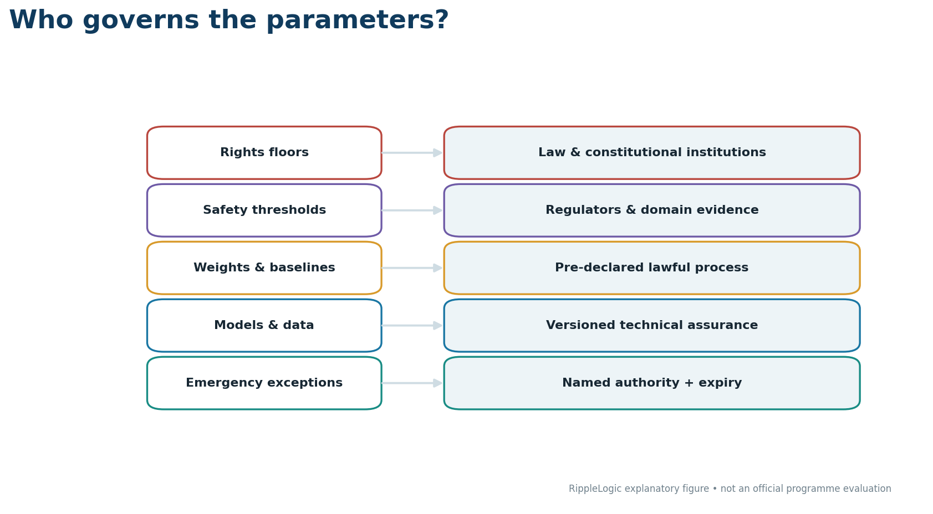
Formalisation does not eliminate politics. It relocates political choice into visible parameters: rights thresholds, scenario libraries, model boundaries, weights, baselines and standards of evidence. Those choices must therefore be governed.
Figure 25. Governance of parameters and evidence
| Decision element | Appropriate authority and safeguard |
| Constitutional or statutory right | Law, courts and competent constitutional institutions; never changed by an analyst’s weight |
| Technical safety threshold | Competent regulator or domain standard with evidence and review |
| Scenario probability | Qualified analysis, provenance, challenge and sensitivity testing |
| Uncertainty dependence | Declare shared data, models, baselines and evaluators; stress dependence clusters and justify any covariance model |
| Welfare weights | Pre-declared lawful process with stakeholder participation and floors |
| Baseline selection | Declared in advance; gate cells measured against the floor reference, not a convenient status quo |
| Stakeholder inclusion | Discovery protocol, affected-party challenge and omission disclosure |
| Model or dataset | Version control, validity limits, bias analysis and change trigger |
| Emergency exception | Named authority, necessity, proportionality, time limit, harm cap and retrospective review |
The most dangerous system is not one with declared values. It is one whose values are buried inside defaults and presented as neutral. Mathematical governance becomes democratic only when parameters are inspectable, contestable and versioned.
Safeguards against technocracy and metric gaming
RippleLogic must itself be governed against misuse. A sophisticated framework can become an instrument of theatre if institutions merely complete fields after the decision has already been made.
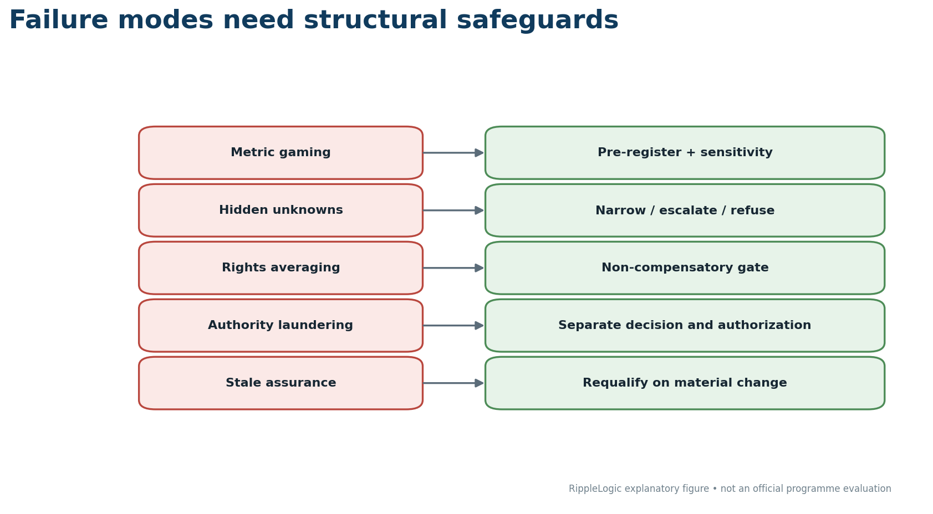
Figure 26. Failure modes and corresponding safeguards
Nine safeguards are especially important:
- Pass-equivalent-state challenge: every TRC_NOT_TRIGGERED and CSV_NOT_MATERIAL declaration receives independent challenger review, a stated evidence boundary and reopening trigger, and periodic sample audit. Neither label means that catastrophe or structural dependence is impossible; each means only that the relevant trigger was not established within the declared boundary.
- Pre-registration: decision-material thresholds, weights, scenario structures and evaluation rules are frozen, versioned and reviewable before outcome-sensitive results are inspected; public disclosure follows the applicable transparency, privacy and security rules.
- Independent challenge: a reviewer searches for omitted groups, scenarios, dependencies and adverse evidence.
- No silent unknowns: material uncertainty produces narrowing, escalation or refusal, never a zero.
- No rights rescue: downstream scores cannot compensate for a failed rights floor.
- No authority laundering: a framework result is not an execution licence.
- Qualification continuity: before consequence-bearing action, the exact selected option, action instance, action specification, configuration, qualification snapshot, current evidence, active controls, obligations and separate authority basis must still match. A material mismatch blocks ordinary execution and requires repair, narrowing, escalation or requalification; this is an execution-bound conformance check, not a sixth gate.
- Requalification: material changes to models, evidence, law, institutional responsibility, funding formula, configuration or controls expire affected assurance and reopen the relevant claims and gates.
- Adverse-result publication: pilots report when the framework is burdensome, inconsistent or unhelpful.
These safeguards recognise a deeper truth: Goodhart pressure is not eliminated. It moves. When final scores are constrained, gaming shifts upstream into stakeholder boundaries, scenario probabilities, evidence sufficiency and the definition of “not material.”
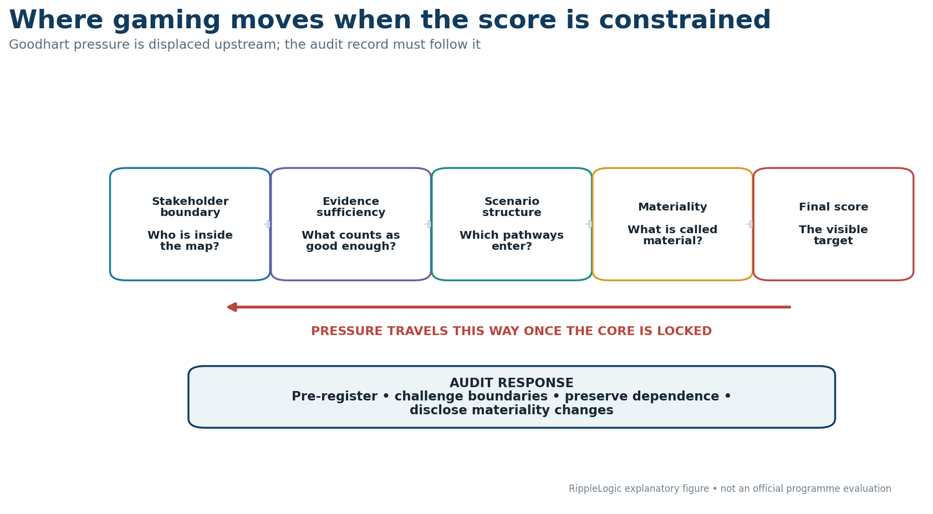
Figure 27. Where gaming goes when you constrain the score
The framework closes some of these routes mechanically rather than by exhortation. Activating an additional catastrophe profile must not dilute the measured loss of an unchanged base profile: each active profile is evaluated separately, and a combined summary cannot rescue a failed one. Overlapping scenario categories may not be summed as though independent, and correlated pathways must be tagged so probability mass is not double-counted. Where one underlying effect appears in more than one Union Scope, the run must declare whether it represents a genuinely different scale-level effect, is deduplicated at a primary scope, or is allocated across scopes rather than quietly counting it twice.
The remaining routes cannot be closed mechanically, only exposed. That is what the audit trail is for.
How to know whether it works
A governance framework should not be judged by the beauty of its theory or the number of fields in its workbook. It should be tested against observable performance.
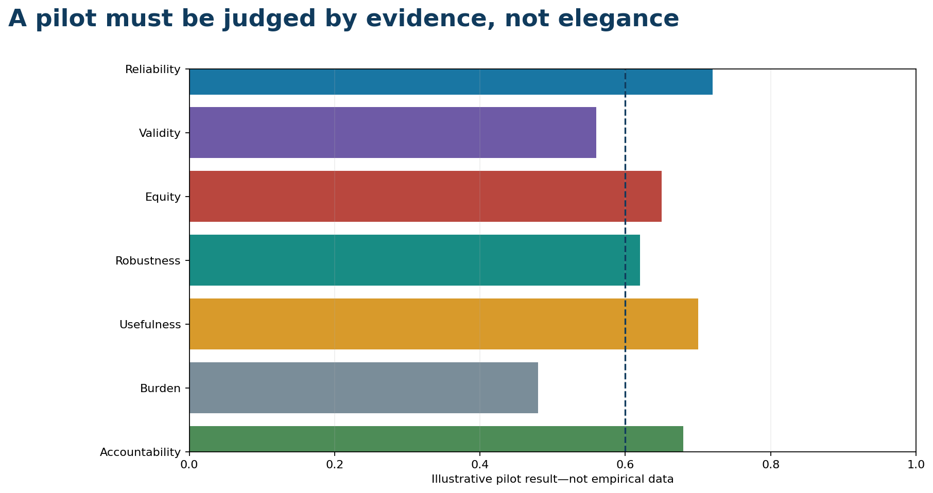
Figure 28. Validation dashboard for a RippleLogic pilot
| Validation dimension | Example measure |
| Reliability | Inter-rater agreement on gate status and material affected groups |
| Construct validity | Whether measures distinguish rights, risk, viability and welfare as intended |
| Predictive usefulness | Whether flagged dependencies and risks correspond to later implementation evidence |
| Decision usefulness | Whether officials report earlier discovery of consequential issues |
| Equity | Whether subgroup harms and exclusion errors become more visible |
| Burden | Time, expertise and cost per run by tier |
| Robustness | Frequency with which plausible assumptions reverse the ranking |
| Accountability | Proportion of material obligations with named owners, deadlines and evidence of discharge |
| Comparative value | Performance against current practice and a simpler structured checklist |
Inter-rater reliability is an early threshold test. Reviewers should complete independent case ratings before reconciliation; common training materials are necessary, but joint discussion must not manufacture the agreement being measured. Gate states and other categorical judgments should be reported with percent agreement plus an appropriate chance-corrected statistic such as Cohen’s or Fleiss’ kappa, weighted kappa for ordered states, Gwet’s AC1 where prevalence makes kappa unstable, or Krippendorff’s alpha when data are mixed or missing. Continuous cell scores can use an intraclass correlation coefficient. Boundary cases, rare fail states and class-specific error rates should be reported separately. Agreement alone does not establish validity, since reviewers can agree and still be wrong, so reliability must be tested alongside construct validity, subgroup visibility, predictive usefulness and comparison with simpler methods. These tests have not yet been completed at scale.
The framework should mature only through such evidence. A responsible claim is not “the mathematics proves the right policy.” It is “the process improved traceability, exposed specified risks, produced sufficiently reliable judgments within this tested domain and remained subject to lawful authority.”
A practical starting point for Indian administration
India does not need to convert every decision into a 49-cell research exercise. Proportionality is essential. The most useful first step would be a MathGov Assurance Annex attached to selected policy and procurement notes.
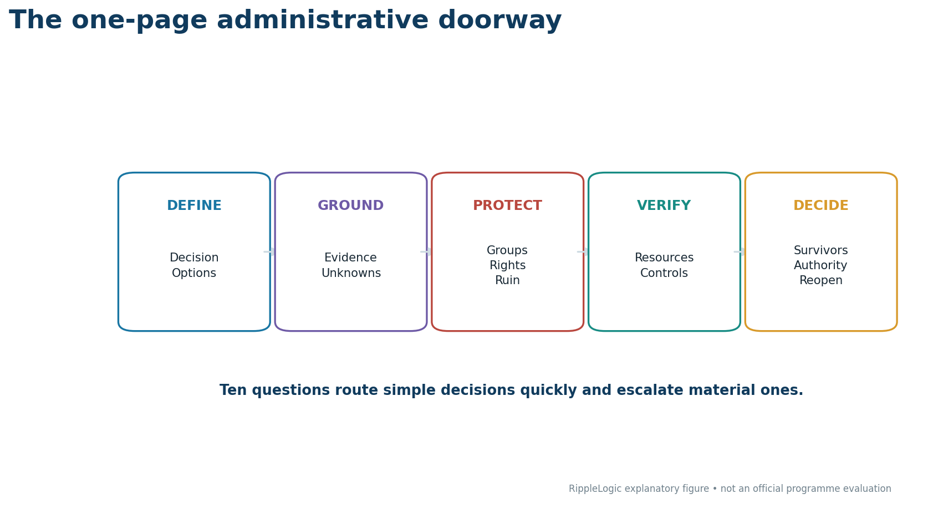
Figure 29. The one-page administrative doorway
The annex would contain ten questions:
1. What exact decision and options are under review?
2. What is the strongest claim the evidence supports?
3. Which material facts remain unknown or contested?
4. Who is affected, especially the worst-affected subgroup?
5. Which rights floors apply, and from which legal source?
6. Which catastrophic or irreversible scenarios apply?
7. Can each option be funded, executed, monitored, corrected and exited?
8. Which options survive qualification?
9. Among survivors, which has the best robust ripple profile?
10. Who has authority to decide and execute the exact qualified action and configuration, and what evidence or observed outcome will reopen the decision?
This one-page surface can route low-stakes matters quickly while escalating consequential decisions into fuller analysis. It gives senior officials, auditors, legislators, journalists and citizens a shared map of where to ask the next question.
Reader key: keep the codes in one place
The public method can be read in five verbs: ground, protect, bound, verify, rank. The main codes are retained here for audit precision rather than repeated as unexplained jargon.
| Code | Plain-language meaning |
| RG | Ground the claim in a declared evidence and validity boundary |
| RF/NCRC | Protect rights and minimum conditions from compensation by aggregate gain |
| TRC | Bound catastrophic, ruinous and irreversible exposure |
| CSV | Verify that the option, transition and resulting state can stand under controls |
| RLS | Rank only the qualified survivors across wider welfare ripples |
| SGP | Separate welfare protection from capability, participation and authority |
| MHIOS | Preserve the human-facing record, workflow, roles and action binding |
| PCC | The governed record carrying parameters, claims, controls and results |
Conclusion: mathematics in service of constitutional judgment
The aim of mathematics-based governance is not to replace wisdom with calculation. It is to prevent power from hiding its calculations, assumptions and exclusions behind rhetoric.
A just public decision must remain more than efficient. It must be grounded in reality, bounded by rights, protected against ruin, viable in actual institutions, attentive to consequences across scales and honest when the evidence cannot support a unique answer.
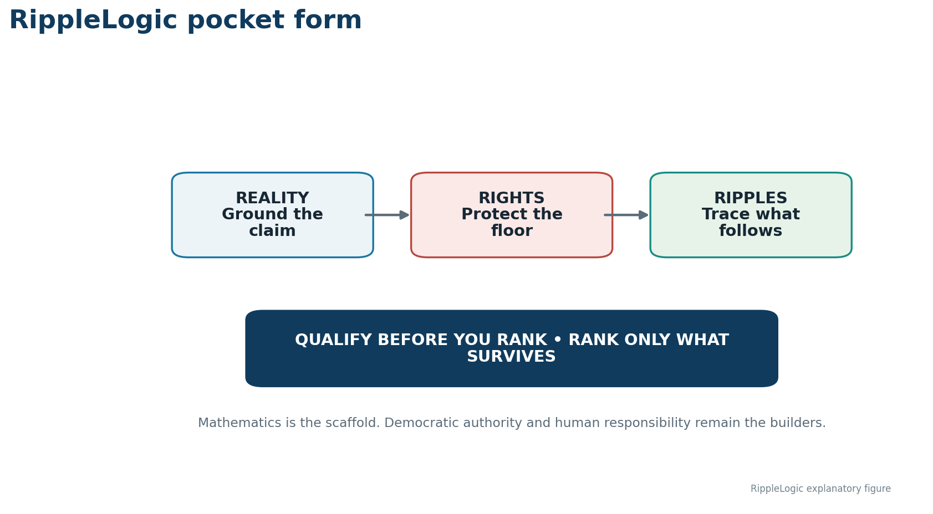
Figure 30. The RippleLogic pocket form
RippleLogic compresses this into a memorable discipline:
Reality. Rights. Ripples.
Qualify before you rank. Rank only what survives.
For India, the opportunity is not government by algorithm. It is something both more modest and more powerful: a public decision system in which evidence can be traced, harms cannot be averaged out of sight, catastrophic risk cannot be purchased with ordinary gains, implementation promises have named owners, and authority cannot pretend that a model made the choice.
The mathematics is the scaffold. Constitutional democracy, public reason and human responsibility remain the builders.
Sources and further reading
• MathGov. RippleLogic Canon v12.6, Sentience Gradient Protocol v8.5 and MathGov Human Interface and Orchestration Standard v0.7, exact tested Core build MathGov_Core_2026_09_v12.6_SGP_v8.5+2026.08.10.1. Public repository: GitHub repository
• MathGov. RippleLogic public doorway and background: RippleLogic website
• Legislative Department, Ministry of Law and Justice, Government of India. The Constitution of India. legislative.gov.in
• India Code. Right to Information Act, 2005. indiacode.nic.in
• India Code. Mahatma Gandhi National Rural Employment Guarantee Act, 2005, Schedule II (as applicable before repeal), paragraph 29 on wage-delay compensation, stage-wise processing limits and calculation through actual deposit in the worker’s account. upload.indiacode.nic.in
• India Code. Viksit Bharat – Guarantee for Rozgar and Ajeevika Mission (Gramin): VB–G RAM G Act, 2025, Act No. 36 of 2025, including section 37 and Schedules I–II. indiacode.nic.in
• Press Information Bureau, Ministry of Rural Development. Commencement of the VB–G RAM G Act across rural India from 1 July 2026, repeal of MGNREGA from the same date, transition arrangements and FY 2026–27 central allocation. pib.gov.in
• Press Information Bureau, Ministry of Rural Development. Frequently Asked Questions on commencement, repeal, entitlement and transition under the VB–G RAM G Act. pib.gov.in
• Comptroller and Auditor General of India. Performance Audit of Ayushman Bharat–Pradhan Mantri Jan Arogya Yojana, Report No. 11 of 2023. cag.gov.in
• Comptroller and Auditor General of India. Implementation of Mahatma Gandhi National Rural Employment Guarantee Act (MGNREGA) for the period ended March 2024, Kerala, Report No. 9 of 2025, laid before the Kerala Legislative Assembly on 24 February 2026. cag.gov.in
• Government of India, Direct Benefit Transfer Mission. DBT portal, home dashboard and Estimated Gains page. Dashboard figures as displayed on 12 August 2026; estimated gains stated by the portal as cumulative up to March 2025 and attributed to “DBT and other governance reforms.” dbtbharat.gov.in
• Commission for Air Quality Management. Graded Response Action Plan and orders for Delhi-NCR. caqm.nic.in
• National Disaster Management Authority. SACHET National Disaster Alert Portal. sachet.ndma.gov.in
• Ministry of Electronics and Information Technology. Digital Personal Data Protection Act, 2023, Digital Personal Data Protection Rules, 2025, and official enforcement-timeline and establishment materials. meity.gov.in
• NITI Aayog. Approach Document for India: Principles for Responsible AI and Operationalizing Principles for Responsible AI. niti.gov.in and niti.gov.in
• Department of Administrative Reforms and Public Grievances. Public grievances and NextGen CPGRAMS materials. darpg.gov.in
• Arrow, K. J. (1963). Social Choice and Individual Values (2nd ed.). Yale University Press.
• Sen, A. (1970). “The Impossibility of a Paretian Liberal.” Journal of Political Economy, 78(1), 152–157. DOI
• Roy, B. (1991). “The Outranking Approach and the Foundations of ELECTRE Methods.” Theory and Decision, 31, 49–73. DOI
• Artzner, P., Delbaen, F., Eber, J.-M., & Heath, D. (1999). “Coherent Measures of Risk.” Mathematical Finance, 9(3), 203–228. DOI
• Rockafellar, R. T., & Uryasev, S. (2000). “Optimization of Conditional Value-at-Risk.” Journal of Risk, 2(3), 21–41. DOI
• Keeney, R. L., & Raiffa, H. (1976). Decisions with Multiple Objectives. Wiley.
• Ostrom, E. (1990). Governing the Commons. Cambridge University Press.
• Rawls, J. (1971). A Theory of Justice. Harvard University Press.
• Sen, A. (1999). Development as Freedom. Knopf.
• Manheim, D., & Garrabrant, S. (2018). “Categorizing Variants of Goodhart’s Law.” DOI
• Department of Expenditure, Ministry of Finance. Public Finance – Central: EFC, PIB, outcome budgeting and the Output-Outcome Framework. doe.gov.in
• NITI Aayog, Development Monitoring and Evaluation Office. Output-Outcome Monitoring Framework materials. niti.gov.in
• Supreme Court of India. Madhyamam Broadcasting Limited v. Union of India, judgment of 5 April 2023, discussing structured proportionality and the culture of justification, with reference to Modern Dental College and Puttaswamy. sci.gov.in
• RAND Corporation. Robust Decision Making, an established approach for decisions under deep uncertainty. rand.org
• Haasnoot, M., Kwakkel, J. H., Walker, W. E., & ter Maat, J. (2013). “Dynamic adaptive policy pathways: a new method for crafting robust decisions for a deeply uncertain world.” Global Environmental Change, 23(2), 485-498. DOI
• US National Institute for Occupational Safety and Health. Hierarchy of Controls. cdc.gov
Editorial note on the illustrations and claims
All diagrams, matrices and worked scores in this article are explanatory constructions based on the RippleLogic architecture. They are not official Government of India evaluations, empirical estimates of the named programmes, or assertions that any named institution has adopted MathGov or RippleLogic. Where a figure is described as worked or illustrative, it demonstrates how the framework would structure a problem; it does not report measured outcomes. This is one of three jurisdictional localisations of the same method; repeated core language is intentional for canonical fidelity and does not imply that India, Viet Nam and New Zealand have interchangeable legal or institutional systems. This document is the long-form public master. Any shorter GFiles or house-style edition should be produced only against a confirmed editorial brief, with claim boundaries and citations preserved.
Statements about Indian law, statutory timelines and programme transitions are stated as at 12 August 2026 and are provided for general orientation. Material legal positions should be confirmed against current notifications and with competent Indian public-law advice before reliance in an administrative or legal setting. The article does not adjudicate the merits of the successor rural-employment allocation model; it identifies the assurance questions and evidence boundaries the transition creates.
This public article has not been represented as an endorsed Indian legal opinion. Before an administrative pilot or formal submission, the rights-limitation record, VB-G RAM G transition treatment and proposed EFC/SFC/PIB/OOMF integration should be co-reviewed by qualified Indian public-law and public-finance specialists, with the review status disclosed rather than implied.
Artifact identity. The audited Core and MHIOS ZIPs used for this edition have SHA-256 hashes af2028ad568444c0d7dabb258051ebcdd82b1d4d348d781412e62e35f5b0ff06 and 0ae9aab27dee025fa4b820c81c100398cc646d3ce9b18fff6426151fce964137. These identify the reviewed files; they do not make the exact build publicly replayable until the matching release is deposited.
(The views and opinions expressed in this article are those of the author and do not necessarily reflect the official policy or position of this website or any affiliated organizations.)

James McGaughran
James McGaughran is an educator, independent researcher, and the founder and lead architect of MathGov, a rights-constrained framework for ethical governance and decision-making. He is currently a Lecturer and Teaching Fellow in the School of Business at British University Vietnam, where his teaching spans international business strategy, marketing, digital content creation, and digital analytics.
McGaughran holds a Master of Arts in Strategic Leadership and Communication from Stephens College in Missouri, United States, where he graduated with a 4.0 GPA. He also holds a Bachelor of Arts in Political Science and Environmental Studies from the University of Colorado Boulder. His interdisciplinary work brings together governance, ethics, public policy, sustainability, strategic leadership, systems thinking, and artificial-intelligence alignment.
He is the principal architect of RippleLogic, the operational decision architecture within MathGov. RippleLogic is designed to help institutions examine evidence, protect fundamental rights, manage catastrophic and irreversible risks, test whether proposed systems are structurally viable, and compare the wider consequences—or “ripples”—of competing decisions. Its purpose is not to replace human judgment, but to make consequential decision-making more transparent, auditable, evidence-grounded, and accountable.
His broader research examines how public institutions can govern complex technologies and high-consequence decisions without reducing ethics to subjective preference or allowing promised benefits to override rights. He is particularly interested in the practical application of auditable decision systems to public administration, regulatory impact assessment, artificial-intelligence governance, environmental policy, education, and long-term civilizational risk.
McGaughran is also a co-author of the peer-reviewed article “Simple techniques to bypass GenAI text detectors: implications for inclusive education,” published in the International Journal of Educational Technology in Higher Education in 2024.
He is currently working with academic supervision to develop prospective doctoral research in public policy, focused on improving how institutions evaluate rights, evidence, uncertainty, and high-consequence interests in regulatory decision-making.
He is based in Hanoi, Vietnam.
- Accountability
- Administrative Reform
- Constitutional Rights
- Data-Driven Governance
- Decision Making
- Evidence-Based Governance
- Finance Ministry
- Good Governance
- Governance Reform
- Government Decision Making
- India Governance
- Mathematics-Based Governance
- Modi
- Policy Reform
- Public Administration
- Public Policy
- Risk Management