














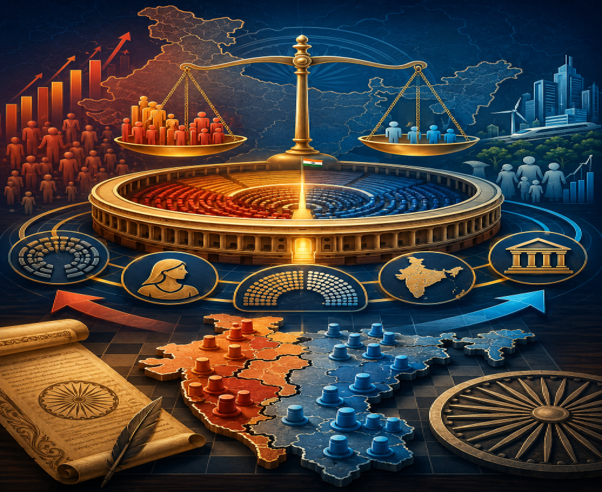









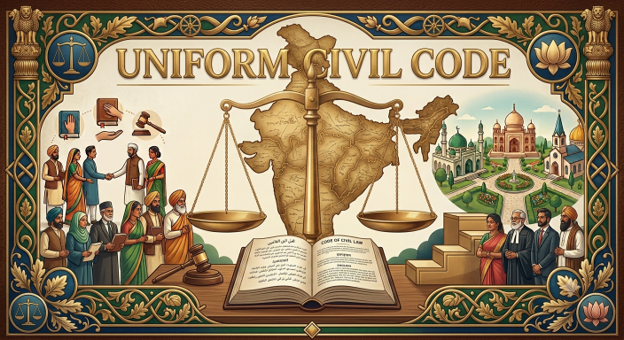
For seventy-five years, a single sentence in the Indian Constitution has sat quietly in a corner, waiting. In the last two years, four states have finally acted on it. Here is the full story of the Uniform Civil Code where it came from, why it divides us, and what is actually happening right now.
The Question India Never Answered
A promise made in 1950, still waiting
Imagine two women in India. Both are thirty-five. Both are getting divorced. Both have a child. Both are frightened about money.
And yet, depending only on the religion they were born into, the law will treat them differently: different rules about how the divorce happens, different rules about maintenance, different rules about what they inherit from their parents.
Same country. Same Constitution. Same courts. Different laws. This is not a loophole or an accident. It is how India’s legal system has worked since Independence. The argument over whether it should change is one of the oldest, angriest, and least understood debates in Indian public life.
So what exactly is a Uniform Civil Code?
Strip away the shouting and the idea is simple. A Uniform Civil Code — UCC means one common set of rules for every Indian citizen on personal matters: marriage, divorce, maintenance, adoption, inheritance and succession.
Not one religion’s rules imposed on everyone, at least in theory, but a new common code that applies regardless of whether you are Hindu, Muslim, Christian, Parsi, Sikh, Jain or Buddhist.
Criminal law in India already works this way. If you commit theft in Kerala or Kashmir, the same Bharatiya Nyaya Sanhita applies to you. It is only in matters of family and property that India still runs several parallel systems.
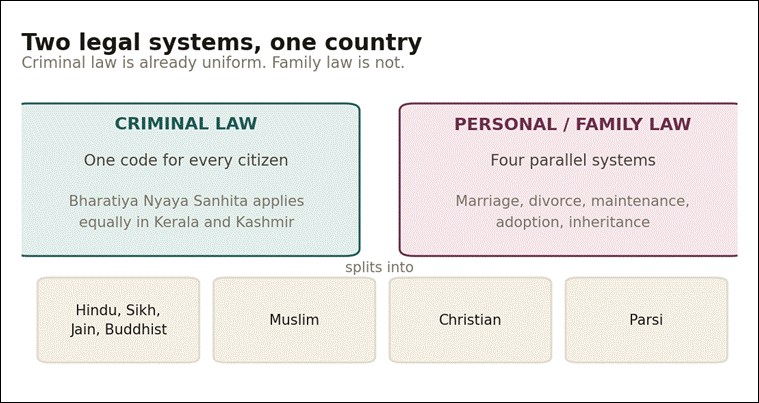
India already has one criminal law for everyone. Family law is where the parallel systems remain.
What are “personal laws”, anyway?
Personal laws are the religion-based rules governing family life. Hindus, Sikhs, Jains and Buddhists are covered by a set of laws codified in the 1950s the Hindu Marriage Act, the Hindu Succession Act and others.
Muslims are governed largely by the Muslim Personal Law (Shariat) Application Act of 1937, which applies Islamic jurisprudence to family matters. Christians have the Indian Christian Marriage Act and the Indian Divorce Act.
Parsis have their own marriage and divorce legislation. Each grew out of a different history. Together they form a patchwork that a law student once described as “one country wearing four different legal uniforms at the same time.”
The one Article that never grew up
All of this leads to Article 44 of the Constitution, which reads: “The State shall endeavour to secure for the citizens a uniform civil code throughout the territory of India.” Notice the word “endeavour.” Not “shall enact.” Not “must.” Article 44 sits in Part IV of the Constitution, among the Directive Principles of State Policy the section containing goals the State should work towards, but which no citizen can walk into a court and demand.
It is, in a sense, a moral instruction rather than a legal command. Of all the Constitution’s provisions, Article 44 is often called the one that has remained almost entirely theoretical for seventy-five years.
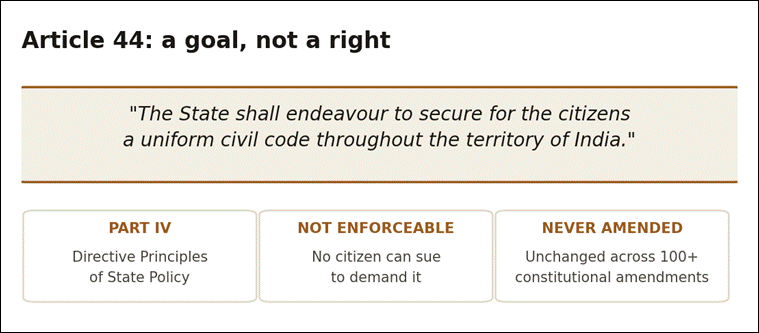
Article 44 has never been amended — neither strengthened nor diluted — across more than a hundred constitutional amendments.
| THE HEART OF IT Article 44 is NOT a fundamental right. You cannot sue the government for failing to bring in a UCC. The Supreme Court has said clearly that it cannot enforce Article 44 — though, as we will see, it has commented on it again and again, usually while deciding somebody’s divorce case. |
How We Got Here
The British drew the line and left it there
The story starts before Independence. Running a vast and unfamiliar subcontinent, the British made a practical decision: they would unify the laws that mattered to trade and order and leave alone the laws that touched faith.
In 1840, the Lex Loci Report recommended codifying Indian law in areas like crime, evidence and contract, and explicitly recommended that the personal laws of Hindus and Muslims be kept outside that project.
That single administrative choice shaped everything that followed. Colonial courts began interpreting religious texts, hiring pandits and maulvis as advisors, and gradually hardening flexible customs into rigid, codified “law.”
Why that decision still matters
This matters more than it first appears. What we now call “Muslim personal law” or “Hindu law” is not simply ancient scripture. It is scripture filtered through British courts, translators and legal categories.
The Hedaya, a twelfth-century Islamic legal text, became the principal source of what the British called Anglo-Muhammadan law after its 1791 English translation. So when people today defend “traditional” personal law, they are often defending a colonial-era codification of tradition and when people attack it, they are attacking the same thing.
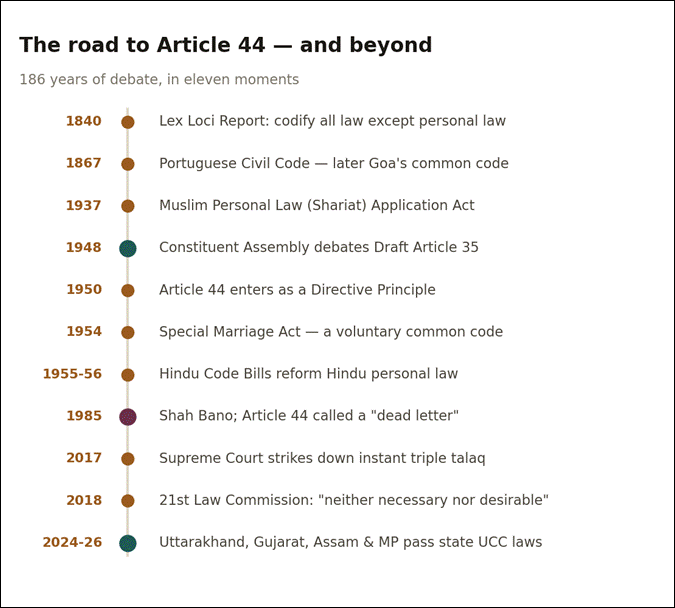
A 186-year arc. Note how little happens between 1950 and 1985 — and how much happens after 2024.
23 November 1948: the day the argument began
Now to the moment that decided everything. On 23 November 1948, the Constituent Assembly debated Draft Article 35, which would become Article 44.
The debate was long, sharp and genuinely difficult. It was not a simple fight between progressives and reactionaries, though it is often flattened into one.
It was a real argument between people who had just watched Partition tear the subcontinent apart, and who disagreed honestly about what would hold the new nation together: shared laws, or protected differences.
The voices against
Most of the opposition came from Muslim members of the Assembly, who moved amendments to keep personal laws outside the Article’s reach. Their arguments were threefold. First, that a uniform civil code would violate the freedom of religion the same Constitution was about to guarantee.
Second, that it would create turmoil within the Muslim community at an already traumatic moment.
Third, and this is the argument that has aged best, that it was simply wrong to alter a community’s personal law without that community’s consent. One member proposed a clause that would have made the Article operational only with the prior assent of the community concerned.
The voices for
On the other side, K.M. Munshi argued forcefully that a common code would not oppress minorities, and that European nations with strong religious traditions had managed common civil codes without collapsing.
Alladi Krishnaswami Ayyar spoke of the code as an instrument of national unity.
The underlying case was that a modern republic promising equality could not indefinitely maintain different rules for different citizens on matters as fundamental as marriage and inheritance and that the people who suffered most from that arrangement were, overwhelmingly, women.
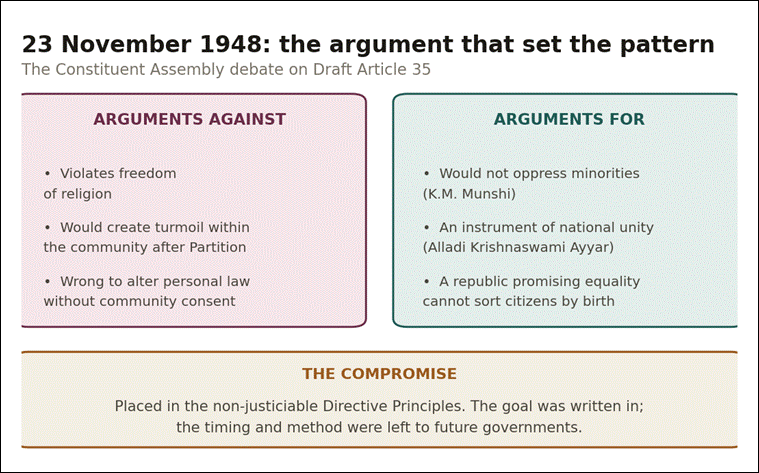
Both sides of the 1948 debate were serious. The Assembly resolved it by compromise, not by victory.
Ambedkar’s quiet compromise
Dr. B.R. Ambedkar’s reply is the most interesting part of the whole debate, and the part most often ignored. Responding to the fears, he suggested that Parliament might one day provide that the code would apply only to those who declared themselves willing to be bound by it so that, at least initially, it would be purely voluntary.
In other words, the man who chaired the Drafting Committee floated an opt-in model. Whether a UCC should be compulsory or optional is therefore not a new question invented by today’s politicians.
It was raised at the moment of drafting, by the drafter himself.
| Parliament may well provide that the Code shall apply only to those who make a declaration that they are prepared to be bound by it — so that in the initial stage the application may be purely voluntary. Dr. B.R. Ambedkar, Constituent Assembly, 23 November 1948 (paraphrased) |
The compromise that has lasted 75 years
The Assembly settled it by placing the UCC in the non-justiciable Directive Principles rather than the Fundamental Rights. It was a deliberate balancing act: the goal of legal uniformity was written into the Constitution, but the timing and manner were left to future governments.
Scholars now read this as a compromise between two legitimate visions civic equality on one side, pluralist accommodation on the other.
Nobody fully won. And crucially, Article 44 has never been amended. Across more than a hundred constitutional amendments, it has been neither strengthened nor diluted. It simply sits there.
Nehru’s half-step: the Hindu Code Bills
What happened next is often forgotten by both camps. In the 1950s, Nehru’s government pushed through a sweeping reform of Hindu personal law the Hindu Marriage Act, the Hindu Succession Act, the Hindu Minority and Guardianship Act, and the Hindu Adoptions and Maintenance Act.
These banned polygamy for Hindus, allowed divorce, and gave Hindu women inheritance rights they had never had.
It was genuinely radical, and it faced ferocious opposition from Hindu conservatives, including within Nehru’s own party.
But it applied to one community only. Reform of Muslim, Christian and Parsi personal law was left for another day a day that has still not fully arrived.
The voluntary code nobody talks about
In 1954, Parliament passed the Special Marriage Act. It is one of the most underrated laws in India. Under it, any two Indians of any religion, or none, can marry under a common, religion-neutral civil law, with common rules on divorce and succession.
It is, in substance, very close to what Ambedkar described: an opt-in civil code, already available, already working, for seventy years.
Its existence complicates both sides of the debate. Supporters of a UCC have to explain why the optional version is not enough; opponents have to explain why the optional version has not caused the catastrophe they predict.
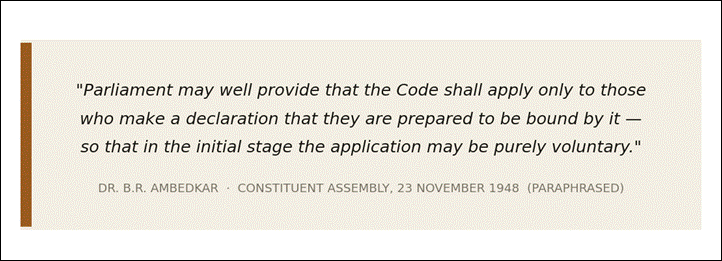
The opt-in idea came from the Constitution’s chief draftsman himself.
Shah Bano – The Case That Changed Everything
A sixty-two-year-old woman in Indore
In 1978, a woman named Shah Bano Begum, aged sixty-two and living in Indore, was thrown out of her home by her husband, Mohd. Ahmed Khan, a prosperous lawyer.
They had been married for over forty years and had five children. She went to court asking for maintenance of a few hundred rupees a month under Section 125 of the Criminal Procedure Code a plain, secular provision that says a man who can afford it must support a wife who cannot support herself.
Her husband responded by pronouncing talaq, returning her mehr of about three thousand rupees, and arguing that under Muslim personal law his obligation was finished.
What the Supreme Court actually said
On 23 April 1985, a five-judge Constitution Bench led by Chief Justice Y.V. Chandrachud ruled unanimously in her favour.
The reasoning mattered as much as the result.
The Court held that Section 125 is a secular provision applying to all citizens regardless of religion, and that a divorced Muslim woman is a “wife” within its meaning.
It went further, examining verses of the Quran itself to argue that Islam imposes an obligation of provision upon a divorced woman, and that mehr is not a payment that discharges the duty of maintenance.
The Court, in other words, did not merely set religious law aside it interpreted it.
Two words that lit the fire: “dead letter”
Then came the paragraph that turned a maintenance case into a national crisis. In an observation not strictly necessary to decide the case what lawyers call obiter dictum the Court lamented that Article 44 had “remained a dead letter” and urged the State to enact a common civil code.
That single line, more than the maintenance award itself, is what detonated.
Suddenly the case was not about one elderly woman’s survival.
It was about whether the Indian State intended to override religious personal law entirely, and whether the Supreme Court had the authority to read the Quran.
The political earthquake
The reaction was ferocious. The All India Muslim Personal Law Board and conservative clerical opinion framed the judgment, especially its scriptural interpretation as judicial interference in religious doctrine.
Mass protests followed. Rajiv Gandhi’s government, elected in 1984 with an enormous majority and dependent on Muslim electoral support, initially defended the verdict and then reversed course.
Arif Mohammad Khan, a Muslim minister who had defended it in Parliament, resigned. Women’s organisations across the political spectrum protested the reversal.
The 1986 law that undid the verdict
In 1986, Parliament passed the Muslim Women (Protection of Rights on Divorce) Act. Despite its title, its effect was to remove divorced Muslim women from the protection of Section 125.
Under the Act, a husband’s maintenance obligation extends to the iddat period roughly three months after which responsibility shifts to the woman’s relatives or to the State Wakf Board.
Critics across the spectrum, including reformist Muslim voices, denounced it as a surrender of women’s rights to electoral arithmetic.
Supporters argued it protected a minority community’s right to govern its own affairs at a moment of genuine insecurity. Both descriptions contain truth, which is precisely why the wound never healed.
The twist most people never hear about
Here is the part that rarely makes it into political speeches. In 2001, in Daniel Latifi v. Union of India brought by Shah Bano’s own lawyer, the Supreme Court upheld the 1986 Act as constitutional, but interpreted it in a way that substantially restored the original position.
The Court read the phrase “reasonable and fair provision and maintenance” to mean that a husband must make a one-time payment within the iddat period sufficient to cover the woman’s future needs for the rest of her life.
And in 2024, in Mohd. Abdul Samad v. State of Telangana, the Court held that the 1986 Act does not override Section 125 at all; a divorced Muslim woman may claim under either, or both.
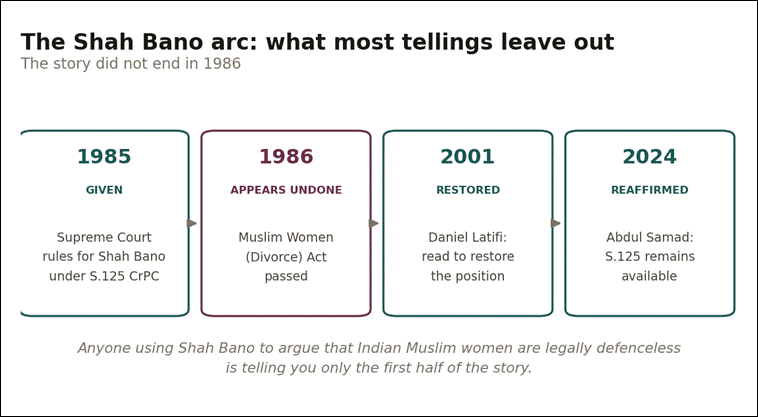
The full arc: given in 1985, apparently undone in 1986, restored in 2001, reaffirmed in 2024.
| WHY THIS TWIST MATTERS The Shah Bano story is usually told as “the Supreme Court gave, Parliament took away.” The fuller version is: the Court gave, Parliament appeared to take away, and the Court then gave it back twice over — in 2001 and again in 2024. Anyone using Shah Bano to argue either that personal law is untouchable, or that Indian Muslim women are legally defenceless, is telling you only the first half of the story. |
What the Courts Have Said Since
Sarla Mudgal, 1995
A decade after Shah Bano, the Court confronted a different problem: Hindu men converting to Islam purely to marry a second wife without committing bigamy.
In Sarla Mudgal v. Union of India, the Court held that such a conversion does not dissolve the first Hindu marriage, and the second marriage remains bigamous.
The judgment again invoked Article 44, arguing a common code would aid national integration. Note the pattern: the observation came in a case about Hindu men exploiting the gap between two personal laws.
John Vallamattom, 2003
In John Vallamattom v. Union of India, a Christian priest challenged Section 118 of the Indian Succession Act, which restricted the ability of Christians to bequeath property for religious or charitable purposes a restriction that applied to no other community.
The Court struck it down as discriminatory, and once more expressed regret that Article 44 remained unimplemented.
This case is useful because it punctures a common assumption: challenges to personal law have not come only from or against one community. Hindus, Muslims and Christians have all had discriminatory provisions in their own laws struck down.
Shayara Bano, 2017 the triple talaq verdict
The most consequential recent judgment came in 2017, when the Supreme Court struck down talaq-e-biddat, instant, irrevocable triple talaq by a 3:2 majority.
Parliament followed in 2019 by criminalising the practice.
For supporters of a UCC, this was proof that personal-law practices can and must be tested against constitutional guarantees of equality and dignity.
For critics, the criminalisation went too far, converting a civil matter into a penal one uniquely for one community.
What is beyond dispute is that the verdict moved the debate from theory into active legislation.
What the courts have carefully not done
One clarification, because it is constantly muddled in public argument. The Supreme Court has never ordered the government to enact a Uniform Civil Code.
It cannot; Article 44 is non-justiciable, and the Court has said so directly.
What it has done, repeatedly, is comment on the absence of a UCC while deciding individual personal-law disputes.
The difference between a judicial observation and a judicial direction is enormous, and collapsing the two is one of the most common errors in this debate on all sides.
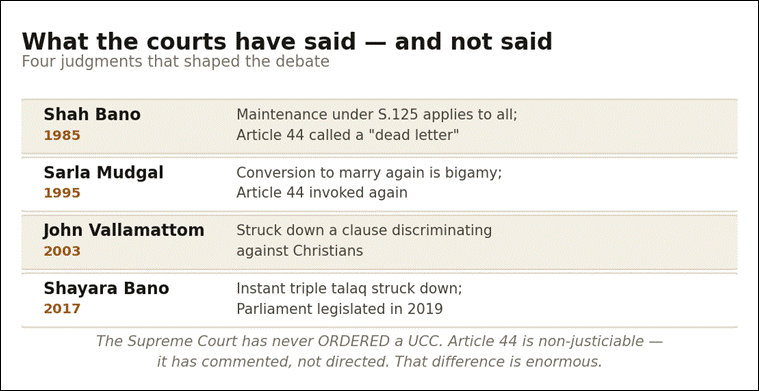
Four judgments that shaped the debate — and one distinction that is constantly misunderstood.
The Commissions and Committees
2016: the Law Commission is called in
In June 2016, the Union Law Ministry asked the 21st Law Commission of India to examine the Uniform Civil Code. The Commission, headed by Justice B.S. Chauhan, did something unusual for an Indian legal body: it went public.
It issued a detailed questionnaire in October 2016 and further public appeals in March and April 2018, inviting responses from citizens and recognised religious organisations.
The response was, by the Commission’s own account, overwhelming. This was, for the first time, a genuine attempt to find out what Indians themselves thought.
2018: the answer nobody expected
On 31 August 2018, the Commission released a Consultation Paper on Reform of Family Law. Its conclusion startled almost everyone. A uniform civil code, it said, was “neither necessary nor desirable at this stage.” Its reasoning was not that discrimination should be tolerated quite the opposite.
The Commission argued that the right target was discrimination, not difference. It recommended removing discriminatory provisions from within each personal law rather than replacing all of them with a single code.
In a much-quoted line, it observed that most countries are now moving towards recognising difference, and that the mere existence of difference does not imply discrimination but is indicative of a robust democracy.
| While diversity of Indian culture can and should be celebrated, specific groups, or weaker sections of society must not be dis-privileged in the process. Resolution of this conflict does not mean abolition of difference. 21st Law Commission of India, Consultation Paper on Reform of Family Law, 2018 |
An important technicality
One detail is worth getting right, because it is regularly misstated. The 21st Law Commission never submitted a formal report on the UCC.
Its term ended on 31 August 2018 the same day the Consultation Paper appeared. What exists is a consultation paper, not a final report. The government has leaned on this distinction in Parliament: when asked directly about the “neither necessary nor desirable” line, the Law Minister noted that the 21st Commission had issued a consultation paper rather than a report.
Opponents call that a dodge; the government calls it accuracy. Both are, technically, correct.
2023: the 22nd Commission reopens the file
In June 2023, the 22nd Law Commission announced it would examine the UCC afresh, and again invited views from the public and religious organisations.
Its stated reasoning was that more than four years had passed since the consultation paper, that the subject remained important, and that there had been various court orders in the interim.
Critics noted the timing state elections in 2023, a general election in 2024 and the Congress issued a statement pointing to the 21st Commission’s conclusion.
A parliamentary standing committee on law and justice, chaired by BJP MP Sushil Kumar Modi, also took up the subject and travelled to Goa to study its civil code.
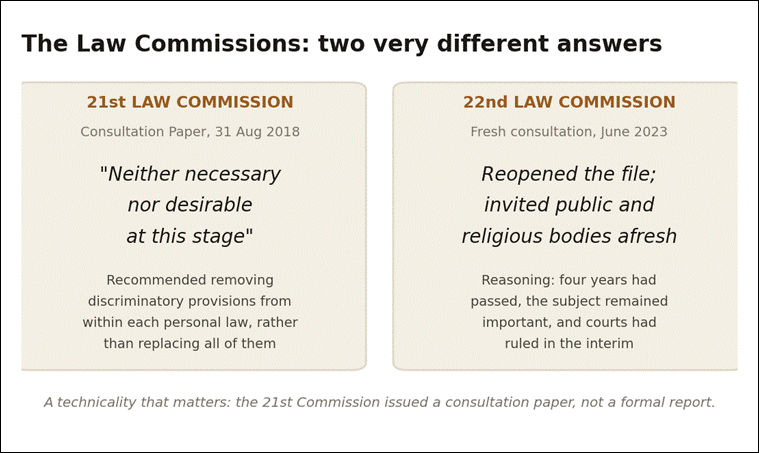
Two commissions, two conclusions — and a technical distinction that both sides use.
Goa, the Living Experiment
India’s only common civil code, and it’s from 1867
There is one place in India where something close to a common civil code has operated for over 150 years.
Goa was a Portuguese colony for more than four centuries. The Portuguese Civil Code of 1867 itself modelled on the Napoleonic Code, was extended to Goa around 1870. When Goa was integrated into India in 1961, the code was retained rather than replaced.
It applies to Hindus, Muslims, Christians and everyone else in the state on matters of marriage, divorce and succession. Successive Goa Chief Ministers have offered it as a working model, pointing out that it has coexisted with communal peace.
What the Goa code actually does
Some of its features are genuinely striking. Registration of marriage is compulsory and consent of both parties is required.
Property acquired during a marriage is held jointly and divided equally on divorce more progressive than anything in mainstream Indian family law.
Parents cannot fully disinherit their children; at least half the estate must pass to them, and sons and daughters inherit equally. Couples may also enter prenuptial agreements.
But Goa is not quite the poster child either
Honesty requires a caveat here, and it is one that enthusiasts on both sides tend to skip. The Goa code contains carve-outs that sit awkwardly with the word “uniform,” including historic provisions applying differently to certain Hindu communities.
Legal scholars have argued that describing it as a fully common civil code is something of a myth, and that a 155-year-old law of foreign origin is overdue for review a view the Law Ministry itself has acknowledged to the parliamentary committee.
Goa proves a common code can exist in India without catastrophe. It does not prove it is perfect.
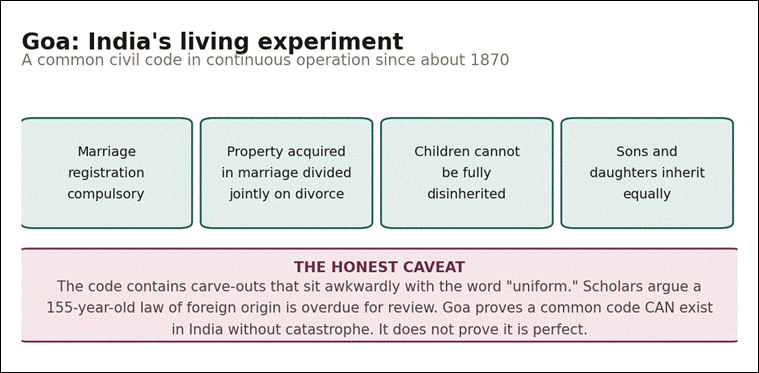
Goa’s code is genuinely progressive in parts — and genuinely imperfect in others.
Why the BJP Wants It
A demand older than the party itself
The BJP’s commitment to a UCC is not recent opportunism; it long predates the party. The Bharatiya Jana Sangh, founded in 1951 and the BJP’s political ancestor, included the UCC in its 1967 election manifesto, promising uniform law for marriage, succession and adoption for all citizens if voted to power.
The demand was articulated by the RSS before that.
It became part of the BJP’s own manifesto from 1998, where the party proposed entrusting the Law Commission with drafting a code that would secure property rights for women, equal guardianship and adoption rights, and mandatory registration of all marriages.
The three-item list
For decades, three commitments defined the BJP’s ideological core: a Ram temple at Ayodhya, the revocation of Article 370 in Jammu and Kashmir, and a Uniform Civil Code.
The first was settled by a Supreme Court verdict in 2019 and the temple’s construction. The second was pushed through Parliament in August 2019. The third has been the last one standing.
Understanding this is essential to understanding the intensity of the current push for the party and its ideological parent, this is unfinished business of the highest symbolic order.
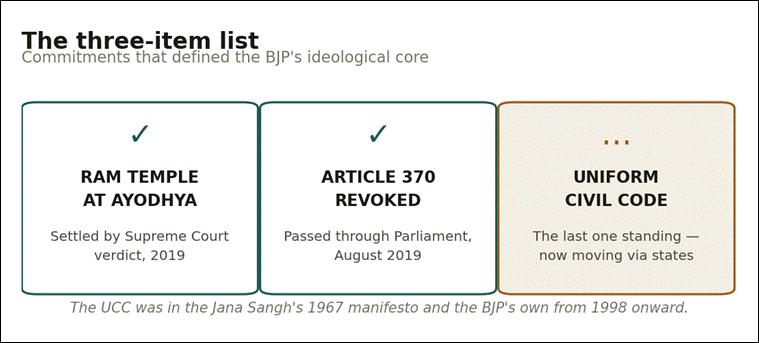
Two of the three long-standing commitments have been settled. The UCC is the last.
The case as the BJP makes it
Stated plainly, the party’s argument runs like this. Gender equality cannot be complete while some Indian women are governed by rules that permit polygamy, unilateral divorce or unequal inheritance.
A constitutional republic promising equality before law cannot justify different civil rules based on birth religion.
Article 44 is a constitutional instruction that successive governments dodged for political convenience.
And the triple talaq verdict showed that personal-law practices can be tested against constitutional standards without the sky falling. The BJP frames the UCC less as a religious project than as the completion of a gender-justice and equality agenda.
The case as critics read it
Critics read the same facts differently. They point out that the party’s reform energy has been directed overwhelmingly at practices associated with one minority community, while Hindu-specific institutions such as the Hindu Undivided Family, which confers significant tax advantages available to no other community, have gone untouched.
They argue that a genuine commitment to uniformity would begin there. Supporters respond that reform must start somewhere and that the most egregious practices were addressed first.
This is one of the genuinely unresolved arguments in the debate, and readers should sit with it rather than resolve it too quickly.
What Is Actually Happening Right Now
Uttarakhand goes first
After seventy-five years of theory, the breakthrough came from a small hill state. Uttarakhand passed its Uniform Civil Code Bill in February 2024, delivering on a commitment the BJP had made before the 2022 state elections.
After the state cabinet approved implementation rules, the law came into force on 27 January 2025, making Uttarakhand the first state in independent India to implement a UCC.
It establishes common rules on marriage, divorce, succession and inheritance for all citizens in the state except Scheduled Tribes, and makes registration of all marriages and live-in relationships mandatory.
The numbers after year one
The state government’s own figures are worth examining. Before the UCC, marriages were registered under a 2010 law through an entirely offline process requiring both spouses and two witnesses to appear at the Sub-Registrar’s office.
Under the UCC, the government says nearly 100 per cent of registrations are now completed online, with couples uploading records and recording video statements from anywhere.
By 19 January 2026, some 4,74,447 marriage registrations had been completed in under a year. That January, the state promulgated a UCC (Amendment) Ordinance making procedural and penal improvements.
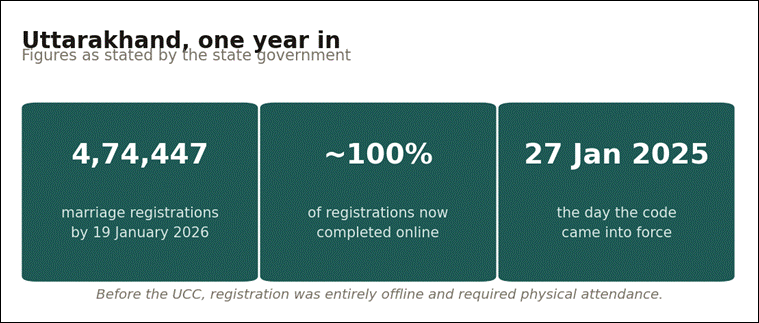
Figures as stated by the Uttarakhand government; they have not been independently verified.
Gujarat, Assam and Madhya Pradesh follow
The pace since has been striking. Gujarat passed its UCC Bill in March 2026 after a debate lasting more than seven hours, becoming the second state to do so; the Congress and AAP withheld support.
Assam’s Legislative Assembly passed its Bill in May 2026, becoming the first state in the Northeast to do so.
Madhya Pradesh followed in July 2026. Chief Minister Mohan Yadav said over 1,164 suggestions had been collected and claimed 93 per cent public support.
All three laws broadly cover marriage, divorce, inheritance, succession and live-in relationships, ban polygamy, and mandate registration.
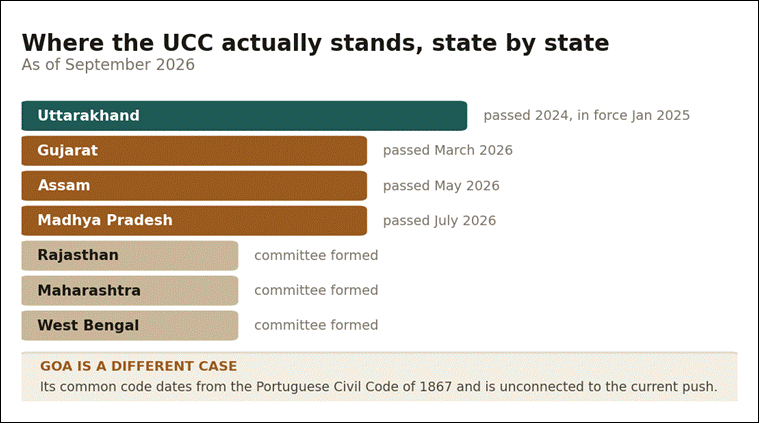
Four states have legislated; three of those bills were reported to be awaiting presidential assent.
One judge, six drafting panels
A quietly remarkable detail: retired Supreme Court judge Justice Ranjana Prakash Desai has headed the UCC drafting panels of Uttarakhand, Gujarat, Madhya Pradesh, West Bengal, Rajasthan and Maharashtra.
This helps explain why the state codes resemble one another so closely they share intellectual authorship.
It also suggests something about the strategy: rather than one contested national law fought out in Parliament, a family of near-identical state laws, each individually easier to pass, collectively building towards something close to national coverage.
The state-first strategy, and its limits
Union Home Minister Amit Shah has set a political deadline: all twenty-one BJP-NDA ruled states should introduce a UCC before the 2029 Lok Sabha elections. This is a significant shift.
The UCC has always been presented as a national commitment, but the operative strategy is now to advance it through state legislatures rather than begin with a central law.
There is an obvious constitutional limitation, though: state laws do not automatically create a national code.
Personal law falls in the Concurrent List, which means state laws in this area typically require presidential assent, and a genuinely national UCC would still require Parliament.
The Case For :The gender-justice argument
The strongest argument for a UCC is about women. Across several personal law systems, women have historically faced unequal inheritance shares, weaker divorce rights, and vulnerability to practices like polygamy.
Supporters argue that a woman’s constitutional right to equality should not vary with the religion recorded on her birth certificate, and that leaving reform to each community’s internal consensus has meant, in practice, leaving it to overwhelmingly male community leadership.
Madhya Pradesh’s government claimed that over 80 per cent of Muslim women in its consultation backed the proposal, a figure critics dispute, but which points to a real constituency.
The integration argument
The second argument is about nationhood. Supporters, echoing Munshi and Ayyar in 1948, say that a country cannot fully cohere while its citizens are sorted into separate legal compartments at birth.
The Supreme Court made a version of this point in Sarla Mudgal. The response from critics is that India’s unity has never rested on uniformity; a nation of twenty-two scheduled languages and enormous regional variation has held together precisely by accommodating difference rather than erasing it.
Both are serious arguments about what actually binds a diverse country.
The practical argument
The third is unglamorous but real: simplicity. India’s family law is a maze.
Determining which law applies to an interfaith couple, a convert, or an adopted child can require expensive litigation, and courts spend enormous time on conflict-of-laws questions that would vanish under a single code.
Mandatory registration, the least ideological part of most state UCCs, genuinely protects spouses by creating documentary proof of marriage in maintenance and inheritance disputes.
The Case Against
The freedom-of-religion argument
Article 25 guarantees the freedom to profess, practise and propagate religion; Article 29 protects the right of any section of citizens to conserve its distinct culture.
Opponents argue that personal law is inseparable from religious practice for many communities, and that replacing it by legislative majority overrides a constitutional protection designed precisely to shield minorities from majorities.
The counter-argument is that Article 25 is itself subject to public order, morality and health, and that the Constitution explicitly permits the State to legislate on social reform.
“It isn’t uniform at all”
The sharpest criticism of the state UCCs is that they are not uniform. All of them exempt Scheduled Tribes.
AIMIM chief Asaduddin Owaisi has been the most prominent voice here, arguing that if the code is genuinely good for society, no community should be excluded and asking why tribal cultural autonomy under Article 29 is protected while Muslim personal law is not. He has also pointed to the untouched Hindu Undivided Family provisions.
Governments respond that tribal customary rights carry distinct constitutional protection under the Fifth and Sixth Schedules, which is legally true but does not fully answer the moral question.
The inheritance objection
A more technical objection concerns wills. Islamic inheritance law limits how much a person may bequeath by will, precisely to guarantee fixed shares to specified heirs including daughters.
Critics argue that codes granting unrestricted testamentary freedom could allow a father to write a will excluding a daughter entirely, producing, in the name of gender justice, a result worse for some daughters than the system it replaces.
Supporters counter that unrestricted testamentary freedom already exists for most Indians and has not produced mass disinheritance.
It is a genuinely contested empirical question that deserves data rather than assertion.
Live-in registration and the privacy question
The provision that has drawn the broadest criticism, including from people otherwise sympathetic to a UCC, is mandatory registration of live-in relationships.
Critics argue this intrudes on privacy and on relationships the Supreme Court has already recognised as lawful between consenting adults.
A Congress MLA in Uttarakhand asked how a state can require registration of something the Supreme Court has validated; a senior High Court lawyer called it an attempt to “peep into bedrooms.
” Chief Minister Dhami has defended it as a protective measure, citing cases where women in unregistered live-in relationships were murdered by partners.
Difference is not the same as discrimination
The most intellectually serious objection is the one the 21st Law Commission made. It is possible to believe that personal laws contain genuine injustices and that replacing them wholesale is the wrong remedy.
On this view, the right approach is surgical: identify every discriminatory provision in every personal law Hindu, Muslim, Christian, Parsi and remove it, while leaving intact the differences that harm nobody.
This is the position that gets least airtime, because it satisfies neither camp’s political needs. It may also be the most defensible.
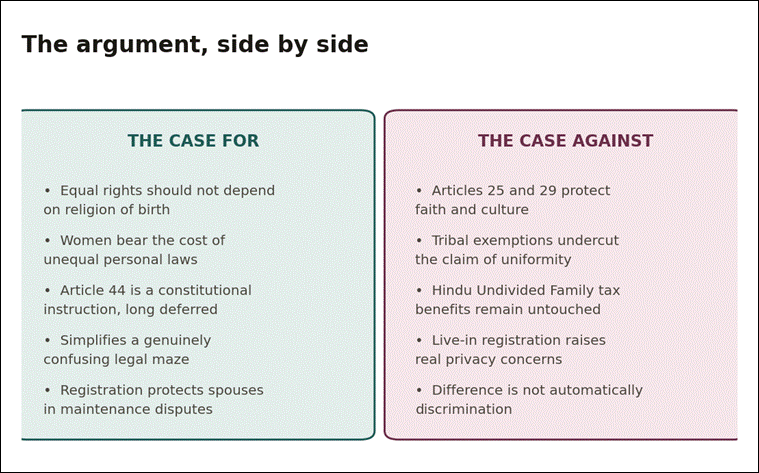
Both columns contain serious arguments. Neither is a caricature of the other.
Where This Actually Goes
Four possible roads
Looking at the constitutional history honestly, there are several routes available, and they are not equally discussed.
The first is a mandatory national code enacted by Parliament, the loudest demand, and the hardest to achieve.
The second is the 21st Law Commission’s approach: reform within each personal law, removing discriminatory provisions one by one.
The third is Ambedkar’s own suggestion an expanded opt-in code on the Special Marriage Act model, which citizens could choose to be governed by.
The current state-by-state strategy is a fourth route nobody in 1948 anticipated.
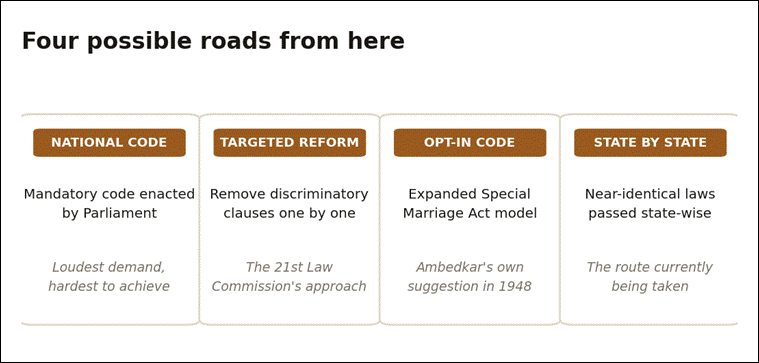
Four routes to the same constitutional goal — with very different politics attached to each.
The question is less whether than how
Here is what strikes me most, having read through the Constituent Assembly debates, the judgments and the commission papers.
Almost nobody serious argues that discriminatory personal-law provisions should survive. The disagreement is about method and legitimacy: whether reform should be uniform or targeted, mandatory or voluntary, legislated over communities or negotiated with them.
Framed that way, the gap between the two camps is narrower than the volume of the argument suggests. Framed as a loyalty test, which is how it is usually framed the gap becomes unbridgeable.
What to watch next
Three things will tell you where this is heading.
First, presidential assent: several state bills were reported to be awaiting it, and the pace of assent will signal the Centre’s appetite.
Second, the courts: state UCCs will almost certainly face constitutional challenge, and how the Supreme Court handles the tribal-exemption and privacy questions will shape everything after.
Third, the data from Uttarakhand: it is now a live experiment, and in a few years there will be real evidence about whether a state UCC delivers the protections its supporters promise or the intrusions its critics fear.
A closing thought
Go back to the two women from the beginning. Whatever one believes about Article 44, the honest starting point is that neither of them chose the legal system she was born into.
Shah Bano did not set out to become a constitutional flashpoint; she asked for a few hundred rupees a month at the age of sixty-two.
That is worth holding onto in a debate that has become almost entirely about symbols.
Behind every clause on marriage, maintenance and inheritance is somebody at the worst moment of their life, hoping the law is on their side.
Getting this right matters far more than winning the argument.
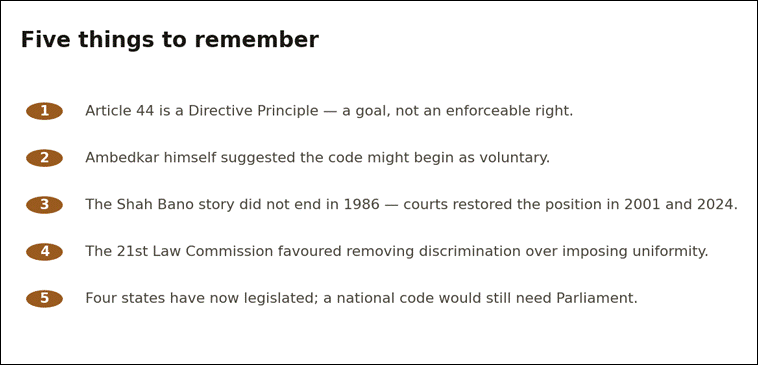
The five points most often lost in the shouting.
References
- Constitution of India, Article 44 — Constituent Assembly debate on Draft Article 35, 23 November 1948. https://www.constitutionofindia.net/articles/article-44-uniform-civil-code-for-the-citizens/
- “Debating Uniform Civil Code: the making of Article 44 in the Constituent Assembly of India,” Indian Law Review, Vol. 9, No. 3. https://www.tandfonline.com/doi/full/10.1080/24730580.2025.2570575
- “Article 44 of the Indian Constitution,” iPleaders Blog. https://blog.ipleaders.in/article-44-of-indian-constitution/
- Mohd. Ahmed Khan v. Shah Bano Begum (1985) 2 SCC 556, Supreme Court of India, 23 April 1985.
- “Shah Bano Case 1985 & Muslim Women’s Rights in India,” Drishti IAS. https://www.drishtiias.com/daily-updates/daily-news-analysis/shah-bano-case-1985-muslim-womens-rights-in-india
- Muslim Women (Protection of Rights on Divorce) Act, 1986.
- Danial Latifi v. Union of India (2001) 7 SCC 740; Mohd. Abdul Samad v. State of Telangana (2024).
- Sarla Mudgal v. Union of India, AIR 1995 SC 1531; John Vallamattom v. Union of India (2003); Shayara Bano v. Union of India (2017) 9 SCC 1.
- 21st Law Commission of India, Consultation Paper on Reform of Family Law, 31 August 2018.
- “UCC neither necessary nor desirable, law panel in 2018,” The Tribune. https://www.tribuneindia.com/news/nation/ucc-neither-necessary-nor-desirable-law-panel-in-2018-518300/amp
- Press Information Bureau, “Law Commission of India solicits views & ideas of the public and recognized religious organizations about Uniform Civil Code,” 2023. https://www.pib.gov.in/PressReleaseIframePage.aspx?PRID=1932397
- “Law Commission of India and Uniform Civil Code,” Economic and Political Weekly, Vol. 58, Issue 40, October 2023. https://www.epw.in/journal/2023/40/commentary/law-commission-india-and-uniform-civil-code.html
- Goa Civil Code / Portuguese Civil Code, 1867 — official translation, India Code. https://www.indiacode.nic.in/bitstream/123456789/8312/1/ocrportuguesecivilcode.pdf
- Tahir Mahmood, “The Portuguese Civil Code of 1867 is a colonial burden on Goa,” Goa High Court Bar Association. https://ghcba.org/the-portuguese-civil-code-of-1867-is-a-colonial-burden-on-goa/
- Bharatiya Jana Sangh 1967 manifesto; BJP manifestos from 1998 onward. BJP Library, “The Uniform Civil Code and the Bharatiya Janata Party.” https://library.bjp.org/jspui/bitstream/123456789/3104/1/Uniform-Civil-Code.pdf
- “Uttarakhand becomes first state to implement Uniform Civil Code,” News On Air, 27 January 2025. https://www.newsonair.gov.in/uniform-civil-code-to-come-into-force-in-uttarakhand
- “Uttarakhand Govt implements the UCC (Amendment) Ordinance, 2026,” News On Air, 27 January 2026. https://www.newsonair.gov.in/uttarakhand-govt-implements-the-ucc-amendment-ordinance-2026
- “Gujarat Passes Uniform Civil Code Bill 2026,” Outlook India, March 2026. https://www.outlookindia.com/national/gujarat-passes-uniform-civil-code-bill-2026-second-state-after-uttarakhand-to-enact-ucc
- “Uttarakhand, Gujarat, now Assam: How the 3 states’ UCC models compare,” ThePrint, May 2026. https://theprint.in/judiciary/uttarakhand-gujarat-now-assam-how-the-3-states-ucc-models-compare-from-marriage-to-succession/2945153/
- “Madhya Pradesh becomes fourth UCC State; three more join the queue,” Citizens for Justice and Peace, August 2026. https://cjp.org.in/madhya-pradesh-becomes-fourth-ucc-state-three-more-join-the-queue/
- “Amit Shah’s UCC Push: Why BJP Is Taking The Uniform Civil Code Route Through States,” Outlook India, September 2026. https://www.outlookindia.com/national/amit-shahs-ucc-push-why-bjp-is-taking-the-uniform-civil-code-route-through-states
- “Backdoor imposition of Hindu law on Muslims: Owaisi on Assam’s UCC Bill,” PTI / ThePrint, May 2026. https://theprint.in/india/backdoor-imposition-of-hindu-law-on-muslims-owaisi-on-assams-ucc-bill/2941360/
- “The Uniform Civil Code (UCC) of Uttarakhand: Advancement in gender justice or violating individual liberties?” Citizens for Justice and Peace. https://cjp.org.in/the-uniform-civil-code-ucc-of-uttarakhand-advancement-in-gender-justice-or-violating-individual-liberties/
- “Only one live-in relationship registered in 10 days after UCC implementation in Uttarakhand,” Deccan Herald. https://www.deccanherald.com/india/uttarakhand/only-one-live-in-relationship-registered-in-10-days-after-ucc-implementation-in-uttarakhand-3390741
- “Goa Civil Code can be model for states seeking to implement UCC: CM Pramod Sawant,” The Tribune. https://www.tribuneindia.com/news/nation/goa-civil-code-can-be-model-for-states-seeking-to-implement-ucc-cm-pramod-sawant-392999/amp

Amir Khan
Amir Khan is a Delhi-based Public Policy Researcher, Political Consultant, and Educator. He holds a Postgraduate degree in Political Science and International Relations from Jamia Millia Islamia, New Delhi. He is currently associated with Bano IAS as an Editor & Content Creator (Magazine) and serves as the Secretary of HIMS Foundation, where he contributes to policy research, editorial development, governance-focused publications, and institutional initiatives. He has previously worked with Pehchaan The Street School, supporting education and social impact programmes.
His work primarily focuses on public policy, governance, electoral studies, constitutional affairs, public administration, and international relations. Through research-driven writing and policy analysis, he develops evidence-based content for Civil Services aspirants and public policy audiences.
His research and writing are grounded in credible sources, official reports, constitutional principles, and data-driven analysis, with an emphasis on presenting complex policy issues in a clear, objective, and accessible manner. He is committed to promoting informed public discourse through accurate, balanced, and well-researched policy content.



Leave a comment