




















An Examination of India’s First Nationwide Caste Enumeration Since 1931
Introduction
Sometime in the coming months, an enumerator will knock on a door somewhere between the Thar Desert and the Sundarbans, tablet in hand, and ask a household to state not just its name, religion and income, but its caste. It sounds like a simple administrative question. It is not. It is, in fact, the reopening of a debate that India has circled for nearly a century, a debate about who its people really are, how unequal they remain, and whether naming that inequality helps to fix it or merely hardens it.
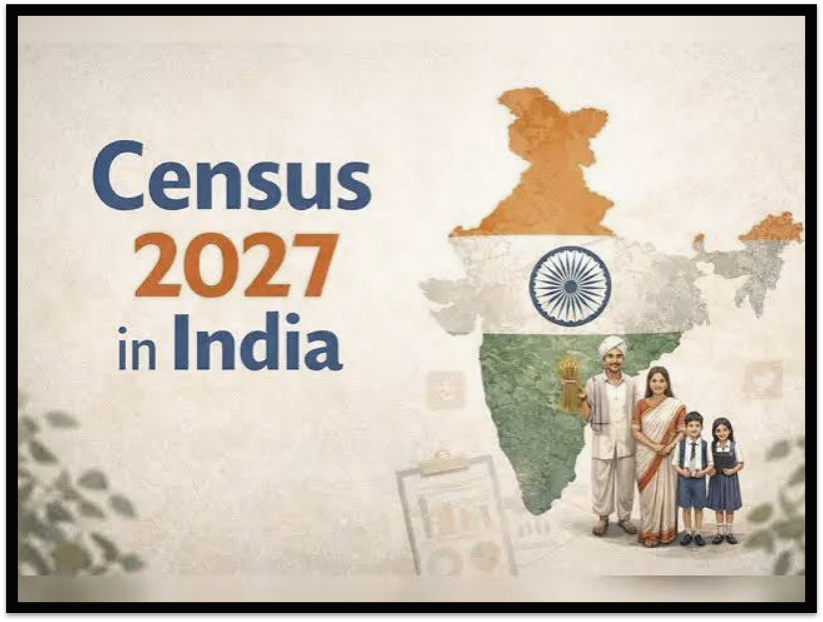
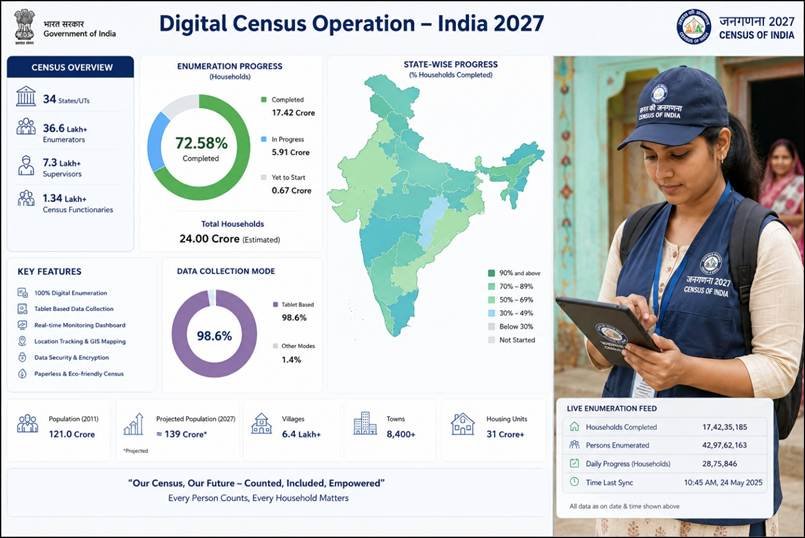
India is preparing to count caste in a nationwide census for the first time since 1931. The Cabinet Committee on Political Affairs approved the move in April 2025, and the exercise now forms part of the 16th Census of India, due to be completed with a reference date of 1 March 2027 for most of the country. It is, by any measure, an enormous undertaking: over 1.4 billion people, millions of enumerators, a fully digital format for the first time in the census’ history, and a question that touches something far more sensitive than age or literacy.
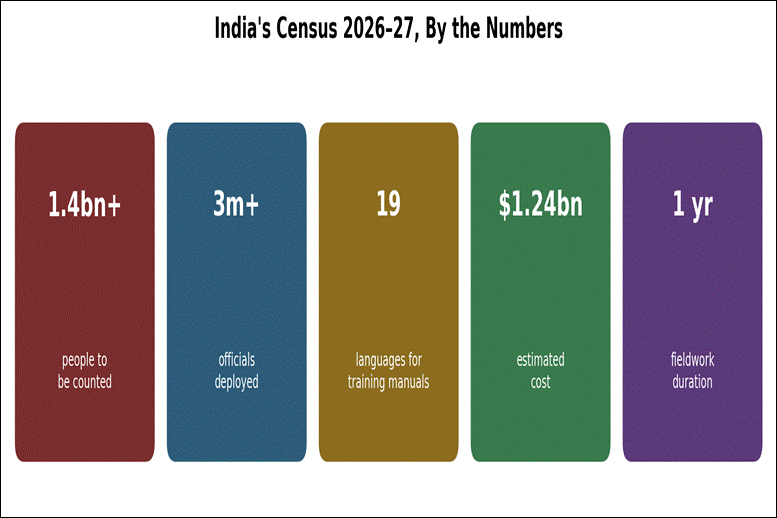
Figure A: The scale of Census 2026–27 in numbers
To grasp why these matters, it helps to remember what caste governs in Indian life, even in 2026. It still shapes who marries whom, in the overwhelming majority of Indian marriages. It correlates closely with land ownership, educational attainment and access to credit. It determines eligibility for one of the largest affirmative-action systems on earth, covering government jobs, university admissions and elected office. And yet, remarkably, the modern Indian state has spent nearly a century governing this reality with almost no reliable data on its current shape, relying instead on inherited assumptions, contested estimates and, at state level, a patchwork of surveys that do not add up to a coherent national picture.
What the caste census actually is, why it has taken ninety-five years to happen, who wants it and who has resisted it, what the legal and economic stakes are, and what India might look like once the numbers are finally known. There are strong arguments on every side of this debate.
What Exactly Is a Caste Census
At its simplest, a caste census is the inclusion of a question or a set of questions about caste and sub-caste identity within the broader population census. India’s regular decennial census already collects a great deal of information: age, sex, literacy, occupation, religion, migration, housing conditions and, since 1951, the population of Scheduled Castes (SCs) and Scheduled Tribes (STs), two constitutionally recognised categories with dedicated welfare protections. What has been missing since independence is any official count of the much larger population that falls outside these two categories, most significantly the Other Backward Classes (OBCs), along with the so-called “general” or forward castes.

How This Differs from Past Exercises
This is different from, though related to, the Socio-Economic and Caste Census (SECC) conducted in 2011, which was a separate exercise from the regular census, run to identify poor households for welfare targeting. The SECC did ask about caste, but the results were never officially released as usable data, a point that has fuelled two decades of political frustration and forms an important part of the story.
The 2027 exercise is different again: caste enumeration will sit inside the main census itself, conducted by the Office of the Registrar General & Census Commissioner of India under the Ministry of Home Affairs, and will, for the first time, be conducted digitally. According to government officials, a pre-trial survey was carried out in fifteen days across the country to test how people describe their caste, ahead of a final questionnaire and specialised training for enumerators, with training manuals reportedly being prepared in nineteen languages for millions of census personnel.
A Brief History of Caste Enumeration in India
To understand why this is happening now, and why it is so contentious, it helps to look back.
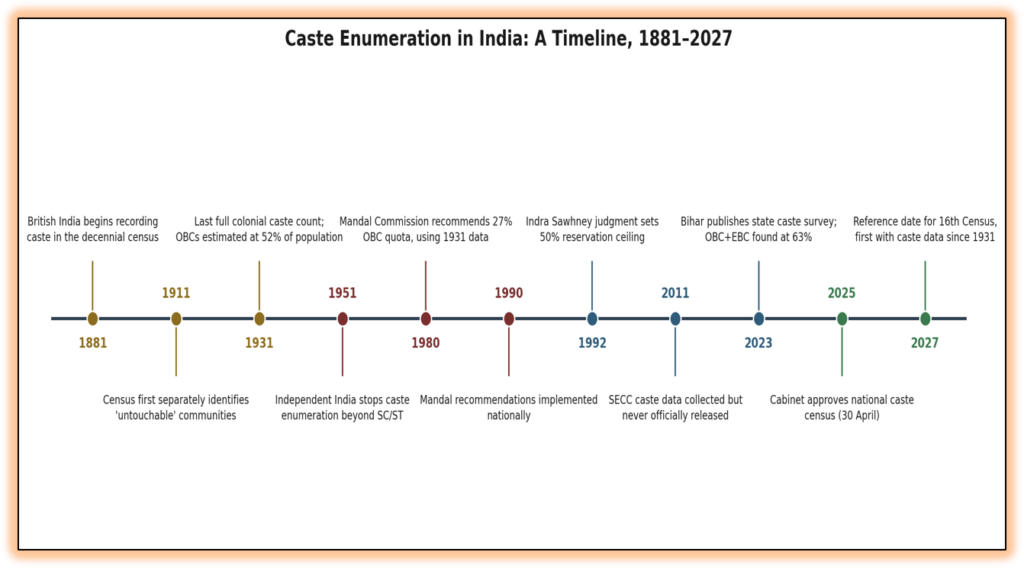
Figure: Caste enumeration in India, 1881–2027
The colonial census, 1881–1931
The British began recording caste as part of the decennial census in 1881 and continued doing so through to 1931. What began as an attempt to understand India’s social structure gradually became something more elaborate and, in the view of many historians, more damaging: a fixed, official taxonomy of caste identity. The number of castes recorded ballooned as enumerators tried to capture ever-finer distinctions, from 1,646 distinct castes recorded in 1901 to 4,147 by 1931, partly because colonial administrators had no settled definition of what separated a caste from a tribe or a sub-group, and different enumerators labelled the same community differently in different decades. Historians generally agree that this process did not simply record a pre-existing social reality; it also helped to harden and formalise caste boundaries that had previously been more fluid and locally contested.
Ambedkar and the 1931 Legacy
That colonial data went on to have consequences its authors could scarcely have imagined. The 1911 census, in particular, is remembered by scholars as a turning point: it was the first serious attempt to count the community then labelled as “untouchables” as a distinct group, work that a young B. R. Ambedkar later drew upon in 1919 to demand separate political representation for the oppressed communities a demand that eventually produced reserved legislative seats from 1937 onwards. The 1931 census became the last full caste count of the colonial era, and its estimate that OBCs made up roughly 52 per cent of British India’s population of around 271 million would go on to shape Indian policy for the rest of the century.
Independence and the retreat from caste counting
When India conducted its first census as a free nation in 1951, the government led by Jawaharlal Nehru took a deliberate decision to stop counting caste beyond SCs and STs. The reasoning, at the time, was that detailed caste enumeration risked entrenching the very divisions that a modernising, secular republic was trying to move beyond. In 1961, the Centre permitted individual states to prepare their own OBC lists if they wished, but no further national count was undertaken. For the next several decades, official India effectively counted only two caste categories nationally SC and ST, while a much larger and more complex social landscape went undocumented at the federal level.
The Mandal Commission and its ninety-year-old evidence base
This absence of contemporary data became strikingly apparent in 1980, when the Mandal Commission recommended 27 per cent reservation in central government jobs and educational institutions for OBCs a recommendation finally implemented in 1990. The commission’s population estimate for OBCs relied, by necessity, on the 1931 colonial data, since nothing more recent existed. In other words, for the better part of a century, one of India’s most consequential social policies has rested on a headcount taken under British rule, before independence, before partition, before the country’s population had even quadrupled.
SECC 2011 an attempt that fizzled
In 2011, the UPA government, under pressure from allies, launched the Socio-Economic and Caste Census, the first nationwide attempt since 1931 to gather caste data. It was a troubled exercise from the outset. Because caste in India is not governed by any single official master list, and because people self-report their caste and sub-caste names in enormously varied ways, the SECC ended up recording well over four million distinct caste and sub-caste descriptions many of them spelling variations, local synonyms, or overlapping categories rather than genuinely distinct groups. Faced with this unwieldy dataset, and reportedly wary of its political implications, the government of the day chose not to officially release the caste figures. An expert group was later set up to examine how to classify the data, but the exercise never produced usable, publicly available numbers. It stands, for many observers, as a cautionary tale about the gap between collecting caste data and being able to use it.
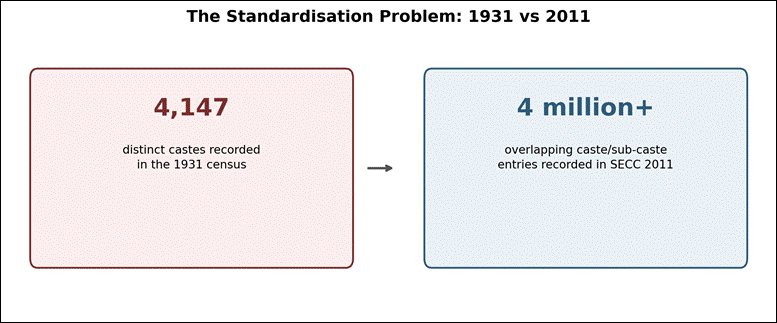
Figure: How the standardisation problem exploded between 1931 and 2011
States step in: Bihar and beyond
With the national census delayed after 2021 (largely due to the Covid-19 pandemic) and no fresh national caste data forthcoming, several states took matters into their own hands. Bihar’s caste-based survey of 2022–23 was the most consequential of these. Conducted in two phases a house-listing exercise followed by detailed caste and economic enumeration involving more than 300,000 enumerators asking seventeen questions of every household it found that Bihar’s population exceeded 130 million, and that OBCs and Extremely Backward Classes (EBCs) together made up roughly 63 per cent of the state. Within days of the results being published in October 2023, the Nitish Kumar government moved to raise reservation for SCs, STs, OBCs and EBCs from 50 per cent to 75 per cent a move that the Patna High Court subsequently struck down in June 2024 for breaching the Supreme Court’s 50 per cent ceiling on reservations, a ruling the state government has appealed. Karnataka, Telangana and Odisha have since conducted their own surveys with varying degrees of completeness and controversy, each illustrating both the political appeal and the administrative difficulty of caste enumeration at scale.
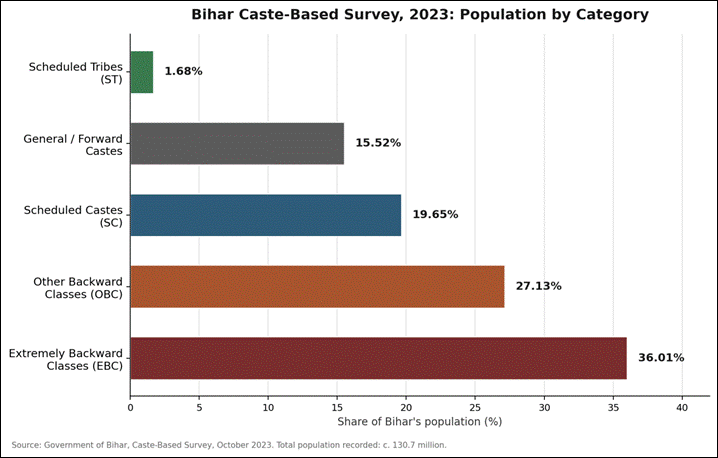
Figure: Bihar’s 2023 caste survey findings, by population share
The Road to Census 2026–27
The April 2025 Reversal
The national picture shifted decisively on 30 April 2025, when the Cabinet Committee on Political Affairs approved the inclusion of caste enumeration in the forthcoming census a move many commentators noted was a striking reversal for a government that had, for years, resisted the idea. As recently as 2021, the Centre had told Parliament it had no plans to count caste, and in the run-up to the 2024 general election, the Prime Minister had dismissed opposition demands for a caste census, framing India’s meaningful divisions instead around women, youth, farmers and the poor. By 2025, with Bihar’s assembly election approaching and opposition parties making social justice and caste data a central campaign theme, the government’s position had changed.
Mechanics of Historic Exercise
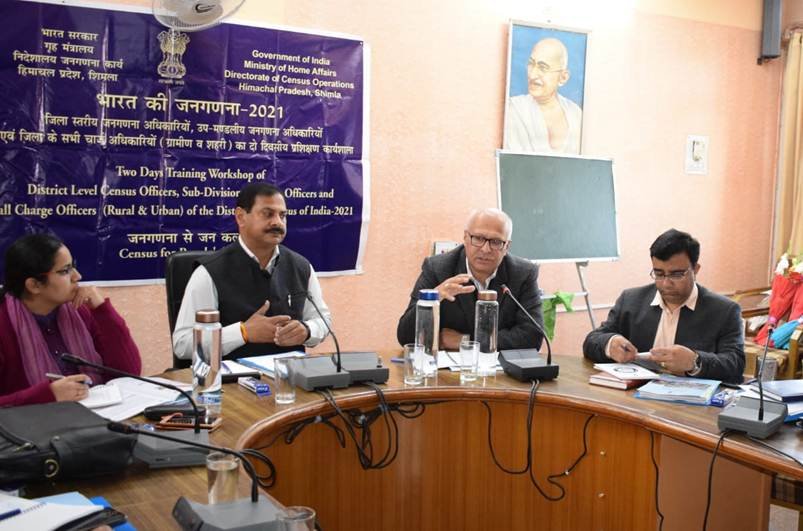
The mechanics of the census that followed are genuinely historic in scale. The Registrar General of India set 1 March 2027 as the reference date for most of the country, with an earlier reference date of 1 October 2026 for Ladakh and the snow-bound, non-synchronous regions of Jammu and Kashmir, Himachal Pradesh and Uttarakhand, where enumeration begins earlier due to seasonal access. The exercise is being run in two phases house-listing followed by population enumeration and will, for the first time in the Indian census’s history, be conducted digitally, with citizens reportedly able to self-enumerate online as well as through field enumerators. It is estimated to cost in the region is $1.24 billion (roughly £980 million) and to involve more than three million officials working across a full year.
The Pilot Survey and Legal Challenges So Far
A fifteen-day pilot survey was run nationwide ahead of the main exercise specifically to test how caste-related questions would function in practice, an acknowledgement, officials say, of the standardisation problems that sank the SECC 2011 data. The final questionnaire is being refined on the back of that pilot, and training materials are being prepared in 19 languages for the enormous enumerator workforce. Legal challenges to the exercise have already reached the Supreme Court: in early 2026 the Court declined to entertain a petition questioning the procedure for recording and verifying caste data, and in April 2026 it dismissed a further plea seeking to halt the caste census altogether, allowing preparations to continue.
The Case For a Caste Census
Supporters of caste enumeration a coalition spanning much of the political opposition, many social justice movements, and, as of 2025, the ruling BJP itself make several distinct arguments.
Evidence-based policy, at last
The single most repeated argument is also the simplest: India’s reservation policy, one of the largest affirmative-action systems in the world, is currently calibrated using data that is close to a century old. The 27 per cent OBC quota implemented in 1990 rests on the 1931 colonial estimate that OBCs made up roughly 52 per cent of the population. Proponents argue it is simply unsound governance to allocate quotas, welfare schemes and development funding using a population snapshot from before independence, before partition, and before India’s population grew nearly fivefold. A fresh, accurate count, they argue, would allow reservation percentages, scholarship allocations and scheme targeting to be recalibrated to reflect today’s demographic reality rather than yesterday’s guesswork.
A constitutional argument
Advocates also point to the Constitution itself. Articles 15 and 16 permit the state to make special provisions for the advancement of socially and educationally backward classes, and the Supreme Court has, in several judgments, stressed that such provisions must rest on demonstrable, quantifiable evidence rather than assumption. On this reading, a caste census is not simply useful but arguably necessary to place affirmative action policy on solid constitutional footing, turning what has often been treated as a political demand into an evidentiary requirement.
Visibility for the genuinely disadvantaged
A further argument concerns internal inequality within the broad OBC category itself. Critics of the current system, including the Rohini Commission, set up in 2017 to examine OBC sub-categorisation have long argued that a small number of politically dominant and relatively better-off OBC communities capture a disproportionate share of the reservation benefits, while hundreds of smaller, more marginalised OBC groups see little advantage. Detailed caste data, broken down to the sub-caste level, is seen by many social scientists as the only realistic way to identify these disparities and design more precisely targeted policy sub-categorising OBCs into more and less backward tiers, rather than treating nearly half the population as a single undifferentiated bloc.
The Bihar precedent
Supporters also point to Bihar’s 2023 survey as proof of concept: within days of the data being published, the state government used it to justify a (subsequently contested) increase in reservation quotas, demonstrating that caste data can translate rapidly into policy change when the political will exists. For proponents, the lesson of Bihar is not that the exercise was chaotic or ultimately capped by the courts, but that accurate data can move genuinely stalled political conversations forward.
Ending decades of political stalemate
There is also a subtler, more procedural argument in favour of the census: that the absence of data has itself become a political weapon, allowing governments of every stripe to avoid difficult redistributive questions simply by pointing to the lack of evidence. As long as nobody can say with confidence how large or how disadvantaged any given caste group factually is today, arguments about reservation, representation and resource allocation remain permanently unresolvable, fought instead through anecdote, assertion and competing state-level surveys of uneven quality. A credible national count, in this view, would not settle every argument, but it would at least force those arguments to be conducted on a shared factual footing, rather than each side simply asserting its own numbers.
The Case Against or the Concerns Raised
The opposing case is not simply reflexive resistance; it draws on genuine administrative, constitutional and sociological concerns that deserve equally serious treatment.
Fears of entrenching, not eroding, caste identity
The most philosophically significant objection dates to Nehru’s original 1951 decision: that officially counting and naming thousands of caste groups risks calcifying an identity that many hoped would gradually diminish in significance. The Rashtriya Swayamsevak Sangh (RSS) and sections of the BJP have historically articulated this concern in terms of Hindu unity the worry that formal caste enumeration undercuts a broader vision of a unified Hindu identity by giving official, permanent shape to internal hierarchies and divisions. Even setting aside that pinpointed ideological framing, plenty of secular commentators share a version of the same worry: that a state-sanctioned caste registry could make caste identity more, not less, salient in everyday political and social life.
The risk of political weaponisation
Because caste is so deeply entangled with electoral arithmetic in India, critics worry that the census could become less a neutral statistical exercise and more a tool for mobilising vote banks. This is not merely a hypothetical concern: political parties across the spectrum have already sparred over whose numbers might rise or fall, which sub-castes might be added to which lists, and how state-level surveys have allegedly favoured specific communities. In Karnataka, for instance, some caste groups have publicly alleged undercounting in the state’s survey, while others have disputed how they were categorised disputes that illustrate how quickly caste data can become a live political battleground rather than a settled administrative fact.
The standardisation problem
This is, in many ways, the most technically serious objection, and the one that sank SECC 2011. Caste and sub-caste identity in India is not governed by any single, agreed master list. People self-report enormously varied names for what may, in social science terms, be the same or overlapping communities; regional spelling variants, occupational sub-groups, and locally specific titles all complicate the picture. SECC 2011 produced well over four million distinct entries, an outcome widely seen as unusable. Officials have acknowledged that the 2026–27 pilot survey again highlighted the challenge of standardising thousands of self-reported caste descriptions into a workable national database, and it remains to be seen whether the final questionnaire design solves a problem that has defeated every previous attempt.
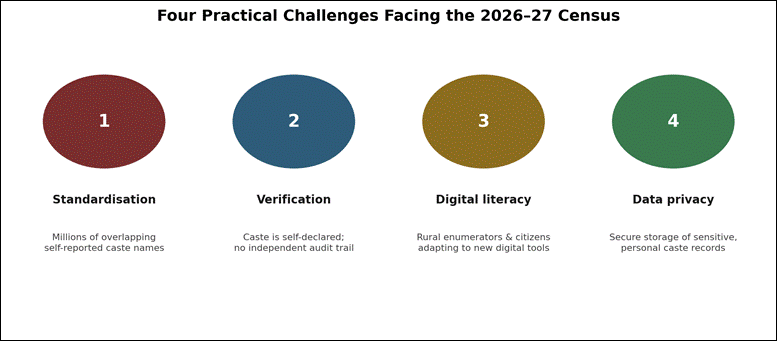
Figure: Four practical challenges the census must overcome
Pressure on the 50 per cent reservation ceiling
Critics also worry about the downstream legal and political consequences. If new data shows, as Bihar’s survey did, that backward-class communities constitute a substantially larger share of the population than reservation policy currently assumes, there will be intense pressure to raise quotas beyond the 50 per cent ceiling set by the Supreme Court in the 1992 Indra Sawhney judgment pressure that, in Bihar’s case, has already led to a reservation law being struck down by the High Court for breaching that limit. Sceptics argue that generating this kind of political pressure without a clear plan for how the courts or Parliament might respond risks years of litigation and uncertainty rather than swift policy improvement.
Privacy and social stigma
There are also more individual-level concerns: about how caste data will be stored and secured, in an era when government databases have not always proven leak-proof; about whether officially declaring caste on record could expose individuals to discrimination or stigma they might otherwise be able to leave behind by moving cities or changing occupations; and about whether communities historically associated with untouchability might face renewed social labelling rather than the intended empowerment.
Political Dimensions
It would be incomplete, and somewhat naïve, to describe the caste census purely as a technical exercise, because its political journey has been anything but neutral.
Opposition Pressure and the BJP’s Earlier Dismissal
For years, the Congress party and a broad alliance of regional and opposition parties including the Samajwadi Party, the Rashtriya Janata Dal, the DMK, and others pushed hard for a national caste census, framing it as central to their social justice platform ahead of the 2024 general election. The BJP, by contrast, spent that campaign dismissing the demand, with the Prime Minister at one point characterising it as a symptom of “urban Naxal” thinking, and suggesting that India’s meaningful social categories were women, youth, farmers and the poor rather than caste groups.
A Calculated Reversal
The reversal that followed in April 2025 was, by most independent accounts, driven substantially by political calculation as much as principle. With the Bihar state election looming later that year, and with opposition parties having made caste data a signature demand, the government’s decision to embrace the caste census allowed it to take ownership of an issue it had previously opposed, while attempting to shape its framing and implementation on its own terms rather than the opposition’s. Congress leaders, for their part, have continued to press the government on timelines, transparency and methodology, arguing that announcing the census is merely a first step and that genuine commitment will be judged by how faithfully the data is collected, released and acted upon.
A Contested Picture at State Level
At state level, the picture is similarly contested. Bihar’s survey and its aftermath became a template both for what caste data can achieve politically and for its legal limits. In Karnataka, the ruling Congress government’s caste survey has drawn BJP accusations of manipulation for electoral gain, including claims that new castes were added to benefit specific communities, allegations the state government disputes. Uttar Pradesh’s BJP government, by contrast, has explicitly ruled out conducting its own state-level caste survey, arguing that census-taking is a central government responsibility, a position opposition parties in the state have criticised as evasive.
What is reasonably clear, whatever one’s view of the various parties’ motives, is that no major political formation in India today argues against caste data collection in principle. The debate has shifted from whether a caste census should happen to how it will be conducted, how quickly, and crucially what will be done with the results once they exist.
Economic and Welfare Implications
Beyond the immediate reservation debate, caste data has broader implications for how India targets welfare spending and public services.
Sharper Welfare Targeting
Government officials involved in the exercise argued that accurate caste data combined with the census’s socio-economic and housing information will allow far more precise targeting of welfare schemes, from housing assistance under programmes like PM Awas Yojana to scholarships, skill-development schemes and health interventions. NITI Aayog data cited in recent reporting suggests that fewer than 60 per cent of eligible citizens currently hold valid caste certificates, a gap that weakens both the inclusiveness and the accountability of existing welfare delivery a problem better data collection is intended, at least in principle, to help close.
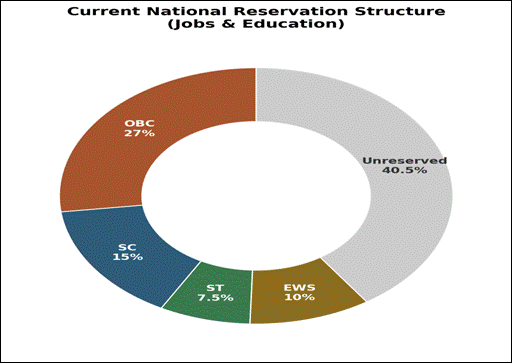
Figure: How the current national reservation structure is divided
The Private-Sector Reservation Question
There is also a live economic-policy question sitting alongside the reservation debate: demands, particularly from some backward-class organisations, for private-sector reservation, an idea that remains far more contested than public-sector quotas and one that fresh caste data would inevitably feed into, whatever government ultimately decides. Business groups have historically resisted mandatory private-sector quotas, arguing they would constrain hiring flexibility and competitiveness, while proponents argue that with the private sector now employing a far larger share of India’s workforce than in 1990, excluding it from affirmative-action conversations leaves a significant gap in the overall picture of opportunity.
The Delimitation Question
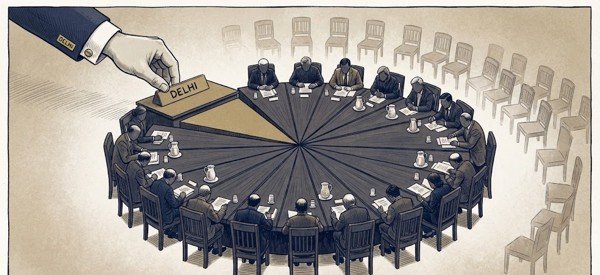
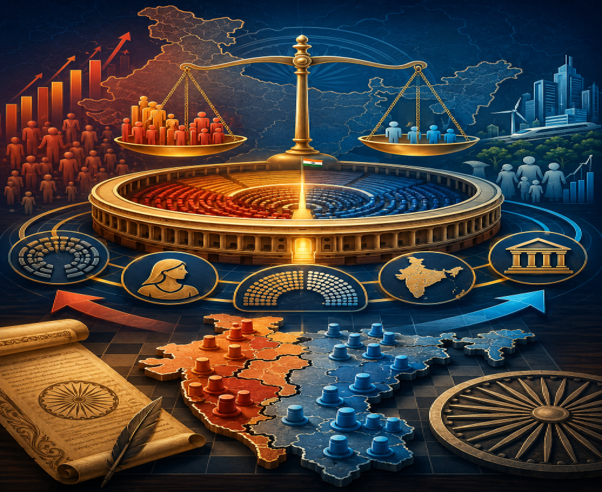
Finally, there is the delimitation question the redrawing of parliamentary and assembly constituencies which is constitutionally tied to the first census conducted after 2026. Because Lok Sabha and assembly seat numbers have been frozen since the 1970s pending a population-based recalibration, the 2027 census carries implications well beyond caste policy: it will eventually feed into decisions about how political representation itself is distributed across states, a process not expected to conclude until closer to 2029–30, once final data is available.
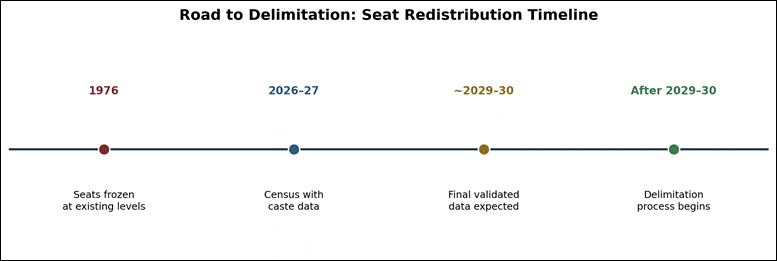
Figure: The road to electoral delimitation
Legal and Judicial Angle
The judiciary sits at the centre of almost every practical consequence of the caste census, and understanding its role requires going back to 1992.
Indra Sawhney and the 50 Per Cent Ceiling
In Indra Sawhney v. Union of India, a nine-judge bench of the Supreme Court upheld the broad principle of caste-based reservation for OBCs while imposing a 50 per cent ceiling on total reservations in government jobs and educational institutions, permitting exceptions only in genuinely extraordinary circumstances. The judgment also introduced the “creamy layer” concept, excluding better-off members of OBC communities from reservation benefits, and ruled that reservation in promotions was not permissible under the framework it established (a position later modified by constitutional amendment for SCs and STs).
A Ceiling Under Growing Strain
That 50 per cent ceiling has proven remarkably durable, but also increasingly contested. States including Tamil Nadu (with a long-standing 69 per cent reservation regime that predates and has survived various challenges under special constitutional protection) and, more recently, Karnataka and Bihar have pushed against the limit, arguing that changed social realities justify going beyond it. Bihar’s 2023 attempt to raise reservations to 75 per cent, based directly on its caste survey findings, was struck down by the Patna High Court in June 2024 precisely because it breached the Indra Sawhney ceiling; the state government has appealed to the Supreme Court, and legal commentators have suggested this could become the vehicle for the Court to revisit the 50 per cent cap directly something a five-judge bench indicated willingness to examine as far back as 2021, in the context of Maharashtra’s Maratha reservation law, which was ultimately struck down in 2021 for exceeding the ceiling without exceptional justification.
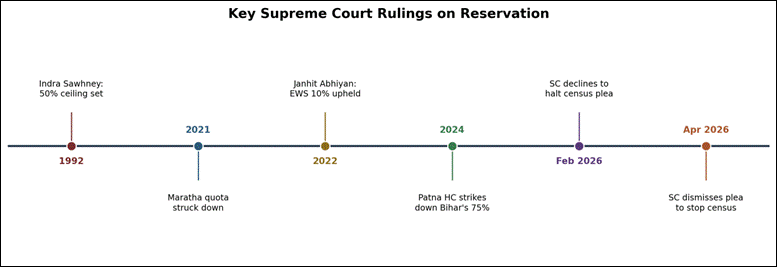
Figure: Key Supreme Court rulings shaping the reservation debate
The Tension the Census Walks Into
This is the legal tension the national caste census walks straight into. If the 2027 data shows, as Bihar’s survey did at state level, that OBC and other backward-class populations are considerably larger than the assumptions underpinning current quotas, the political pressure to breach the 50 per cent ceiling nationally will intensify sharply placing the Supreme Court in the position of having to decide, with much higher stakes than in any single state case, whether Indra Sawhney’s core limit still holds. Alongside this sits the unresolved question of OBC sub-categorisation recommended by the Rohini Commission and demands from some quarters for a two-tier reservation system within the SC category itself, both of which fresh, granular caste data would directly inform. On the procedural side, the Supreme Court has so far declined to intervene to halt or reshape the census, dismissing challenges to its methodology and to the exercise itself in rulings handed down in February and April 2026, effectively allowing the government’s process to proceed while leaving the larger constitutional questions for another day, most likely once the actual data exists.
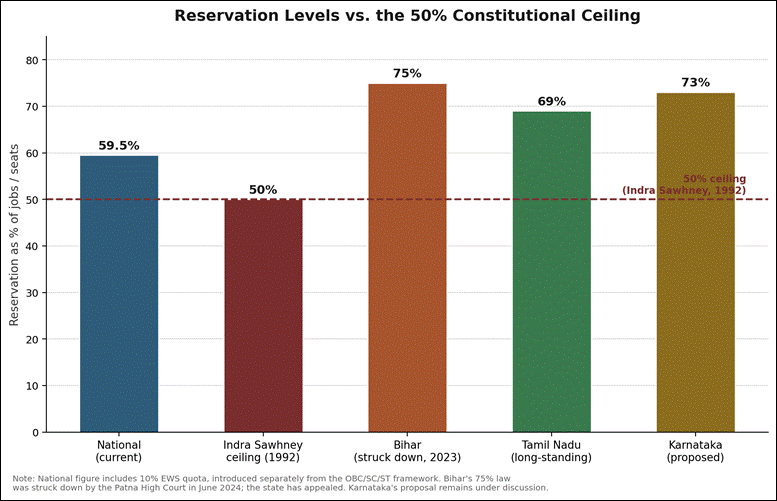
Figure: State and national reservation levels against the 50% constitutional ceiling
Global Comparisons
India is not alone in grappling with how, or whether, to count identity categories that carry deep social and political weight, though its caste system, rooted in a distinct social and religious history, has no exact international parallel.
The UK, the US and South Africa
The United Kingdom’s own census asks about ethnicity in considerable detail, alongside religion, and that data directly informs equality monitoring, resource allocation and anti-discrimination policy, without generating anything like the same intensity of controversy that caste enumeration provokes in India, a difference often attributed to the far smaller number of categories involved and to ethnicity’s different relationship to economic opportunity in British society. The United States has collected racial and ethnic data in its census since the country’s founding, and that data underpins the entire architecture of American civil rights law and affirmative action policy, though it remains a recurrent subject of political and legal contest of its own, including recent Supreme Court rulings curbing race-conscious university admissions. South Africa, meanwhile, continues to collect racial classification data inherited in modified form from the apartheid era, explicitly in order to measure and redress the economic legacy of that system through its Black Economic Empowerment framework perhaps the closest global parallel to India’s use of caste data to calibrate affirmative action, notwithstanding the very different histories involved.
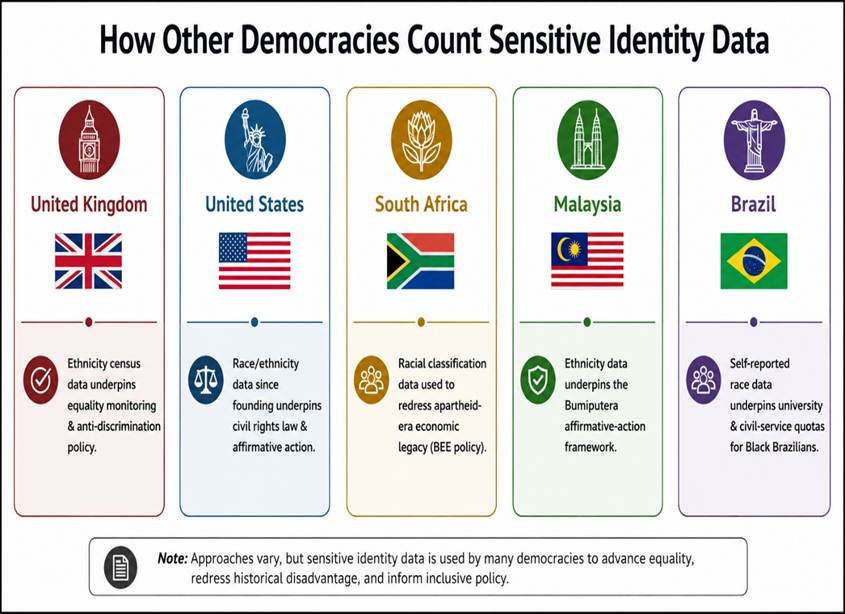
Figure: How five democracies use sensitive identity data
Malaysia and Brazil
Malaysia offers a further, instructive comparison: its census and subsequent economic policy have long tracked ethnicity (Malay, Chinese, Indian and others) explicitly to underpin the Bumiputera affirmative-action framework, a system that has proven durable in policy terms but has also been criticised, much as some critics criticise Indian reservation policy, for benefiting better-off members of favoured groups disproportionately, and for calcifying ethnic categories that might otherwise have blurred with time. Brazil, too, has increasingly used self-reported racial categories in its census to underpin university and civil-service quotas for Black and mixed-race Brazilians, a policy that has expanded steadily since the mid-2000s despite ongoing debate over how race should be defined and verified in a society with a long history of more fluid racial self-identification than either the United States or India.
What Comparisons Suggest
What these comparisons suggest, cautiously, is that officially counting sensitive social categories is neither unusual nor inherently destabilising in itself; countries as different as Britain, the United States, South Africa, Malaysia and Brazil have all built consequential policy on such data, with mixed but rarely catastrophic results. What matters far more, across every one of these examples, is the transparency of the methodology, the credibility of the resulting data, and the clarity of purpose to which it is subsequently put the difference, in other words, between data used to correct disadvantage and data that becomes an end in itself. India’s particular challenge is one of sheer scale and complexity: no other democracy is attempting to classify a population of 1.4 billion people against a caste system comprising thousands of communities with no single agreed taxonomy, using a colonial-era enumeration method that was never designed with today’s mobile, urbanising, intermarrying population in mind.
Voices From the Ground
Behind the political and legal debate are perspectives that rarely make it into policy documents.
Long-Overdue Recognition
Many Dalit and OBC activists have welcomed the census as long overdue recognition, arguing that decades of policy have been built on guesswork precisely because there has been no political appetite to generate the evidence that might force uncomfortable redistribution. For these voices, the absence of caste data has itself been a form of policy neglect a way of avoiding difficult questions about who actually holds power and resources in Indian society.
A Scholarly Note of Caution
Some social scientists and historians, while broadly supportive of the exercise, have urged caution about how the results are interpreted, pointing out that raw population percentages tell only part of the story. Scholars studying the history of caste counting have argued that any credible census should try to capture not just numbers but also relative social and economic power noting that caste disadvantage in India is expressed as much through wealth, land ownership, and access to institutions as through population share alone, and that a headcount which measures only the former without any sense of the latter risks producing a partial picture.
Mixed Reactions on the Ground
Meanwhile, ordinary citizens’ reactions, as reflected across news coverage of the pilot surveys and state exercises, have ranged from genuine hope that accurate data might finally direct welfare resources more fairly, to scepticism that yet another data-collection exercise will translate into real change, to quieter unease particularly among some upper-caste and mixed-heritage families about how caste declarations might be used, recorded and potentially held against them or their children in future.
A Generational Divide
There is also a generational dimension to this that rarely features prominently in political debate. Younger, urban Indians, particularly those from inter-caste marriages, or those who have spent their lives in cities far from their families’ ancestral communities, sometimes report genuine uncertainty about how to answer a caste question at all, having grown up with caste as a background fact of extended family history rather than a lived, daily marker of identity. For this group, the census threatens to force a kind of specificity that their own lives have not required for a generation, which is precisely the tension at the heart of the wider debate: caste has plainly not disappeared as a determinant of opportunity in India, and the data will likely prove that conclusively, even as it becomes markedly less central to the everyday self-understanding of a growing, if still limited, section of Indian society.
Challenges in Implementation
Even setting aside the political and legal debates, the practical challenge of conducting this census is formidable.
The Sheer Logistics of Enumerating 1.4 billion People
Enumerating 1.4 billion people digitally, for the first time in the census’s history, requires an enormous logistical apparatus: more than three million officials, training manuals prepared in nineteen languages, updated household databases, and digital mapping to guide field operations across some of the world’s most geographically and linguistically diverse terrain, from Himalayan villages accessible only before the winter snows to dense urban slums undergoing constant flux. Officials have staggered the reference dates specifically to accommodate seasonal access constraints in Ladakh, Jammu and Kashmir, Himachal Pradesh and Uttarakhand.
Standardisation, Once Again
There is the standardisation challenge already discussed the risk that caste self-reporting will again generate millions of overlapping, inconsistent entries unless the final questionnaire, enumerator training and back-end classification systems are markedly better designed than those used in SECC 2011. Officials have indicated that the pilot survey was run explicitly to stress-test this problem, though whether the lessons learned will be sufficient at national scale, across every regional language and dialect, remains to be seen.
Verification and the Long Timeline
Verification presents its own difficulties: unlike literacy or age, caste is essentially self-declared, and there is no straightforward way to independently audit a household’s response, raising the possibility of both under- and over-reporting driven by strategic considerations around reservation eligibility. And the sheer duration of the exercise a full year of fieldwork, followed by a further two to three years before a final, validated report is expected around 2029–30 means that whatever political conversation the census sparks in 2026–27 will likely still be unresolved by the time hard numbers finally arrive.
What Happens After the Data Comes In?
Assuming the exercise is completed and the data eventually published itself is not guaranteed, given SECC 2011’s fate several consequences seem likely to follow, though their precise shape remains genuinely uncertain.
Renewed Pressure on Reservation and Sub-Categorisation
The most immediate is a renewed, evidence-backed push to revisit reservation percentages, both at state and central level, very possibly reigniting the constitutional argument over the Indra Sawhney 50 per cent ceiling that Bihar’s case has already brought to the doorstep of the Supreme Court. Sub-categorisation of OBCs along the lines proposed by the Rohini Commission becomes far more feasible with granular data, potentially reshaping how the existing 27 per cent quota is distributed among hundreds of different communities rather than treated as a single bloc. Welfare scheme design, particularly in housing, education and health, is likely to be recalibrated using the new socio-economic and caste cross-tabulations, at least in principle improving targeting accuracy.
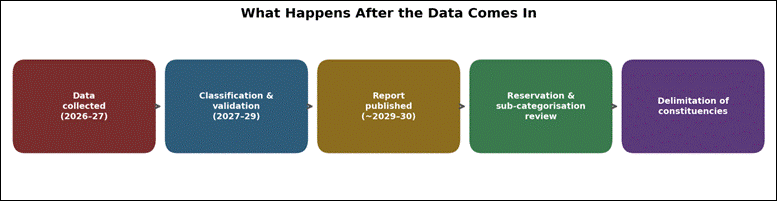
Figure: From data collection to political consequence
A Slow-Unfolding Political Consequence
Longer term, the data will also feed into delimitation the redrawing of electoral constituencies a process tied by constitutional convention to the first census after 2026 and not expected to conclude until around 2029–30, meaning the caste census’s full political consequences will likely unfold gradually over the remainder of this decade rather than arriving all at once. Whether all of this ultimately advances social justice, as its supporters hope, or instead entrenches caste as an even more central axis of Indian political life, as some critics fear, is a question this article cannot answer in advance only history will settle it, much as it eventually settled the arguments over the last caste census, taken under an entirely different government, in an entirely different India, ninety-five years ago.
Conclusion
The caste census due to conclude by 2027 is, in one sense, simply an administrative exercise a set of questions added to a very long form. In another sense, it is one of the more consequential governance decisions India has taken this decade: an attempt to replace nine decades of guesswork with contemporary evidence, in a country where that evidence directly shapes who gets a government job, a university place, a welfare cheque, or a parliamentary seat.
Its supporters are right that no modern state should be calibrating major policy on data collected before its own independence. Its critics are right that naming and counting caste carries real risks of political exploitation, of administrative chaos, of hardening identities that many Indians would rather see fade. Both things can be true at once, and the honest answer, at this stage, is that nobody yet knows how this particular chapter ends. What can be said with more confidence is that India has chosen, after a century of avoidance, to find out and the numbers that emerge, whenever they finally do, are likely to shape the country’s politics, its courts and its welfare state for a generation to come. Its to be seen, however, how it transforms India on the ground. It should not remain an academic exercise. Wait and Watch!
Bibliography
Government and official sources
Press Information Bureau, Government of India (2025) Cabinet approves Caste enumeration in the upcoming Census, 30 April. Available at: https://www.pib.gov.in/PressReleasePage.aspx?PRID=2125526
Press Information Bureau, Government of India (2025) Cabinet approves scheme of Conduct of Census of India 2027. Available at: https://www.pib.gov.in/PressReleasePage.aspx?PRID=2202983®=3&lang=1
Prime Minister’s Office, Government of India (2025) Cabinet approves Caste enumeration in the upcoming Census, 30 April. Available at: https://www.pmindia.gov.in/en/news_updates/cabinet-approves-caste-enumeration-in-the-upcoming-census/
Press Information Bureau, Government of India (2023) Recommendations for Equitable Reservation Benefits: OBC Sub-Categorisation Report Delivered to President. Available at: https://www.pib.gov.in/PressReleaseIframePage.aspx?PRID=1944515
Doordarshan News (2025) Govt decides to include caste enumeration in forthcoming census exercise, 30 April. Available at: https://newsonair.gov.in/govt-decides-to-include-caste-enumeration-in-forthcoming-census-exercise
Doordarshan News (2026) Supreme Court dismisses plea against caste enumeration in Census, 20 May. Available at: https://www.newsonair.gov.in/supreme-court-dismisses-plea-against-caste-enumeration-in-census/
Doordarshan News (2026) Supreme Court dismisses plea seeking direction to Centre to stop caste Census, 10 April. Available at: https://www.newsonair.gov.in/supreme-court-dismisses-plea-seeking-direction-to-centre-to-stop-caste-census
Doordarshan News (2024) Patna High Court scraps Bihar govt’s decision of increasing reservation for backward classes from 50 to 65%, 20 June. Available at: https://www.newsonair.gov.in/patna-high-court-strikes-down-bihars-65-reservation-quota-hike
Doordarshan News (2024) SC refuses to stay Patna High Court order scrapping 65% caste-based reservation, 29 July. Available at: https://www.newsonair.gov.in/sc-refuses-to-stay-patna-high-court-order-scrapping-65-caste-based-reservation
Indian Kanoon (1992) Indra Sawhney Etc. Etc vs Union Of India And Others, Etc. Etc., 16 November. Available at: https://indiankanoon.org/doc/1363234/
News and analysis — national census (2025–2026)
Deccan Herald (2025) ‘Census to count caste for 1st time since 1931’, 30 April. Available at: https://www.deccanherald.com/india/census-to-count-caste-for-1st-time-since-1931-3519519
Deccan Herald (2025) ‘Census to be done in two phases between April 2026 and February 2027, questionnaire being finalised: Govt’, 2 December. Available at: https://www.deccanherald.com/india/census-to-be-done-in-two-phases-between-april-2026-and-february-2027-questionnaire-being-finalised-govt-3817118
Wikipedia (2026) Caste census. Available at: https://en.wikipedia.org/wiki/Caste_census
Study IQ (2025) ‘Cabinet Approves Caste Enumeration in the Upcoming Census’, 1 May. Available at: https://www.studyiq.com/articles/cabinet-approves-caste-enumeration-in-the-upcoming-census/
IAS Gyan (2025) ‘About Cabinet Approves Caste Census 2025: UPSC Current Affairs’. Available at: https://www.iasgyan.in/daily-current-affairs/caste-census-24
Construction World (2025) ‘Cabinet Approves Caste Enumeration in Upcoming Census’, 5 May. Available at: https://www.constructionworld.in/policy-updates-and-economic-news/cabinet-approves-caste-enumeration-in-upcoming-census/73006
LiveLaw (2026) ‘Supreme Court Dismisses Plea To Stop Caste Census, Questions “Badtameezi Ki Language” In Petition’, 10 April. Available at: https://www.livelaw.in/top-stories/supreme-court-dismisses-plea-to-stop-caste-census-questions-badtameezi-ki-language-in-petition-529812
The Federal (2026) ‘SC dismisses plea against caste enumeration in Census, says govt needs data for welfare’, 20 May. Available at: https://thefederal.com/category/news/supreme-court-dismisses-plea-against-caste-enumeration-census-243818
Daily Pioneer (2026) ‘Supreme Court dismisses plea against caste enumeration in Census’. Available at: https://dailypioneer.com/news/supreme-court-dismisses-plea-against-caste-enumeration-in-census
Bihar caste survey, 2022–23
Wikipedia (2023) 2022 Bihar Caste-Based Survey. Available at: https://en.wikipedia.org/wiki/2022_Bihar_Caste-Based_Survey
ETV Bharat (2023) ‘Bihar caste survey released: OBCs, EBCs comprise more than 63% of state’s population’, 2 October. Available at: https://www.etvbharat.com/english/state/bihar/bihar-caste-survey-released-ebc-obc/na20231002153757886886271
Onmanorama (2023) ‘Bihar caste census reveals OBC, EBC comprise 63% of state’s population’, 2 October. Available at: https://www.onmanorama.com/news/india/2023/10/02/bihar-caste-census-reveals-obc-ebc-comprise-majority-total-population.html
Deccan Herald (2023) ‘Caste survey in Bihar: OBCs, EBCs make up 63.13% of population; Gen Category 15.52%’, 2 October. Available at: https://www.deccanherald.com/india/bihar/bihar-releases-caste-census-details-here-2709070
Study IQ (2025) ‘Bihar Caste Census Report 2023, Caste Wise Population, Survey PDF’. Available at: https://www.studyiq.com/articles/bihar-caste-census-report/
Careers360 / Press Trust of India (2023) ‘Bihar Caste Survey Report: 6.11% are graduates, 15% cleared Class 10’, 8 November. Available at: https://news.careers360.com/bihar-caste-survey-report-6-11-percent-are-graduates-15-cleared-class-10
Bihar reservation law and litigation
Wikipedia (2024) Reservation policy in Bihar. Available at: https://en.wikipedia.org/wiki/Reservation_policy_in_Bihar
Careers360 (2024) ‘Patna HC strikes down Bihar laws increasing reservation for SC, ST, OBC to 65%’, 20 June. Available at: https://news.careers360.com/patna-hc-strikes-down-bihar-laws-increasing-reservation-for-sc-st-obc-65
The Tribune (2024) ‘Patna High Court strikes down Bihar’s 50 per cent to 65 per cent quota hike’, 20 June. Available at: https://www.tribuneindia.com/news/india/patna-high-court-strikes-down-bihars-50-to-65-per-cent-quota-hike-632549
OpIndia (2024) ‘SC refuses interim stay on Patna HC’s ruling striking down Bihar government’s 65% reservation law’, 29 July. Available at: https://www.opindia.com/2024/07/sc-refuses-interim-stay-on-patna-hc-judgement-that-struck-down-bihar-govt-law-increasing-reservations-to-65/
India TV (2024) ‘Bihar govt moves SC against Patna High Court order quashing 65 per cent reservation law’, 3 July. Available at: https://www.indiatvnews.com/news/india/bihar-government-moves-supreme-court-against-patna-high-court-order-quashing-65-per-cent-reservation-law-2024-07-03-940051
Business Standard (2024) ‘Bihar reservation case: SC refuses to stay Patna High Court’s order scrapping 65% reservation’, 29 July. Available at: https://www.business-standard.com/india-news/bihar-reservation-case-sc-refuses-to-stay-patna-high-court-s-order-scrapping-65-reservation-124072900387_1.html
Deccan Herald (2025) ‘Supreme Court issues notice to Bihar govt on pleas challenging Patna HC order on caste survey’. Available at: https://www.deccanherald.com/amp/story/india%2Fsupreme-court-issues-notice-to-bihar-govt-on-pleas-challenging-patna-hc-order-on-caste-survey-2715407.html
Indra Sawhney and reservation law
Deb, S. and Dharani, P. (2024) ‘Indra Sawhney v. Union of India and Ors. (1992): case analysis’, iPleaders Blog, 19 May. Available at: https://blog.ipleaders.in/indra-sawhney-v-union-of-india-and-ors-1992-case-analysis/
Supreme Court Observer (2023) ‘Do Reservations Have to be Below 50%? From Balaji (1962) to Indra Sawhney (1992)’, 9 October. Available at: https://www.scobserver.in/journal/do-reservations-have-to-be-below-50-from-balaji-1962-to-indra-sawhney-1992/
Supreme Court Observer (2023) ‘Does The 50% Limit on Reservations in Indra Sawhney Hold Good? (Part II)’, 9 October. Available at: https://www.scobserver.in/journal/does-the-50-limit-on-reservations-in-indra-sawhney-hold-good-part-ii/
Lawctopus (2025) ‘Detailed Case Analysis: Indira Sawhney v. Union of India’, 21 March. Available at: https://www.lawctopus.com/clatalogue/clat-pg/indira-sawhney-v-union-of-india/
Study IQ (2024) ‘Indra Sawhney Case Analysis, SC Judgements, Summary’, 22 October. Available at: https://www.studyiq.com/articles/indra-sawhney-case/
Dhyeya Law (n.d.) ‘Case: Indra Sawhney v Union of India and Ors. (1992)’. Available at: https://www.dhyeyalaw.in/indra-sawhney-v-union-of-india-1992
Hindustan Times (2021) ‘SC to revisit 50% cap on reservation’, 9 March, via PressReader. Available at: https://www.pressreader.com/india/hindustan-times-east-up/20210309/281479279160492
Deccan Herald (2025) ‘Reservation scrum’ (editorial on Tamil Nadu/Karnataka reservation ceilings). Available at: https://www.deccanherald.com/opinion/editorial/reservation-scrum-2501540
Rohini Commission and OBC sub-categorisation
ThePrint (2025) ‘Rohini Commission report on OBC sub-categorisation in cold storage as SC gives nod to SC/ST sub-quota’, 3 March. Available at: https://theprint.in/india/governance/rohini-commission-report-on-obc-sub-categorisation-in-cold-storage-as-sc-gives-nod-to-sc-st-sub-quota/2202938/
Vajiram & Ravi (2025) ‘Sub-Categorisation of OBCs – G Rohini Commission’, 21 April. Available at: https://vajiramandravi.com/current-affairs/sub-categorisation-of-obcs-g-rohini-commission/
Business Standard (2023) ‘Rohini Commission decoded: Understanding sub-categorisation of OBCs’, 26 October. Available at: https://www.business-standard.com/india-news/rohini-commission-decoded-understanding-sub-categorisation-of-obcs-123102600760_1.html
Manorama Yearbook (2023) ‘Rohini Commission for sub-categorisation of OBCs submits report to President’, 1 August. Available at: https://www.manoramayearbook.in/current-affairs/india/2023/08/01/rohini-commission-upsc.html
Deccan Herald (2025) ‘The caste conundrum in OBC sub-quotas’. Available at: https://www.deccanherald.com/india/the-caste-conundrum-in-obc-sub-quotas-2678805
General note on sourcing
Historical material on the 1881–1931 colonial censuses, the Mandal Commission (1980–1990), the SECC 2011, and international comparisons (UK, US, South Africa, Malaysia, Brazil) draws on a combination of the above government and news sources together with standard reference material on Indian constitutional and administrative history. Where population percentages or dates are disputed or approximate across sources (for example, the exact reservation percentage struck down in Bihar reported as both 65% under state law and 75% when combined with the separate 10% EWS quota), the article notes the figure most consistently reported by primary government and press sources at the time of writing.

Amir Khan
Amir Khan is a Delhi-based Public Policy Researcher, Political Consultant, and Educator. He holds a Postgraduate degree in Political Science and International Relations from Jamia Millia Islamia, New Delhi. He is currently associated with Bano IAS as an Editor & Content Creator (Magazine) and serves as the Secretary of HIMS Foundation, where he contributes to policy research, editorial development, governance-focused publications, and institutional initiatives. He has previously worked with Pehchaan The Street School, supporting education and social impact programmes.
His work primarily focuses on public policy, governance, electoral studies, constitutional affairs, public administration, and international relations. Through research-driven writing and policy analysis, he develops evidence-based content for Civil Services aspirants and public policy audiences.
His research and writing are grounded in credible sources, official reports, constitutional principles, and data-driven analysis, with an emphasis on presenting complex policy issues in a clear, objective, and accessible manner. He is committed to promoting informed public discourse through accurate, balanced, and well-researched policy content.