































The success of reform is not measured by how an organisation is rearranged, but by how much friction disappears from its decision-making, accountability and execution.
“The deck is polished. The logic is plausible.”
The Problem
The deck is polished. The logic is plausible.
Most boards have sat through some version of the same slide deck. A management team arrives with a redesigned org chart, a new set of titles, and a promise of flatter reporting lines and faster decisions. A phrase, “realignment,” “efficiency,” or “simplification,” does work that a more specific sentence should be doing. The deck is polished. The logic is plausible. And the board, lacking any real instrument for telling the difference, approves it. Directors rarely doubt the intelligence of such proposals. What they lack is a way to test whether the proposal touches the real problem, and that gap is where restructurings quietly fail.
Paperwork can’t tell you which one it is
This piece exists to answer one question. When a restructuring proposal reaches the board table, how does a director tell whether the structure actually changes the mechanism producing the company’s problem, or merely changes the appearance of the organization around a mechanism nobody has touched? The uncomfortable answer is that the deck itself cannot tell you. A genuine turnaround and a cosmetic reshuffle produce nearly identical paperwork. Something else has to do the diagnostic work the document cannot do on its own. That something else is a set of questions, asked in a specific order, before the vote.
We audit mechanisms, not motives
It is worth being precise about what those questions are checking for. The point is not to put a boardroom psychologist’s stethoscope to the CEO’s chest and diagnose avoidance, intent, or bad faith. A leadership team can fail every test below through ordinary analytical incompleteness, a chaotic market, or simple haste. Nobody has to be consciously dodging a hard conversation. Treating every failed test as evidence of bad faith would be unfair to management, and it would also be bad method, because motives are the one thing a board cannot observe from a document.
Call it mechanism matching
What a board can audit is narrower and more defensible. Does the proposed intervention operate on the same mechanism that produced the diagnosed problem? Or does it change boxes on a chart while the mechanism continues, untouched, underneath? Call it mechanism matching. “Strategic avoidance” remains one possible explanation for a failed audit, and sometimes it is the right one. But it is a conclusion the board reaches after the questions are answered. It is not the thing the audit is designed to detect, and it should never be the starting assumption in the boardroom.
Six tests, twelve cases
What follows is a six-part instrument, built to be run before a board approves a restructuring, not narrated afterward to explain why it worked or why it didn’t. I call it the Friction Telemetry Audit. I apply it first to three global restructurings: Meta’s 2022–2023 “Year of Efficiency,” Salesforce’s 2023 workforce reduction, and Microsoft’s cultural reset and reorganization beginning in 2014. Then I turn to India, where regulators’ orders, forensic audits, and court judgments make the public record unusually rich, and apply the same tests to five corporate failures, three boardroom disputes, and one major restructuring.
Why a failed test isn’t a failed company
The public record does not permit a complete six-test score for any case below. That is a finding about evidence, not a defect in the cases. The six tests are the author’s own proposal, the cases illustrate them without validating them, and a pass would not predict success. A diagnostic that only ever confirms itself is not a diagnostic. It is a mirror wearing a methodology’s clothes. Several cases satisfy the early tests and leave the later ones unanswerable. Where that happens, this piece says so, and scores the test as insufficient evidence instead of as failed. Absence of visible evidence is a limit on what an outsider can see. It is not proof that a board did nothing.
What outsiders can and can’t see
One honest limitation applies to every case. Evidence in the global cases comes from what each company said publicly, while a sitting board almost always has franker material: minutes, management presentations, the actual conversation in the room. The Indian cases differ in one useful way. Regulators and courts have published findings, forensic audits, and orders that expose some of that internal material. Even so, many of those findings are allegations and not adjudicated facts, and this piece labels them as such. The Audit is written for people with full access, not as a verdict from outside.
Five labels used in this piece
To keep the evidence honest, this piece uses five labels. Documented means an identified primary record, such as a filing, order, or judgment, supports the statement. Reported means a named outlet or company statement says so. Alleged means a complaint, investigation, or proceeding asserts it and no court has adjudicated it. Not established means the record the author reviewed is silent. Interpretation means the author’s reading of what the evidence implies for a test. Where a sentence might blur these, the sentence itself, not a general disclaimer, carries the qualification.
“The deck cannot tell you. Something else has to.”
The Instrument
How to read a result
Each test returns one of three results. Pass means the evidence supports the requirement, though not that the restructuring will succeed. Fail means the evidence contradicts it, for example a decision-rights matrix in which the same person keeps every approval. Insufficient evidence means the requirement cannot yet be judged, because the board lacks the documentation or the record is silent. That result is a prompt to obtain the evidence or accept the uncertainty openly. It is not a finding that the proposal is defective. The Instrument is an advisory protocol for board deliberation, not a statement of legal duty.
Test 1: Name the mechanism, in three levels
Test One: The Causal Diagnosis. This test has three levels, and a board should insist on reaching the third before approving anything. Level One is the condition: what changed, in the market or the business, that the company is responding to. Level Two is the mechanism: why did that condition produce this particular organizational outcome, and which internal decision process, incentive, or information gap let it happen or let it compound? Level Three, the one boards skip most often, is the intervention logic: why will this specific structural change alter the Level Two mechanism, rather than simply rearranging the org chart around it?
A cause, not a culprit
This is deliberately not a requirement to name a single person to blame. A market shift or a capital constraint can be the Level One condition, with no individual villain anywhere in the picture. What fails this test is the absence of a causal chain specific enough to act on. “Misalignment” and “inefficiency” fail regardless of cause, because they stop at a category, not a mechanism. And a diagnosis that stops at Level One, however candid, is not yet a diagnosis a board can act on. The board’s request is simple: show me the chain, in writing, from condition to mechanism to remedy.
Test 2: Check the dates
Test Two: Temporal Integrity. Was the causal diagnosis documented before the org chart was drawn, or did the structure arrive first and the explanation follow to justify it? This is the single most checkable test available to a board, because it can be verified against dates rather than a narrative. Ask for the paper trail. One caution applies as rigorously to this piece’s own case studies as to any board’s: sequence establishes coherence, not causality. A diagnosis that precedes a restructuring is evidence the two are connected. It is not proof the restructuring was caused by that diagnosis rather than by something else entirely.
Test 3: Map who decides
Test Three: Decision Rights. Require management to produce a short decision-rights matrix: three to five consequential decisions, each with its old owner, new owner, escalation threshold, and expected effect named explicitly. If that matrix comes back empty, or every row reads “same owner, new title,” the restructuring has changed geometry without changing authority. If it comes back populated with specific, namable shifts, the board has something concrete to hold management to later, rather than a chart that merely looks different. In promoter-led companies, this test also has to find the real veto holders, who may not sit on the board at all.
“Call it mechanism matching.”
Test 4: Find the workarounds
Test Four: Friction Elimination. Every dysfunctional structure generates informal workarounds: the shadow approval chain, the backchannel that exists because the formal one doesn’t work. But not every informal workaround is pathological, and some are adaptive capacity that competent managers tolerate deliberately. The test isn’t whether workarounds exist, because they always do. It is which specific, documented workarounds the new structure eliminates, and why it would eliminate them. A board should ask for the list before approving the redesign, then check the new structure against it line by line.
Test 5: Commit to failure criteria
Test Five: Precommitment. Drop any fixed timeframe, because six months is the right horizon for some changes and meaningless for others. Instead, require management to state, in advance, what should improve, by what magnitude, over what defined horizon, and what observable evidence would tell the board the design is failing rather than merely still settling. A proposal that cannot state its own disconfirming evidence in advance is hard to hold accountable later. Good measures include leading indicators that the mechanism is changing, lagging business outcomes, and guardrails against harmful side effects.
Test 6: Try the cheaper fix first
Test Six: The Non-Structural Counterfactual. Ask the question the other five tests never force into the open: if the org chart were frozen for twelve months, what adjustment to incentives, delegation thresholds, or decision cadence would resolve the diagnosed problem instead? A board that cannot get a specific answer, and a credible account of why that cheaper, less disruptive option was evaluated and rejected, has not established that restructuring is the right instrument at all. It has only established that restructuring is the instrument management reached for first.
Where the telemetry comes in
The name promises telemetry, so here is what it looks like. Friction can be measured. Useful indicators include the median time from proposal to decision, the number of approval layers a decision crosses, how often decisions are escalated or sent back for rework, the number of cross-functional handoffs, and how many workarounds are reported each quarter. A board that records these before a restructuring has a baseline. One that records them afterward can see whether the mechanism moved, not merely whether the chart changed. Without a baseline, “faster decisions” remains a slogan, and Tests Three through Five have nothing to measure against.
Pair every speed measure with a guardrail
Measure comparable decisions, not every decision, and pair each speed measure with a quality check. Faster decisions can be worse ones. Fewer escalations can mean clearer authority or quieter dissent. A drop in reported workarounds can mean they disappeared, or that people stopped reporting them. The pairings below are starting points to tailor to the proposed change, not universal benchmarks. Their purpose is to let a board tell real improvement from the appearance of it, which is the same test the whole Audit applies to org charts.
| Intended change | Primary indicator | Guardrail |
| Faster decisions | Median decision time for comparable decisions | Error and reversal rates |
| Clearer authority | Escalations caused by ownership disputes | Appropriate escalation of material risks |
| Fewer workarounds | Verified drop in informal approval routes | Control exceptions and unreported issues |
| Better coordination | Cross-functional handoffs and rework | Quality of cross-functional outcomes |
A Worked Example (Invented)
An invented company, a familiar proposal
Consider a mid-sized equipment maker, invented for this example. Product launches have slipped from nine months to fourteen. Management proposes merging three divisions into two, with a new head of product, and calls it a plan to launch faster. The deck is polished. The board has a protocol, so it asks for written answers before the vote. What follows shows how the six tests would turn a plausible presentation into a specific, testable decision. No real company is described, and every fact in this section is hypothetical.
Tests 1 and 2: the diagnosis arrives late
Test One asks for the mechanism. Management’s answer is that the divisions “lack alignment.” That is a category. Pressed, the team finds that every launch needs sign-off from six functional heads, in sequence. That is a Level Two mechanism. Level Three is the gap: the merger does not touch the six sign-offs. Test Two asks for dates, and the sign-off analysis is dated three weeks after the first draft of the new structure. The board notes that the explanation followed the design, and asks management to reconcile the two before any vote.
Tests 3 and 4: same approvals, new titles
Test Three asks for a decision-rights matrix. It comes back with three rows, and in every row the same six executives hold the same approvals under new titles. Authority has not moved. Test Four asks for the workarounds, and engineers describe a common one: they email a single vice president directly to skip two of the sign-offs. The merger does not remove the reason the shortcut exists, so it will migrate into the new boxes. Nothing in the proposal turns the shortcut into a rule or removes the need for it.
Tests 5 and 6: a cheaper fix appears
Test Five asks for failure criteria. Management commits to cutting launch time to ten months within a year, with defect rates as a guardrail, and says the plan has failed if neither moves by month nine. Test Six asks what else would work. Someone proposes cutting sign-offs from six to two through delegation thresholds, a change that costs almost nothing and takes weeks. Management has no answer on why the merger is better. The board learns that restructuring was the instrument management reached for first, not the one the evidence pointed to.
The decision, and what it shows
The board does not reject management. It approves the delegation change now, defers the merger, and asks for the six-sign-off analysis to be rerun in six months against the precommitted measures. Nothing here required guessing anyone’s motives. It required only that each claim be put in writing and checked against a test. That is the Audit’s whole claim: not that it predicts which restructurings succeed, but that it shows a board which questions the polished deck left unanswered.
“Most of the six can’t be checked from the outside.”
Three Global Cases
Meta cut a quarter of its workforce
In November 2022, Meta cut roughly 11,000 jobs, about 13 percent of its workforce. Four months later, Mark Zuckerberg announced a second wave: 10,000 more positions, alongside 5,000 unfilled roles eliminated outright, under a banner he had already named, 2023 as the “year of efficiency.” By May, it had announced employee reductions totalling roughly 21,000. Meta’s own results show restructuring charges of $4.61 billion in 2022 and $3.45 billion in 2023, covering office and data-center consolidation as well as severance. The scale alone makes it a case every board should study, and the language around it makes it a test of the Instrument.
Zuckerberg did offer a diagnosis
Run against Test One, Meta’s case is instructive because it is not a clean failure. Zuckerberg’s November 2022 message, delivered the same day as the first cuts, said plainly: “I made the decision to significantly increase our investments,” on a bet that pandemic-era growth would continue. “I got this wrong, and I take responsibility for that.” That is a real, dated, concurrent Level One diagnosis. Crediting it honestly matters, because it separates a defensible critique from an overstated one. It does not settle Test Two, which asks what existed before the design. It shows only that the diagnosis was stated with the announcement, not assembled afterward. What the board was told before the decision is not public.
The 2022 shock was real
Fairness requires weighing the circumstances. Zuckerberg’s message named three forces behind the revenue shortfall: a macroeconomic downturn, increased competition, and loss of advertising signal. Meta’s shares had lost more than two-thirds of their value by that November, and headcount had grown 28 percent over the prior twelve months, to about 87,000. He also said he viewed layoffs as a last resort, and that the company had cut other costs first. An audit of mechanism is not a judgment that the cuts were wrong. The Instrument asks only whether the board can see why these cuts, and not others, were chosen.
The gap is one level down
What the public record does not establish is Level Two or Level Three. Which internal budget-approval mechanism let the overbuilding continue for two years before anyone corrected it? Why were the specific cuts expected to change that mechanism, rather than simply shrink its footprint? A CEO can be entirely candid about misreading the market while a board still has no way of knowing, from what is public, whether the deeper mechanism was ever named internally. On those levels, the honest finding is Insufficient Public Evidence, not Failed. Treat that as a list of documents to request from your own management, not a list of failures to assign to someone else’s.
Salesforce cut ten percent in January 2023
Salesforce’s restructuring, announced in a January 2023 SEC filing, cut roughly 7,000 people, about 10 percent of the workforce. The filing itself described the goal as reducing operating costs and improving margins. On its face, that is a contemporaneous, Level One economic diagnosis, materially similar to Meta’s. The case becomes interesting only when a second, entirely separate piece of evidence enters the picture. Treating the two as one story would blur what each actually shows, and separating them is the discipline this case tests.
Two years later, a different admission
More than two years later, on a podcast, Marc Benioff described the execution of those layoffs as a “complete dumpster fire.” He connected the turbulence to the abrupt departure of his co-CEO, Bret Taylor, shortly before the cuts began. It would be a mistake to treat that later comment as evidence about why the 2023 restructuring happened. It was not contemporaneous, and the SEC filing already supplies a simpler economic rationale that does not require it. What the remark documents is something else: a second subject, on a second timeline.
A second subject, on a second timeline
What Benioff described is a leadership disruption that he later characterized as part of the difficult context around the layoffs. It ran alongside the economic restructuring rather than explaining it, and it did not surface publicly for two years. Run against the Instrument, Salesforce passes Test One for the economic rationale, while the leadership question was never publicly diagnosed at the time. Tests Three, Four, and Six return Insufficient Public Evidence. The point is not that Salesforce scores badly. Two genuinely different diagnoses, on two different timelines, have to be scored separately instead of blended into one verdict.
Nadella named a culture problem
Satya Nadella became Microsoft’s CEO in February 2014 and inherited a company whose internal culture had become, by extensive public account, defined by internal competition sharp enough to impede Microsoft’s own products from working together. His first public moves were diagnostic and named: a shift from a “know-it-all” culture to a “learn-it-all” one, built around a new performance framework that emphasized individual impact, contribution to others’ success, and use of others’ work. It was a specific diagnosis, offered early, which is more than many restructurings can claim.
Stack ranking ended before he arrived
The record needs stating plainly. Microsoft’s stack-ranking performance system, the forced bell-curve reviews widely blamed for internal backstabbing, was eliminated in November 2013, three months before Nadella became CEO. The announcement came from outgoing CEO Steve Ballmer’s HR chief, Lisa Brummel, after public criticism that included a scathing Vanity Fair piece. Nadella did not name and end stack ranking. He inherited its absence and built a more ambitious cultural framework in the space it left behind. That distinction matters for anyone tempted to credit one leader with every part of a turnaround.
The 18,000 job cuts had another cause
The 2014 restructuring most often cited alongside Nadella’s cultural reset, roughly 18,000 job eliminations, was substantially a different intervention running on an overlapping timeline. Microsoft itself attributed approximately 12,500 of those positions to the integration of the Nokia Devices and Services acquisition, a decision made under Ballmer. It was not a structural implementation of Nadella’s cultural diagnosis. Decoupled this way, the Microsoft case becomes more honest and still useful. It does not show that a named cultural diagnosis caused a specific structural intervention, because the two were substantially separate.
The cultural track has a clear chronology
What the case does show, cleanly, is a reported chronology for the cultural track alone that fits Test Two on its own terms. Nadella’s diagnosis was public, specific, and substantially preceded the performance-management changes that followed from it. That is a narrower and more defensible claim than crediting the Nokia headcount reduction to it as well. On Test Six the picture is suggestive but incomplete. Microsoft’s growth-mindset framework is a non-structural lever in practice: a choice to change incentives and evaluation criteria rather than redraw reporting lines, running in parallel to the separate Nokia integration. Nothing public shows that an alternative was weighed and rejected, which is what the test requires.
“What the public record can verify ends at the paper trail.”
The Global Evidence Matrix
| Test | Meta | Salesforce | Microsoft (cultural track) |
| 1. Causal Diagnosis | Level 1: Pass. Level 2/3: Insufficient Public Evidence | Level 1: Pass (economic rationale). Leadership disruption: surfaced 2+ years later | Level 1/2: Pass for the cultural track, named and specific |
| 2. Temporal Integrity | Not established: diagnosis was published with the announcement; what preceded the design is not public | Not established for the design: rationale stated in the filing; leadership context surfaced 2+ years later | Reported chronology: diagnosis preceded the performance-framework rollout |
| 3. Decision Rights | Insufficient Public Evidence | Insufficient Public Evidence | Insufficient Public Evidence |
| 4. Friction Elimination | Insufficient Public Evidence | Insufficient Public Evidence | Insufficient Public Evidence |
| 5. Precommitment | Insufficient Public Evidence | Insufficient Public Evidence | Insufficient Public Evidence |
| 6. Non-Structural Counterfactual | Insufficient Public Evidence | Insufficient Public Evidence | Not established: a non-structural lever ran alongside, but no public record shows an alternative weighed and rejected |
Little can be scored from outside
Of the six tests, the public record speaks with real confidence to little more than Level One of Causal Diagnosis, plus the Microsoft chronology for Temporal Integrity. Tests Three through Six, the deeper levels of Test One, and Test Two for Meta and Salesforce return Insufficient Evidence, and that pattern is the finding, not a gap in the research. These cases illustrate how the Instrument would be applied by someone with full access to a boardroom. They cannot validate it from outside one. The Indian cases that follow offer a partial exception, because regulators and courts have published what outsiders usually cannot see.
India: Same Questions, Different Failure Modes
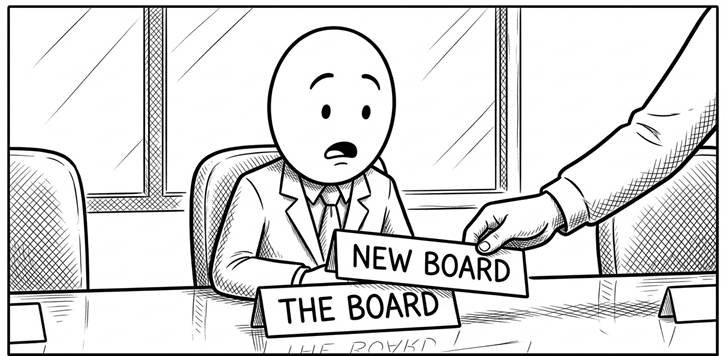
“Someone always takes the seat.”
Two kinds of cases
Not every case below is a restructuring, and the difference matters. TCS is a direct application: a workforce redesign to which the six tests apply to the intervention itself. The rest are governance stress tests. They concern failures, accounting problems, and contests for control, not a proposed reorganization, and they show why individual tests matter: who decides, who verifies, and what was known when. India suits this purpose because regulators, tribunals, and courts have published findings that outsiders often cannot see, and because promoter control raises the stakes of decision rights. None of these cases says whether a restructuring was well designed.
Four governance risks recur in these cases
The Indian cases selected here illustrate four recurring governance risks: dominant promoters or founders, oversight that is passive or under-informed, related-party diversion of funds, and contests between founders and professional management or institutional shareholders. They are illustrations from a chosen set of cases, not a statistical finding. These risks are not unique to India, and no single case fits one neatly. But they change what the Instrument has to ask. In a promoter-controlled company, the decision-rights test must ask who really decides. In a group with many entities, the information test must ask who built the numbers the board sees. And in many of the cases below, the external trigger was not an investor or a journalist but the state.
Three boards were replaced by the state
In three of the five failures below, the board’s story ended with someone else taking the board’s seat. The National Company Law Tribunal suspended IL&FS’s board in 2018. The Reserve Bank of India superseded DHFL’s board in 2019 and Yes Bank’s in 2020. Each is a version of the external trigger, the point at which delay becomes untenable because an outside authority makes it so. It is a serious loss of control, because the board surrenders not only the decision but the ability to shape what follows. The cases ask what questions might have surfaced the problem earlier.
A note on allegations and fairness
Two cautions govern everything that follows. First, many of the facts below are regulatory findings, forensic-audit conclusions, or criminal allegations that individuals contest, and some proceedings are still pending. Where that is true, the text says “alleged” or names its source, and facts are stated as of mid-October 2026. Second, the Instrument asks what a board could have been expected to ask. It does not claim that asking would have prevented any outcome. Counterfactuals about complex failures are speculation. The honest claim is narrower: these are the questions whose answers are missing from the public record, and that a board could have required in writing.
IL&FS: A group that defaulted within months
IL&FS, a large infrastructure financier, began missing obligations in mid-2018. One subsidiary defaulted on about ₹450 crore of inter-corporate deposits and commercial papers in June, and the group missed a ₹1,000 crore short-term loan repayment to SIDBI on September 4. On October 1, acting on a government petition under Sections 241 and 242 of the Companies Act, the Tribunal suspended the board and installed a new board led by Uday Kotak. The government’s petition alleged mismanagement of public funds. Reported consolidated debt exceeded ₹91,000 crore.
IL&FS: What came out after the board went
The supersession was only the first step. After prima facie findings by the Institute of Chartered Accountants of India and an interim report from the Serious Fraud Investigation Office dated November 30, 2018, the government asked the Tribunal to reopen the books of IL&FS and its group companies for the past five financial years. The public record therefore shows serious questions about the accounts emerging after, not before, the board lost control. What it does not show, in the sources reviewed for this piece, is what the board’s own papers said about debt sustainability or group-level funding.
IL&FS: What the Instrument asks
A board running the Audit would have faced questions it could not answer with a slide. Test One at Level Two: what mechanism connected one entity’s distress to the whole group’s, and who owned it? Test Three: who could approve the movement of money between group entities, and with what independent review? Test Two: when did the board’s papers first show rising stress, and how does that compare with the first default? None of these asks anyone to predict a collapse. They ask the board to hold in writing the mechanism it was relying on. When the board cannot produce such a document, the absence becomes a governance question.
Yes Bank: Three years of warnings
The Reserve Bank had been monitoring Yes Bank since 2017, according to the Finance Minister, and flagged weak compliance, wrong asset classification, and governance issues. Gross non-performing assets reportedly rose from 0.31 percent in March 2014 to 7.39 percent by September 2019. The RBI declined to give co-founder Rana Kapoor another three-year term as CEO, reportedly allowing him to continue only until January 2019. In January 2020, the independent director who chaired the audit committee resigned, citing governance concerns. On March 5, 2020, the RBI imposed a moratorium and superseded the board.
Yes Bank: The resignation that could have been a trigger
The most striking board-level fact is the audit chair’s resignation. An independent director who leaves an audit committee, citing governance, sends a signal a board can read in real time. The Instrument asks a simple question about it: what happens automatically when it occurs? Test Five would have required the board to state in advance what evidence counts as failure and what it will do. In the sources reviewed, no such rule is reported. The record shows a resignation in January and a moratorium in March, two months apart, and a regulator that had been raising concerns for roughly three years. That sequence is a timeline, not proof that a trigger would have changed the outcome.
Yes Bank: Promoter control and decision rights
An analysis by the Institute of South Asian Studies in Singapore describes the co-founder as having taken total control of the bank, which lent to groups that later struggled, among them Reliance ADAG entities and Cox & Kings. Whether those decisions followed the bank’s credit policy, and who approved them, are the Test Three questions a board needs answered. Which large lending decisions required committee approval? Who sat on that committee, and who could override it? The public record contains the outcome: an SBI-led reconstruction in which SBI took a 49 percent stake for ₹2,450 crore. It contains much less on the approvals.
DHFL: A board replaced, then an insolvency
In November 2019 the RBI superseded the board of Dewan Housing Finance Corporation, citing governance concerns and payment defaults. DHFL became the first finance company the RBI referred to insolvency proceedings under the Insolvency and Bankruptcy Code. Lenders had commissioned forensic audits, and the government’s Serious Fraud Investigation Office opened a probe in December 2019. In 2021, Piramal Capital and Housing Finance completed the acquisition of DHFL for ₹34,250 crore, after creditors approved its plan. These outcomes are matters of record. The causes remain contested in court.
DHFL: The alleged parallel ledger
The CBI’s 2022 FIR alleges that DHFL and its promoters, Kapil and Dheeraj Wadhawan, defrauded a 17-bank consortium led by Union Bank of India of ₹34,615 crore, partly through shell entities known as the “Bandra Book” entities. Separately, forensic-audit findings reported in the press describe about ₹11,756 crore in loans recorded as home loans to some 260,000 borrowers but allegedly routed to just 91 entities. These are allegations, and the individuals concerned face proceedings. They are nonetheless the clearest illustration in this piece of why Test Four exists. A parallel set of books, if proven, would be the ultimate workaround.
DHFL: What the Audit asks about certifications
A board that receives management certifications about a loan book faces a Test Four question it can ask in advance: which processes exist outside the formal systems, and what independent verification sits behind what we are shown? That is a different request from asking management to certify. It asks an audit function independent of management to sample the books against underlying accounts. The public record does not say what verification DHFL’s board required. The Instrument’s point is narrower and more useful: it turns “did the board trust management?” into “what evidence, independent of management, did the board demand?”
IndusInd: A gap between knowing and telling
IndusInd Bank is the cleanest test of the sequence question, because the dates are documented. SEBI’s findings, as reported, say the bank noticed incorrect accounting treatment in its derivatives book on September 26, 2023, and that management was aware of the discrepancies by December 2023. The bank disclosed them publicly on March 10, 2025, about fifteen months after management awareness and seventeen months after the first notice. PwC estimated a negative impact of ₹1,979 crore as of June 30, 2024. Grant Thornton later put the cumulative adverse accounting impact at ₹1,959.98 crore as of March 2025. These figures come from the bank’s disclosures, its reviewers, and reported regulatory findings.
IndusInd: Where Test Two bites
Test Two asks whether a diagnosis was documented before an action, and when. Here the interesting interval is between knowing and telling. A board’s job in that interval is to decide what disclosure is required, who decides, and by when. The record shows an internal diagnosis in 2023 and a public one in 2025. It does not show what the board knew in between, which is exactly what a sitting board needs to be able to reconstruct. Separately, the RBI approved only a one-year extension for CEO Sumant Kathpalia in March 2025, though the board had recommended three years. The record does not say why. He and his deputy resigned in April.
IndusInd: Still unfolding, and why that matters
This case is not closed. The National Financial Reporting Authority has sought audit files going back to 2017, and regulators have opened further proceedings, so what is known will change. That is a lesson in its own right. A board that waits for every finding before asking questions will ask them too late. The Instrument is designed to be applied on the evidence available at the time of the vote, with unknowns labelled. Readers should treat the facts here as a snapshot of the public record as of this writing, and recheck them before relying on them.
Religare and Fortis: Money that moved between entities
The Religare and Fortis cases involve two listed companies and one set of promoters, the Singh brothers. SEBI’s investigation of Religare Finvest, a subsidiary of Religare Enterprises, found funds diverted for the benefit of promoter-linked entities. Its final order, running to 390 pages, put diversion from the material subsidiary at ₹2,473.66 crore, with a further ₹487.92 crore misutilised, and fined 52 entities a total of ₹21 crore. At Fortis Healthcare, SEBI separately directed recovery of ₹403 crore it found diverted. Delhi Police also arrested the brothers in 2019 on allegations relating to Religare Finvest. SEBI’s orders are regulatory findings, not criminal verdicts, and, like the police allegations, remain subject to legal process.
Fortis: The board didn’t authorise it
The most instructive fact in this cluster is internal to Fortis. The company commissioned an external legal inquiry after reports that Fortis Hospitals had placed about ₹473 crore in short-term investments with entities linked to the promoters. Fortis reported that the payments were “not specifically authorised” by its board, and that there was evidence they had been used to repay loans owed by promoter-linked companies. That is a decision-rights gap in its plainest form: payments made without specific board authorisation. The ₹473 crore and ₹403 crore figures come from different sources and are not interchangeable. Test Three asks which transactions require board approval, and who verifies that the approval actually occurred.
Religare: Directors’ roles and SEBI’s penalties
SEBI’s order did not stop at the promoters. In setting penalties on key managerial personnel and directors of the Religare entities, the regulator took into account the position and responsibilities each held, the amounts diverted or misutilised, and each person’s tenure. That approach is worth noticing, because it treats board and executive roles as carrying specific, differentiated responsibility. It is also a reminder of why a written record matters. Accurate records help establish what was disclosed, considered, challenged, and approved. They do not by themselves show that a director met their duties, but their absence leaves little to show.
When Boards Fight: Tata, Tata Trusts and TVS
“Who holds the final say?”
Boardroom disputes fail differently from boardroom failures. Nobody has necessarily done anything illegal, and the dispute may be conducted entirely within the rules. The question for the Instrument shifts. It asks whether the rules are clear enough that a contest over power does not become a contest over the company. The three cases here, Tata Sons and Cyrus Mistry, the Tata Trusts, and the TVS group, involve living people and, in two cases, disputes that remain unresolved. They are described only through dated, attributed reporting or court findings, and nothing here takes a side.
Disputes are a different test
Tata and Mistry: The facts
Cyrus Mistry became chairman of Tata Sons in December 2012. On October 24, 2016, a majority of the board removed him, and in February 2017 shareholders voted to remove him as a director. The National Company Law Tribunal dismissed his challenge in July 2018. In December 2019 the appellate tribunal ruled the October 2016 board proceedings illegal and ordered him reinstated. The Supreme Court stayed that order in January 2020. On March 26, 2021, it set the order aside, holding that the removal did not amount to oppression of minority shareholders or mismanagement.
Tata and Mistry: What the court settled
The Supreme Court held that reinstatement had been granted without any foundation in the pleadings, without a prayer for it, and without a basis in law under Sections 241 and 242 of the Companies Act. It rejected the claims of oppression and mismanagement. The Shapoorji Pallonji Group had argued that the removal was an ambush in violation of governance principles, while Tata Sons argued that it acted within its Articles of Association. Tata Sons won this one in court. The Instrument asks a further question: could the board also show, in writing, why and how it decided?
Tata and Mistry: A fast removal, tested
This case is a useful counterweight to the common assumption that boards act too slowly. Mistry served just under four years before his removal. Whatever one thinks of the decision, it raises the mirror-image question to deferral: when is removing a leader quickly the right call, and what process makes it defensible? The Instrument is neutral on the outcome. It asks whether the diagnosis was documented before the vote (Test Two), who held the power to decide (Test Three), and what the board would accept as evidence it had been wrong (Test Five). Those questions protect a board that acts as much as one that waits.
Tata Trusts: Seats, information, and a split
In September 2025, trustees of the Tata Trusts, which together hold a controlling stake in Tata Sons, met to consider reappointing Vijay Singh as a nominee director on the Tata Sons board. Four trustees voted against, and Singh later resigned from the board. Those four proposed Mehli Mistry as a nominee, which Noel Tata and Venu Srinivasan opposed. On October 28, 2025, three of the six trustees, including Noel Tata, Venu Srinivasan, and Vijay Singh, opposed Mistry’s reappointment as a trustee, ending his tenure. The Trusts are separate legal entities with overlapping trustees, and reports do not always say which trust took each decision.
Tata Trusts: The information question
Reporting describes a recurring concern among the trustees who opposed Singh: whether nominee directors, who serve as the link between the Trusts and the Tata Sons board, were updating the Trusts fully. Separately, Article 121 of the Tata Sons Articles lists reserved matters, including the appointment or removal of the chairman, that require the consent of the Trusts’ nominee directors. Those two facts frame an information and decision-rights problem, exactly what Tests One and Three address. Who holds a veto, what must they report, and to whom? The dispute is unresolved, and such questions are better asked before a contest than during one.
TVS: A reported clash over a compliance role
At Sundaram-Clayton, the die-casting company in the TVS group, a boardroom dispute surfaced in March 2026. According to Outlook Business, citing Mint, managing director Lakshmi Venu raised a concern about the reporting line of the company secretary and compliance officer, who reportedly was not a full-time employee and reported to an executive at the group’s holding company. The board accepted that officer’s resignation on March 27 and named a successor. After an emergency meeting on Monday, March 30, it reportedly reversed those decisions, saw the independent chairman leave the chair, and redesignated Venu Srinivasan as chairman and managing director.
TVS: Two governance questions, no verdict
The TVS dispute is also tangled in a separate family disagreement over whether a March 2024 memorandum of understanding settled who owns which businesses. As of October 13, 2026, the family had announced no deal. The governance questions are visible without taking any side. Should a listed company’s compliance officer report to the company’s own board or to a separate group entity? How much independent authority does a chairman have in a family-controlled company? These are Test Three questions about decision rights and reporting lines. This piece offers no view on who is right, and the facts are as reported by the press.
What the three disputes share
Set side by side, the three disputes turn on the same ambiguity: who holds the final say, and how does the board know what it needs to know? At Tata Sons, a court settled a contested removal. At the Tata Trusts, trustees disagree over nominee directors and the information that flows to them. At the TVS group, reporting lines and the chair’s authority are reportedly in dispute. None of these is a failure of arithmetic or accounting. Each is a question of decision rights and information flow, which Tests One and Three exist to answer, and which are cheaper to settle in a charter than in a courtroom.
TCS: The Restructuring Closest to Home
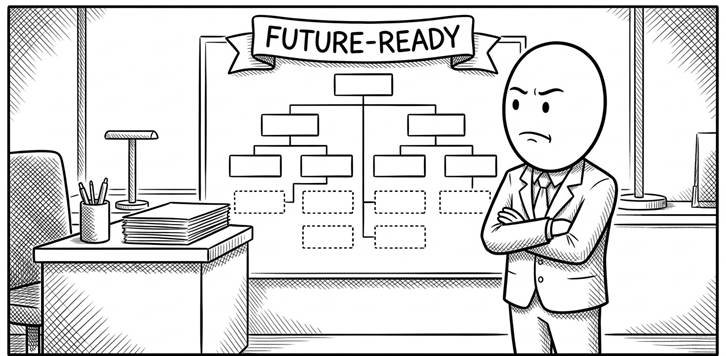
“The banner names the condition. The mechanism is still missing.”
TCS cut two percent of its workforce
On July 27, 2025, Tata Consultancy Services told employees it would reduce its global workforce by about 2 percent, roughly 12,261 people, mainly in middle and senior grades, phased through the financial year. At the time it employed 613,069 people. The company described the move as part of becoming “future-ready,” a transformation covering new technologies, new markets, AI deployment, and a realigned workforce model. Press accounts called it the largest downsizing in the company’s history. Employee unions condemned the decision and alleged forced resignations. The IT Ministry was reported to be monitoring the situation.
TCS: What the CEO said, and what stays unknown
CEO K. Krithivasan told Moneycontrol the cuts were “not because of AI but to address skills for the future.” The company said reskilling and redeployment had been tried and that not everyone could be placed, despite training about 550,000 employees at foundational level and 100,000 at advanced level. That is a Level One diagnosis, a skills mismatch, with a partial answer to Test Six: the company says it tried redeployment, but the public account does not show how alternatives were compared. What the public record does not show is the Level Two mechanism: which hiring, bench, or skilling processes allowed the mismatch to build up, and who owned them.
TCS: Why it belongs next to Meta
TCS and Meta look structurally similar in what the public can see: a candid Level One explanation, a large headcount reduction, and silence on mechanism, decision rights, and failure criteria. That does not make either restructuring wrong. The Instrument is neutral on whether cuts are necessary. It asks the board what it was shown, and what it asked for, before approving them. For Indian boards, TCS is the nearest live example of a restructuring whose design documents any director would want to see: the skills diagnosis, the redeployment data, and the criteria for judging success.
Lessons for Indian Boards
Ask for the second level, whoever is speaking
Meta’s lesson for an Indian board is about candour. A chief executive can admit a mistake sincerely and still leave the board without a diagnosis it can act on. Indian promoter-led boards often face a version of this: a founder who is both candid and in control. The board’s job is to ask for Level Two, the mechanism, in writing, and to treat “we got the market wrong” as the start of an answer and not the end of one. Where the chairman is also the promoter, independent directors should ask the question, record it, and note whether it was answered.
Score two admissions separately
Salesforce’s lesson is about timing. The economic rationale was contemporaneous, and the account of leadership turbulence came two years later. Indian boards will recognise the pattern in the IndusInd timeline, where an internal diagnosis in 2023 reached the public in 2025. A board should ask not only what the problem is but what it knows that has not yet been disclosed, and should set a rule for when knowledge becomes disclosure. Treating the economic story and the governance story as one narrative lets the second hide inside the first.
Decouple the interventions
Microsoft’s lesson is about attribution. A cultural reset and an acquisition integration ran in parallel, and crediting one for the other’s results would have been wrong. Indian conglomerates that combine a transformation narrative with a headcount reduction face the same risk. A board should ask whether each intervention has its own diagnosis, its own owner, and its own success criteria. If a culture story is covering a cost decision, or a cost story is covering a culture problem, the board should separate them before voting.
Don’t let the regulator be your trigger
India’s most striking pattern is that, in several of these stories, regulators and tribunals made the final decision, not boards. IL&FS, Yes Bank, and DHFL each ended with the state replacing the board. For a director, that is the clearest argument for acting on earlier signals: an independent director’s resignation citing governance, a regulator’s repeated findings, a supervisory limit on a CEO’s term. A board that treats those as triggers keeps control of the decision. A board that waits for an order accepts the loss of control that comes with it.
Promoter control raises the bar on independence
In companies where a promoter or family holds decisive power, the Instrument’s tests do double duty. Test One has to be answered by someone other than the person whose decisions are being examined. Test Three has to map the real veto holders, who may sit in a trust, a holding company, or a family agreement. Test Four has to find the workarounds that exist because formal approvals are bypassed. None of this requires distrust. It requires that the board’s information about itself come from a source that is not also its subject.
The Indian Evidence Table
| Case | Trigger or outcome | Test that bites hardest | Evidence status |
| IL&FS | Board suspended by the NCLT, October 2018 | Tests 1 and 3: group funding mechanism; approval of inter-entity money | Outcome documented; board-level findings not reviewed here |
| Yes Bank | RBI moratorium and board superseded, March 2020 | Tests 2 and 5: years of RBI concerns; audit chair’s resignation | Regulator concerns reported; internal approvals not public |
| DHFL | Board superseded; insolvency referral, November 2019 | Test 4: alleged parallel ledger | Allegations; proceedings continue |
| IndusInd Bank | CEO and deputy resigned, April 2025 | Test 2: noticed Sept 2023; management aware Dec 2023; disclosed Mar 2025 | Timeline documented; still developing |
| Religare and Fortis | SEBI orders; arrests in 2019 | Test 3: payments not authorised by the board | Regulatory findings; legal process continues |
| Tata and Mistry | Supreme Court ruling, March 2021 | Tests 2, 3, and 5 | Court found no oppression or mismanagement |
| Tata Trusts | Trustee split, 2025 | Tests 1 and 3: information flow; reserved matters | Press reports; unresolved |
| TVS group | Board reversal, March 2026 | Test 3: reporting lines; chair’s authority | Press reports; unresolved |
| TCS | Two percent workforce reduction, July 2025 | Tests 1 and 6 | Company statements; mechanism not public |
What the silence means for shareholders
The recurring finding of insufficient evidence is not an accusation. This piece does not claim that companies are obliged to publish decision-rights matrices or precommitted failure criteria, and their absence from the public record is not wrongdoing. But the pattern matters to the people who own and regulate these companies. Announcements typically disclose the condition and the outcome, and rarely the mechanism or the test of success. Shareholders, lenders, and regulators can ask for more. A board that can answer Tests Three through Six in writing, to its own owners, offers something a headline cannot: a basis for judging the restructuring afterward.
The Pre-Vote Protocol
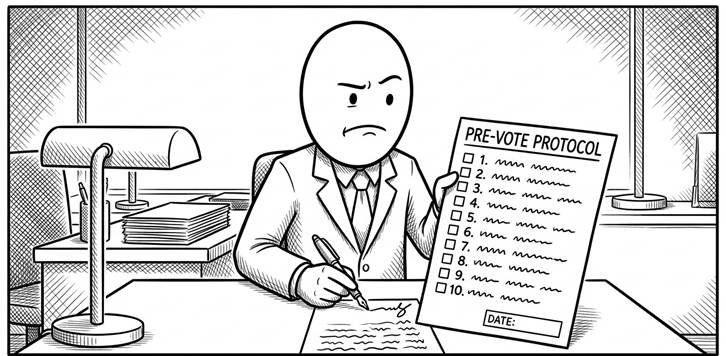
“Before the vote, not after it.”
Ten questions before the vote
Before approving any restructuring proposal, a board should require management to submit written answers to the following, in this order:
1. Causal Condition: What specific market, technological, or operational condition failed, degraded, or shifted?
2. Failure Mechanism: What exact internal operating mechanism produced or amplified that failure?
3. Decision Authority: Who currently holds formal decision rights over that mechanism?
4. Sequence Audit: On what date was the causal diagnosis documented, relative to the first draft of the proposed structure?
5. Decision Rights Matrix: Which three to five consequential decisions shift to new owners, and at what specific thresholds?
6. Workaround Audit: Which documented informal processes will this design explicitly eliminate, and why would it eliminate them?
7. Non-Structural Counterfactual: What non-structural option was evaluated and rejected, and on what evidence?
8. Precommitted Target Metrics: What must improve, by what magnitude, over what horizon?
9. Disconfirming Evidence: What observable result would tell the board, within that horizon, that the design is failing?
10. Formal Revisit Date: On what calendar date will the board review management’s performance against these precommitments?
Five more for promoter-led boards
The Indian cases suggest five additions for boards in which a promoter, family, or trust holds decisive power. First, who ultimately controls this decision: the board, a promoter, or a trust, and where is that written? Second, what independent information does the board receive, and who built it? Third, which related parties benefit from this transaction, and who approved it independently of them? Fourth, what would our regulator ask first, and have we asked it ourselves? Fifth, if an independent director resigned citing governance, what would happen automatically, and by when?
Make the protocol a gate
Questions only bind when management cannot skip them. The simplest enforcement is a rule the board adopts in advance: no restructuring proposal reaches the agenda without written answers to the ten questions, reviewed first by the chair or an independent committee. That reviewer should test whether the causal case is supported by evidence, whether decision rights really move, whether alternatives were weighed, and whether success measures can be verified independently. The rule moves the contest from the meeting, where a forceful founder or CEO has the advantage, to the paper, where the board sets the terms.
The emergency exception
A gate must not freeze a company in a crisis. In an acute liquidity event, a regulatory intervention, or another existential threat, a board may need to approve immediate cost containment before the mechanism is understood. The protocol allows that, on one condition: the emergency decision is treated as containment, not diagnosis, and it triggers a binding review of Levels Two and Three within a fixed window, such as sixty to ninety days. The board should record that it invoked the exception, and why. Speed is a legitimate reason to act before the answers exist. It is not a reason to stop asking for them.
Approve, condition, defer, or redesign
When the answers are mixed, a board has four honest options. It can approve, if the critical causal, authority, and accountability questions have credible answers. It can approve with conditions, if the gaps can be closed through staged implementation, safeguards, or reporting requirements. It can defer, if a material uncertainty stops it judging whether the intervention fits the diagnosed mechanism. Or it can send the proposal back for redesign, if the intervention does not credibly address the mechanism. Whichever it chooses, the board should record why. A restructuring can pass every question and still be the wrong decision for reasons outside its internal logic.
Which gaps weigh most
Not all gaps are equal. Gaps in Tests One, Three, and Five concern the causal case, who actually decides, and how success will be judged, so they usually warrant conditions or deferral before approval. Gaps in Tests Two, Four, and Six concern whether the design followed the diagnosis, which workarounds it removes, and whether a cheaper option was weighed. They call for scrutiny in proportion to the risk. This weighting is a judgment, not a validated scoring model, and it should never be turned into a single pass-or-fail number.
The chart will say what its authors need
Documents codify intent. Culture decides outcomes. An org chart is a document like any other. It can be made to tell almost any story its designers need. A mechanism-matched structure cannot rescue a mistaken diagnosis, a flawed strategy, or a deteriorating market. It can only prevent the organization’s own form from becoming one more source of failure on top of whatever else is going wrong. The board’s job was never to demand a better story. It is to determine whether the structure in front of it changes the mechanism that produced the problem, and to know, before the vote, which of the ten answers it still doesn’t have.
John M. Birchbauer is a Strategic Diagnostician and Independent Board Advisor.
Evidence cutoff: mid-October 2026. The IndusInd, DHFL, Tata Trusts, and TVS matters are developing and should be rechecked before publication.
Sources referenced (global cases): Meta Platforms, Inc. Form 10-Q (Q1 and Q3 2023) and Form 10-K (FY2022 and FY2023), U.S. Securities and Exchange Commission, and fourth-quarter results releases for 2022 and 2023; Mark Zuckerberg, company-wide message, November 9, 2022, reported by ABC News, and CNBC, “Meta layoffs: 10,000 more workers to be cut in restructuring,” March 14, 2023; TechCrunch, “Meta conducts yet another round of layoffs,” May 24, 2023; Salesforce, Inc. Form 8-K, January 4, 2023, U.S. Securities and Exchange Commission; CNBC, “Salesforce is cutting 10% of its personnel, more than 7,000 employees,” January 4, 2023; CX Today, “Marc Benioff on ‘Dumpster Fire’ Layoffs & How Salesforce Bounced Back,” January 2025; Microsoft Corporation, Form 8-K, July 17, 2014; Lisa Brummel internal memo, November 12, 2013, as reported by The Seattle Times, CNN, and ABC News; Microsoft public communications on its post-2014 performance management framework.
Sources referenced (India): Bar & Bench, “IL&FS Insolvency: The Journey So Far”; Government of India reply on resolution of debts of IL&FS and its subsidiaries; BloombergQuint and Moneylife reporting on the NCLT order of October 1, 2018; Institute for South Asian Studies (NUS), Brief No. 756, “Yes Bank in Moratorium,” March 10, 2020; Business Standard and TBS News reporting on Yes Bank, March 2020; Moneylife, “RBI Finally Dismisses DHFL Board,” November 20, 2019; Insolvency Tracker and Moneylife reporting on the CBI FIR against DHFL, June 2022; Business Standard, April 15-16 and April 27, 2025, on the PwC and Grant Thornton findings at IndusInd Bank; CAalley, BW Legal World, and Angel One reporting on IndusInd Bank, SEBI, and NFRA; SEBI orders in the matter of Religare Enterprises Limited (March and September 2019); Outlook Business and Scroll reporting on SEBI’s final order and the Fortis inquiry; ThePrint, 2019; Supreme Court of India, judgment of March 26, 2021 in the Tata Sons and Cyrus Mistry matter, as reported by LiveLaw, Scroll, and The Indian Lawyer; Outlook Business, Business Today, The Statesman, Angel One, and The Week/PTI reporting on the Tata Trusts, September to October 2025; Outlook Business, April 2 and October 13, 2026, on the TVS group, citing Mint; Moneylife, Business Today, The News Minute, and Evertiq reporting on TCS, July 2025.

John M Birchbauer
John M. Birchbauer is a Strategic Diagnostician and Independent Board Advisor with more than 25 years of experience across automotive retail and global B2B logistics. He is the founder of Paradise Group LLC, an independent advisory practice, and held senior leadership roles at JM Family Enterprises, where his work included the AAX acquisition, the Retail Suite platform, and the VIN Explosion Tool — bridging algorithmic intelligence with frontline dealership operations. He currently holds a Chairman role with INVESTARMS PLC and is co-founder of Definait, an early-stage AI fintech venture with planned operations in Dubai.
His advisory practice centers on his "Third Question" diagnostic framework — a governance methodology built on a simple premise: most boards stop at what happened and what they're doing about it, when the question that actually changes outcomes is what the current answer assumes, and who benefits if that assumption goes unchallenged. He mentors entrepreneurs through MicroMentor, including participation in a joint World Bank and Caribbean Climate Innovation Center international pilot program.
He is based in Waukesha, Wisconsin, USA.


Leave a comment