




























Ethanol Shouldn’t Ride in Just Any Tanker
Part I of this series established that ethanol is hygroscopic — it actively draws moisture out of the air, rather than repelling it the way petrol does. That property does not stop mattering once the ethanol leaves the distillery gate; if anything, it matters more, because every additional link in the supply chain is another chance for moisture to get in.
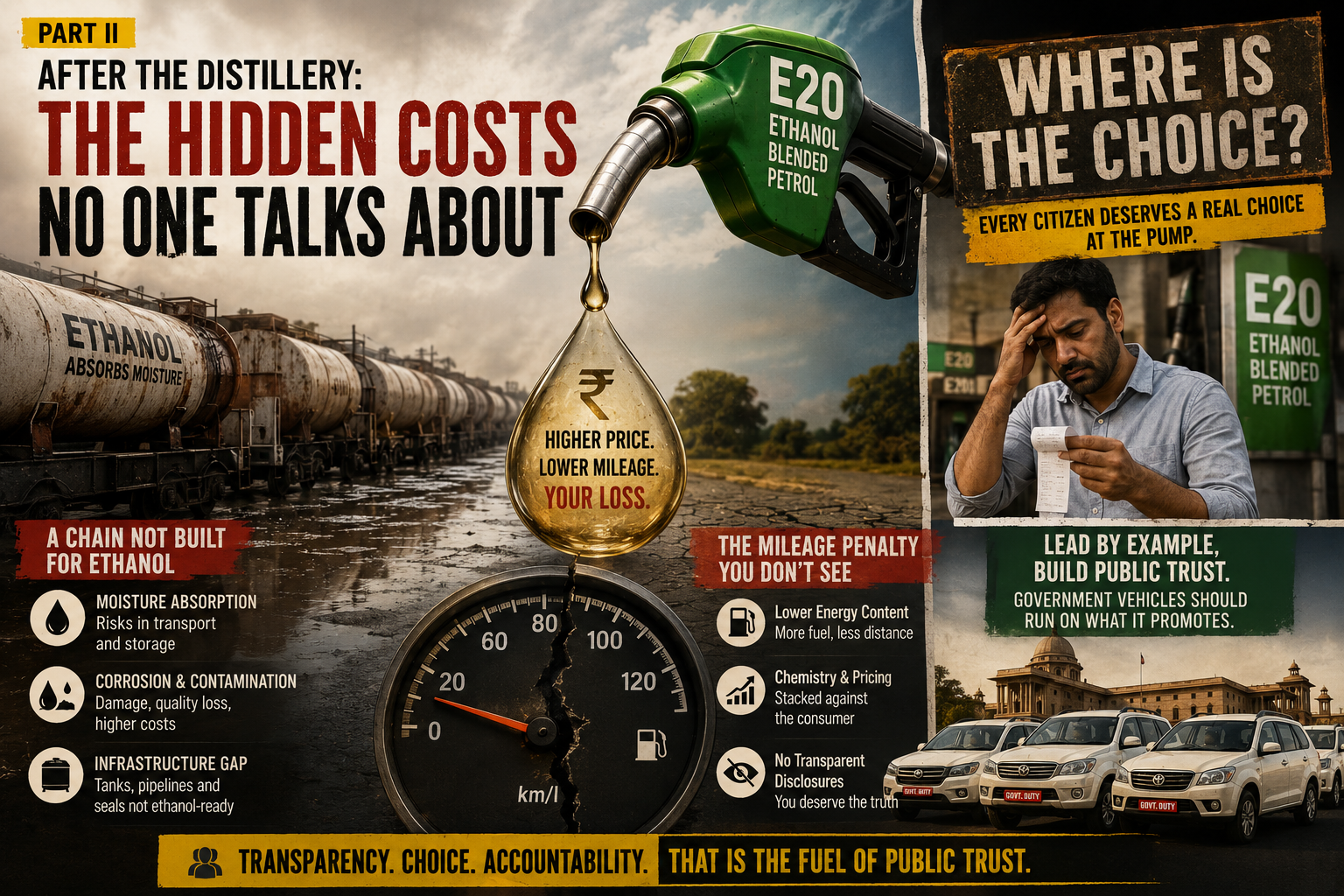
Mature ethanol markets have built their logistics around exactly this constraint. In the United States, rail movement of fuel ethanol now runs on dedicated DOT-117 tank cars, phased in to replace the older DOT-111A standard specifically for flammable, moisture-sensitive liquids. Ethanol is also incompatible with the vast existing petroleum pipeline network — it can corrode pipeline steel and degrade seals not built for it — which is why, unlike petrol, it still moves overwhelmingly by dedicated rail car and tanker truck rather than pipeline in the US.
India’s own bulk ethanol logistics are, credit where due, closer to this standard than a casual reading might suggest. Dedicated stainless-steel tankers are already standard industry practice for moving neat ethanol from distillery to OMC depot, and several Indian logistics operators — D.G. Patel Group, Madhu Transport, Shivaroadlines among them — market exactly this as their core service, with GPS-tracked, contamination-controlled fleets built for the purpose.
The weak point in India’s ethanol logistics isn’t the primary tanker fleet moving neat ethanol — it’s everything downstream of the depot.
The gap sits further down the chain. Once ethanol is blended into E20 at the OMC depot, the last-mile tanker moving finished fuel to a retail pump is often the same fleet used for plain petrol, not a fuel dedicated to the higher-ethanol product. Underground storage tanks at many pumps were built for E0 or E5 petrol, frequently in mild steel, and were never re-certified against the higher moisture sensitivity of a 20 per cent ethanol blend.
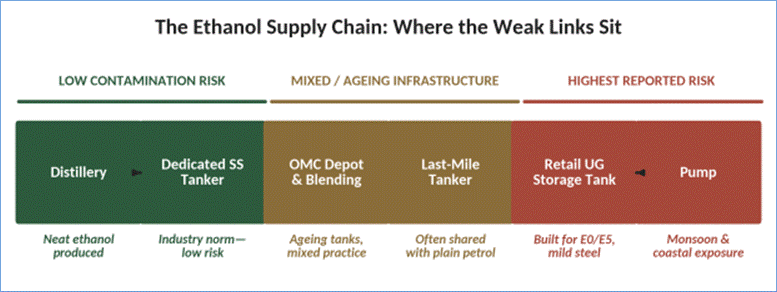
Fig. 1 — The ethanol supply chain, and where contamination risk concentrates.
This is not a hypothetical concern raised only by this piece. Petrol pump dealers told The Hindu, Outlook India and Newsdrum in July 2026 — within days of each other — that monsoon rainfall, condensation and ageing seals were allowing water into underground E20 stock, particularly in coastal regions where sub-soil moisture adds a further route of ingress. One industry expert cited in that reporting put the threshold at which the entire stock in an underground tank begins to phase-separate at roughly 0.5 per cent water content.
That figure sits close to, though not identical with, the specification limit for neat fuel-grade ethanol itself: the US ASTM D4806 standard caps water content in anhydrous denatured ethanol at around 1 per cent by mass before blending. The two numbers describe different points in the chain — one the incoming ethanol spec, the other a field-observed threshold for finished E20 stock sitting in an ageing underground tank — but both say the same thing: the tolerance for water is thin, and it does not take much contamination to cross it.
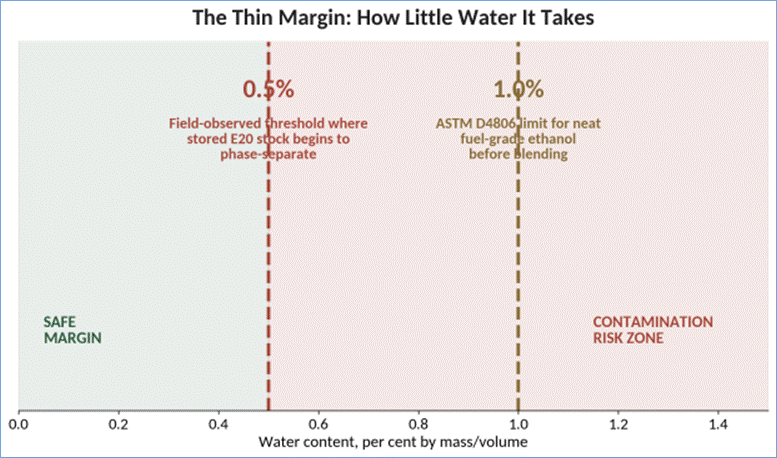
Fig. 2 — The margin between the ASTM neat-ethanol spec and the field-observed phase-separation threshold. Source: ASTM D4806; Outlook India, July 2026.
The clearest illustration of what happens when it is crossed did not come from within India. Bhutan rejected a consignment of E20 fuel in 2026 over a moisture-related quality failure — a small, telling data point on how unforgiving the margin actually is once ethanol content rises, and a reminder that the same blend India now sells nationwide has already failed a quality check just across the border.
Oil marketing companies have not ignored this. Seals and washers in dispensing units have been replaced with neoprene rubber compatible with higher ethanol content, and OMCs maintain quality-control checks at the depot stage before fuel is released. But dealers’ complaints, and Bhutan’s rejection, point to the same conclusion: replacing visible components at the pump is not the same as certifying an entire ageing underground storage and last-mile transport system built for a fuel that didn’t absorb water the way E20 does.
None of this argues that India’s ethanol logistics are uniquely careless — the dedicated-tanker practice for bulk movement is genuinely sound, and follows the same logic mature markets use. The argument is narrower: E20 was rolled out nationwide in five years, and the last-mile and storage infrastructure it depends on was not upgraded on the same timeline as the blending mandate itself, leaving exactly the gap this section has described — concentrated at the depot-to-pump stage, at the height of monsoon, and along the coast.
Same Price, Fewer Joules: The Chemistry Behind the Mileage Complaint
Behind the mileage complaints running through this backlash sits a straightforward chemistry answer that the public debate has largely skipped. Petrol is a mixture of hydrocarbons — molecules built almost entirely from carbon and hydrogen, roughly in the C4 to C12 range, with no oxygen atom bound into the molecule itself.
Ethanol, C2H5OH, is different at the molecular level, not just in how it behaves around water. It already carries an oxygen atom internally — oxygen makes up about 35 per cent of ethanol’s weight — which means part of the molecule has, in effect, already been through a stage of oxidation before it ever reaches the combustion chamber.
Ethanol’s internal oxygen atom means part of its combustion work is already done before it reaches the engine — there is simply less oxidation energy left to release.
That internal oxygen is the direct reason ethanol releases less heat per litre when it burns. Petrol’s lower heating value runs around 33 to 34 megajoules per litre; ethanol’s is roughly 21 megajoules per litre — about 65 per cent of petrol’s volumetric energy content, even after accounting for ethanol’s slightly higher density.
A related figure makes the same point from a different angle. Ethanol’s hydrogen-to-carbon ratio is 3.0, against 1.85 for petrol — a higher share of ethanol’s mass is hydrogen and oxygen rather than the carbon-hydrogen bonds that do the heavy lifting in releasing combustion energy.
Scaled to blend level, the effect is real but not enormous per percentage point: the IEA’s fuel-properties assessment puts the theoretical fuel-consumption increase from a 10 per cent ethanol blend at around 3.5 per cent versus pure petrol. At E20, that compounds toward the 5-to-15-per-cent mileage penalty this series has already cited — and a Business Standard survey published this month found six in ten new petrol car owners reporting a mileage drop of more than 10 per cent, which is now a measured consumer experience rather than a theoretical one.
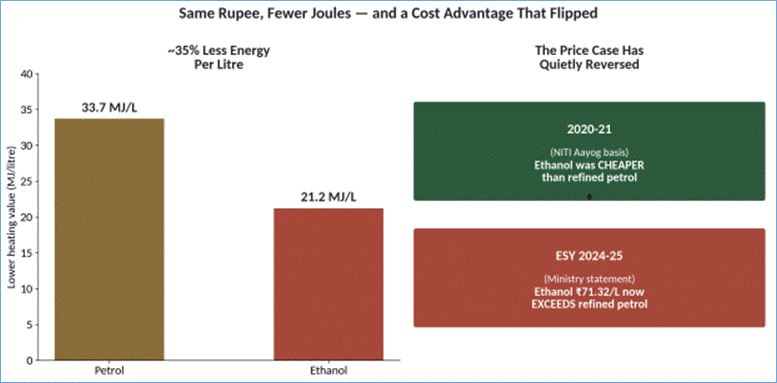
Fig. 3 — Energy content per litre, and the ethanol-vs-petrol cost reversal. Source: IEA-AMF fuel properties; Ministry of Petroleum & Natural Gas statement, August 2025.
This would be a straightforward, if unwelcome, trade-off if ethanol were still meaningfully cheaper than the petrol it displaces — which was, in fact, the original basis for the programme’s economics. The Ministry of Petroleum & Natural Gas has itself confirmed that this is no longer true: in 2020-21, when NITI Aayog built the initial case for blending, ethanol was cheaper than petrol; by Ethanol Supply Year 2024-25, the ministry’s own statement acknowledged, the weighted average procurement cost of ethanol had risen past the cost of refined petrol.
The number behind that admission is specific: average ethanol procurement cost, inclusive of transport and GST, stood at Rs 71.32 per litre as of end-July 2025, with maize-based ethanol alone rising from Rs 52.92 to Rs 71.86 per litre over three years. None of that cost difference shows up on the price board — E20 sells at the same forecourt price as plain petrol in almost every state, with the gap absorbed upstream through excise relief and OMC margin adjustments rather than passed through transparently.
Put together, the consumer is not simply paying petrol price for a fuel that covers fewer kilometres per litre. They are paying petrol price for a fuel that has, by the ministry’s own account, become more expensive to produce than the fuel it replaces, while delivering roughly a third less energy once it is in the tank — with both facts obscured by a pricing structure that shows an identical number at the pump either way.
None of this is an argument that ethanol’s chemistry makes it a bad fuel — lower energy density is a known, manageable property, and flex-fuel engines tuned for it can partly close the efficiency gap through higher compression ratios, as Brazil’s fleet demonstrates. It is an argument for a transparent price board: one that shows the ethanol component’s real cost and real energy content alongside petrol’s, so a motorist can see the trade-off they are actually making rather than discovering it later, the way most owners apparently have, in reduced mileage after the fact.
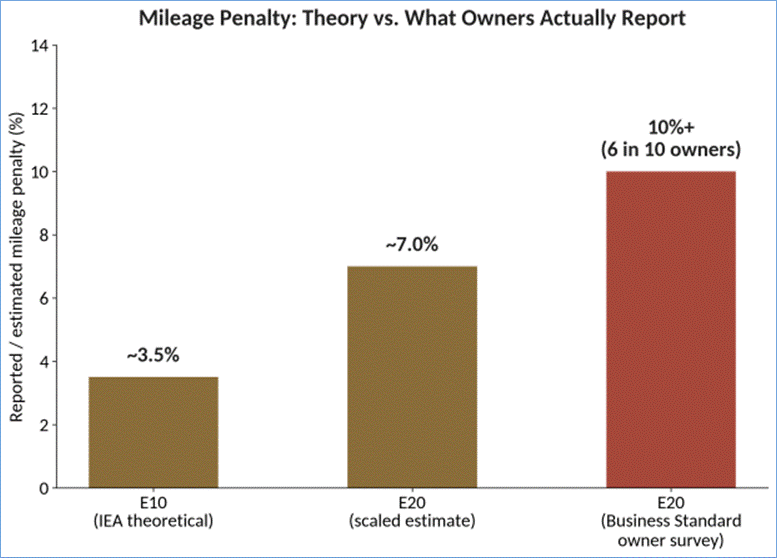
Fig. 4 — Theoretical mileage penalty vs. what a recent owner survey actually reports. Source: IEA-AMF; Business Standard, July 2026.
Earn the Mandate: Choice at the Pump, Confidence From the Top
The transportation and pricing gaps described above are technical and economic problems. The bigger one facing the programme in mid-2026 is political, and it has moved well past social media grumbling. India’s Attorney General, R. Venkataramani, described the ethanol programme as an “experiment” during a court hearing in July 2026, and even after the government disputed the characterisation, the clip went viral for a simple reason: it said out loud what many motorists already suspected.
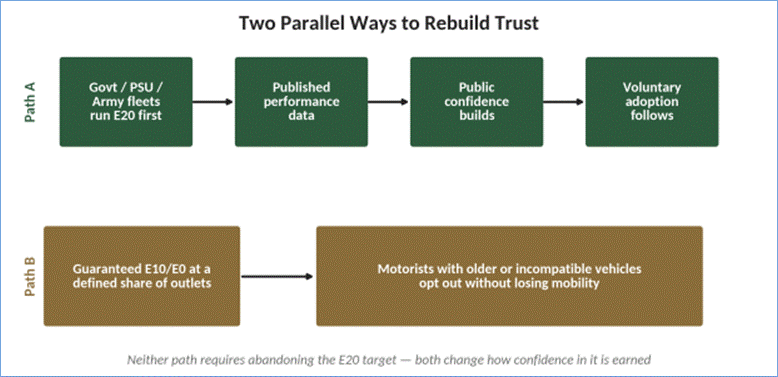
Fig. 5 — Two parallel routes to rebuilding public confidence in E20.
A protest against E20 has been announced at Delhi’s Jantar Mantar, with organisers claiming interest from thousands of prospective participants. Opposition voices in Parliament have argued the rollout lacked adequate consultation, with one line of criticism holding that the government cannot ask citizens to prove damage to their vehicles while its own supporting data remains unpublished. The government’s own side has not been entirely dismissive either — one senior minister has acknowledged that mileage “may drop a little,” while pointing to ethanol’s use in motorsport as reassurance, a comparison unlikely to land with the owner of a ten-year-old hatchback.
The most common demand running through this backlash is simple: let people choose. The government’s answer, delivered just as directly, was no. The Petroleum Ministry stated in July 2026 that stocking pure petrol, E10 and E20 simultaneously at every outlet was impractical, citing more than one lakh retail outlets nationwide and the handling costs, inventory complexity and reduced efficiency of running three parallel grades through that network.
A motorist who suspects they are the test fleet will trust the programme less every time a minister says the fuel is safe. A motorist who watches the government’s own vehicles run it first has an actual reason to believe it.
The ministry’s logistics argument is not wrong, but it answers a bigger question than the one being asked. Stocking three grades at every one of a lakh outlets would indeed be an enormous lift; guaranteeing a lower-blend option at a defined, meaningfully smaller share of outlets — concentrated where older vehicles and two-wheelers are most common — is a materially different and smaller ask than the all-or-nothing framing the ministry’s rejection implies.
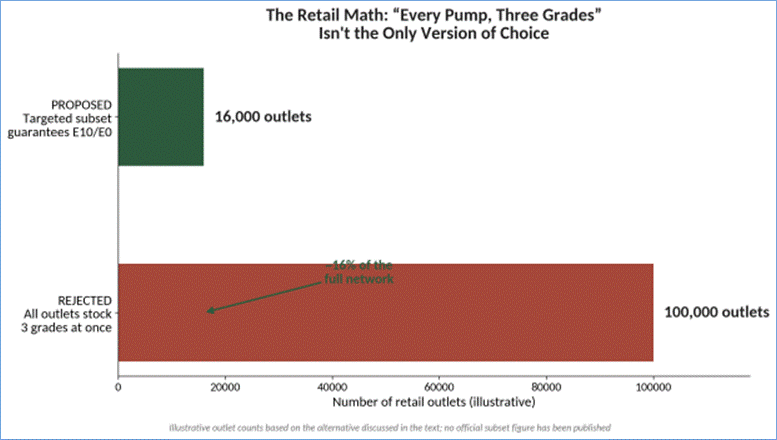
Fig. 6 — What the ministry rejected, versus a narrower version of the same idea. Illustrative framing; no official subset figure has been published.
That narrower version of choice would not slow the blending target down. It would simply let owners of vehicles the government’s own testing has flagged as more vulnerable — pre-2001 imports, older two-wheelers, carburetted engines — opt out without losing mobility, while the rest of the network continues moving toward E20 and beyond on schedule.
The second proposal — mandate E20, and eventually higher blends, for central and state government vehicles and the armed forces first — has a real precedent behind it, and it is not one India would be inventing from scratch. The United States used exactly this mechanism to break what economists call the alternative-fuel “chicken-or-egg” problem: the 1992 Energy Policy Act, expanded in 2005, mandated that federal and state government fleets purchase alternative-fuel vehicles specifically to seed demand and build confidence before the wider consumer market was expected to follow.
India is unusually well positioned to run the same play, arguably better than the US was. Central and state government departments, public-sector undertakings, state transport corporations and the armed forces together operate a vehicle fleet in the hundreds of thousands, refuelled largely through dedicated depots rather than public retail pumps — which sidesteps the multi-grade retail logistics problem entirely, since these fleets do not compete with ordinary motorists for pump space.
That fleet is also unusually visible. A government car pool, a state transport corporation’s bus fleet, or army vehicles running E20 without incident for a year, with performance and maintenance data published rather than asserted, would be a far more persuasive signal to a skeptical motorist than another ministerial press conference — precisely because it inverts the optics the Attorney General’s remark accidentally captured. The public would be watching the government’s own fleet absorb the risk first, not the other way around.
Neither proposal is free of trade-offs, and it would be dishonest to present them as such. A guaranteed lower-blend option at a defined share of outlets still adds real handling and inventory complexity the ministry is not wrong to flag, just at a smaller and more defensible scale than a universal three-grade mandate.
A government-fleet-first mandate, similarly, only builds confidence if its results are actually published — mileage, maintenance costs, breakdown rates — rather than quietly absorbed into departmental budgets the way government vehicle costs typically are. A demonstration fleet that runs the fuel but never reports on it will move public opinion no more than the assurances that have failed to move it so far.
Bhuwan Mohan Prasad is an environmental consultant holding a Bachelor’s in Civil Engineering and a Master’s in Environmental Engineering from IIT Kanpur, along with two Master’s degrees from the University of Toronto — in Chemical/Environmental Engineering, and in Forestry/Composite Materials. His professional experience includes serving as Senior Environmental Engineer at the Central Pollution Control Board, New Delhi, Project Manager with WSP Global Inc. and as Environmental Advisor with Ontario Power Generation, Toronto.
References
US Department of Transportation, Pipeline and Hazardous Materials Safety Administration — DOT-117 tank car standard for ethanol and other flammable liquids.
US EPA / ASTM International — ASTM D4806 specification for denatured fuel ethanol, water content limits.
The Hindu, Outlook India, Newsdrum, Trak.in — reporting on petrol pump dealer complaints of E20 moisture contamination, July 2026.
Reporting on Bhutan’s 2026 rejection of an E20 fuel consignment over quality/moisture concerns.
IMARC Group — India ethanol logistics and market report; industry practice on dedicated stainless-steel tanker transport.
D.G. Patel Group, Madhu Transport, Shivaroadlines — published service descriptions for dedicated ethanol tanker logistics in India.
US Energy Policy Act, 1992 and 2005 amendments — alternative-fuel vehicle purchase mandates for federal and state government fleets.
Reporting on Attorney General R. Venkataramani’s “experiment” remark on E20 during a July 2026 court hearing.
Reporting on Tehseen Poonawalla’s planned Jantar Mantar protest against E20, and Congress leader Priyank Kharge’s public statements, July 2026.
Statements by Union Minister Hardeep Singh Puri on E20 mileage impact and motorsport ethanol use, July 2026.
Ministry of Petroleum & Natural Gas — statement rejecting simultaneous multi-grade (E0/E10/E20) retail stocking, July 2026.
IEA Advanced Motor Fuels (AMF) — fuel properties database; theoretical fuel-consumption impact of ethanol blending.
BioEnergy Times — Ministry of Petroleum & Natural Gas statement on ethanol procurement cost exceeding refined petrol cost, August 2025.
Business Standard — consumer survey on E20 mileage impact among new petrol car owners, July 2026.
NITI Aayog — original 2020-21 ethanol roadmap cost-basis assumptions (referenced in Part I).

Bhuwan Mohan Prasad
An alumnus of Indian Institute of Technology Kanpur and University of Toronto, Bhuwan Mohan Prasad combines his professional work as an engineering consultant with his passion for independent writing. His writing spans political policy, the environment, public health, and energy.