



























An Institutional Mystery About the Unseen Execution System
A fictional Indian mission, real Indian audit findings, and a systems mystery about how individually competent parts can combine into an unsuccessful whole.
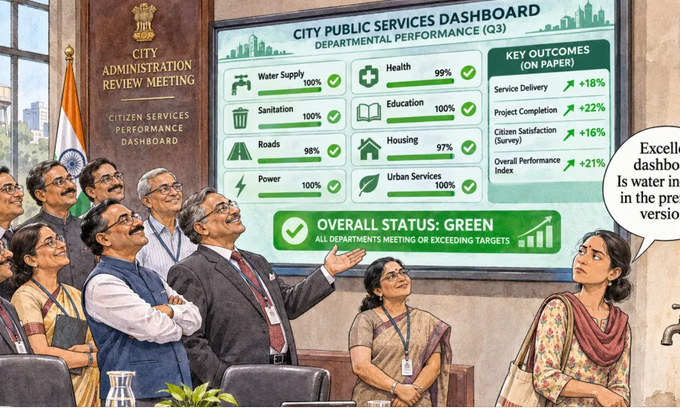
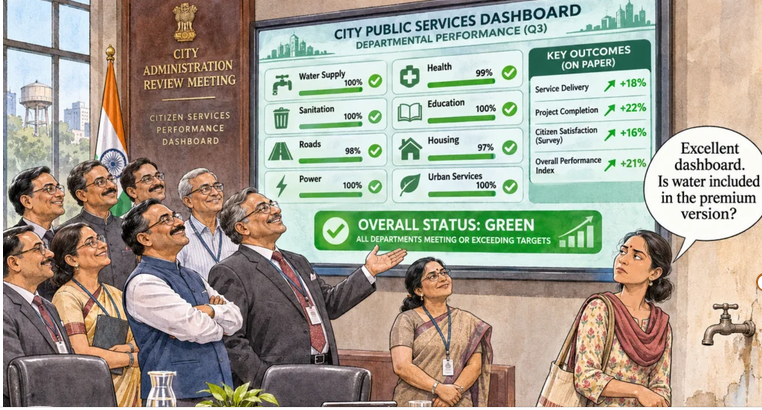
Fictional editorial cartoon: every departmental indicator is green while the citizen outcome is not.
Visual disclosure: all cartoon panels are AI-generated editorial illustrations created under author direction. They depict fictional or composite scenes and are not representations of actual individuals or institutions.
NOTE TO THE READER
The Samanvaya Urban Transformation Mission, its officials, the researcher Dr. Arjun Sen, his assistant Isha, and the dialogue in this article are fictional composite devices. They are used to make a systems problem concrete; they do not portray any particular Indian ministry, state, municipality, official, project or researcher.
The Indian public-sector cases identified by name are real and are drawn from official audit or government sources. The research scenes are dramatized. The intellectual progression they represent—from component-level explanations, to recurring execution conditions, to the interaction among those conditions as an outcome-producing governing object—is the underlying research proposition examined by the author.
The goal is simple: make a difficult governance problem understandable without making it less precise.
The real audit findings and systems literature stand independently of the analytical labels introduced later. The article should therefore be read as an examination of one lens, not as an editorial endorsement of a proprietary framework.
1. THE SUCCESSFUL FAILURE
At 9:28 on Monday morning, Meera Rao knew the meeting was going badly. Nobody had said anything yet. That was how she knew.
Around the conference table sat the senior leadership of the fictional Samanvaya Urban Transformation Mission. On the wall was a dashboard. Almost everything was green: Finance. Procurement. Engineering. Technology. Contract compliance. Monthly reporting.
Citizen satisfaction was unmistakably red.
Meera: “Excellent. Apparently we are doing wonderfully.”
Nobody smiled.
Meera: “So why is the programme failing?”
Arvind Kapoor, the Financial Controller, opened a folder substantial enough to qualify as building material. All sanctioned releases, he explained, had been processed within the prescribed period. Nandita Menon from Procurement had completed the tenders, evaluations and awards. Ramesh Iyer from Engineering reported the civil works substantially complete. Neha Bhat from Digital Systems reported 99.4 per cent platform availability. Legal had vetted the contracts. Operations had deployed the teams. Monitoring had submitted the reports.
Meera: “Wonderful. Who would like to explain the small inconvenience that the system does not work?”
Three kilometres away, Kavita Devi knew none of this. She knew her water supply was unreliable. She knew a recently resurfaced road had been excavated again. She knew her grievance had been registered, forwarded, and then forwarded again.
Kavita: “The complaint is travelling better than the water.”
That joke contains the first clue. Citizens do not experience departments. They experience the combined consequence of departments.
2. THE LABORATORY OF BROKEN SYSTEMS
Elsewhere—and earlier in the logic of our story—a systems researcher named Dr. Arjun Sen had accumulated an unusual laboratory. No test tubes. No microscopes. Instead: audit findings, contracts, incident reports, performance data, decision timelines, organisational charts, and financial outcomes.
Across one wall he had written a question: WHY DO COMPETENT ORGANISATIONS PRODUCE INCOMPETENT OUTCOMES?
Isha: “Maybe they are not competent.”
Arjun: “That was theory number one. Sometimes correct. Not enough.”
The obvious suspects came first: bad management, weak leadership, human error, poor training. Sometimes those explanations worked. But not always. There were cases containing capable people who appeared to be behaving rationally within the authority, information, incentives and constraints around them.
Next came process. Again, sometimes the process really was broken. But other organisations had policies, controls, escalation procedures, committees, dashboards, audits and reports—and still deteriorated.
Then came the component. Finance. Procurement. Technology. Operations. Risk. Vendor management. Sometimes one component failed. The stranger cases were those in which each component could defend itself and the failure appeared only when the components had to operate together.
Arjun: “This is not always a failure inside the boxes.”
Isha: “Then where is it?”
Arjun: “Between them.”
None of this begins from zero. Deming warned against optimizing parts at the expense of the whole. Forrester formalized dynamic systems thinking. Pressman and Wildavsky demonstrated the fragility of implementation across many actors. Rasmussen, Reason, Leveson, Weick and Sutcliffe, and other safety and reliability scholars showed how interaction, drift, feedback, organisational conditions and adaptation shape consequential outcomes.
The narrower research question here is not whether interaction matters. It plainly does. The question is whether a recurring set of execution conditions can be represented and governed as a distinct outcome-producing object.
3. THE EIGHT CLUES
Arjun stopped sorting the cases by department. Instead, he asked what conditions repeatedly shaped consequential execution.
AUTHORITY — Who can actually change what happens next—not merely recommend, circulate or advise?
EVIDENCE — What does the decision-maker know, how current is it, and does it arrive while action still matters?
STANDARDS — What counts as acceptable execution, and do participants mean the same thing by complete?
TIMING — When does the corrective option expire?
INCENTIVES — What is each participant actually rewarded for optimizing?
HANDOFFS & DEPENDENCIES — What must move across a boundary, and whose success depends upon someone else?
INTERVENTION RIGHTS — Who can pause, redirect, escalate, refuse or stop?
ACCOUNTABILITY — Who carries the consequence, and does that person possess enough authority, evidence and intervention capacity to influence it?
Eight familiar ideas. Nothing magical. The important change came when they stopped behaving like a checklist.
Suppose evidence changes. Authority may need to act differently. Suppose the evidence arrives late. Timing changes the value of authority. Suppose the authority-holder is rewarded for avoiding delay. Incentives now interact with evidence and timing. Suppose intervention depends on another department. Dependency changes what authority practically means. Suppose accountability remains with someone who cannot intervene. Responsibility exists. Governability does not.
One connection became five. Five became twenty. Soon the wall looked less like a management model and more like a crime investigation.
Isha: “That is ugly. It looks like a system.”
Arjun stopped looking at the cards and looked at the connections.
| The conditions are not merely beside one another. Their interaction is producing the trajectory. |
The specific proposition under examination is that these recurring conditions can interact as a distinct outcome-producing governing object. The parts are familiar. The question is whether representing their interaction as one governing object adds useful visibility and intervention capacity beyond governing the parts separately.
Arjun wrote a name across the wall: THE UNSEEN EXECUTION SYSTEM.
Isha: “Who owns that?”
Arjun: “Exactly.”
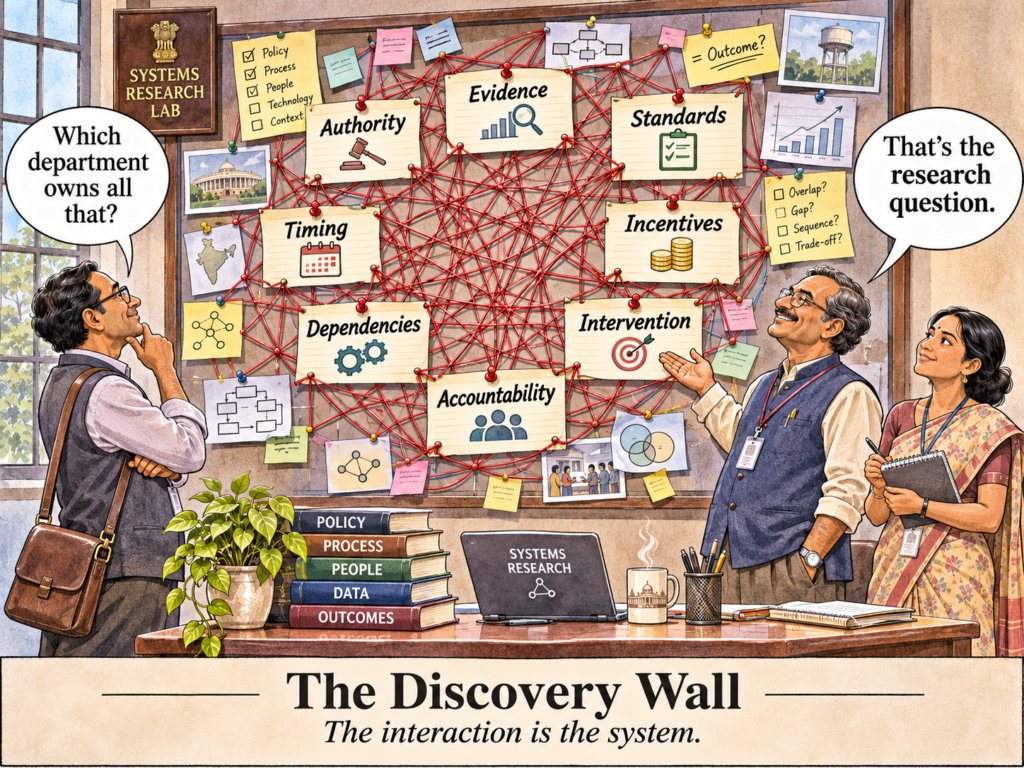
Fictional editorial cartoon: the interaction among governing conditions becomes visible as a system.
4. WHEN THE FICTION BECOMES UNCOMFORTABLY REAL
Back at Samanvaya, Meera’s team reaches the water project. The reservoir, connecting main and utility relocation had originally been sequenced as one commissioning path. Mid-project, a court stay temporarily blocked access to a critical right-of-way. Engineering re-sequenced the civil works it could lawfully complete. The utility finished the relocation defined in its approved instruction. Finance and Procurement kept the remaining packages moving. When access reopened, however, the changed dependency did not trigger a new integrated commissioning sequence.
The reservoir is complete, but Operations still cannot commission it at design capacity because the final main segment now requires fresh site clearance and a revised utility instruction. Who failed? Engineering? Not necessarily. The utility? Not necessarily. Finance? No. Procurement? No.
The more precise question is whether the changed condition was translated into updated sequencing, authority, evidence and intervention across the whole outcome.
Meera: “Everyone owns their task. Who owns the re-sequencing when the conditions change?”
Now leave the fictional city. India has documented versions of exactly this problem.
KERALA: THE ASSET EXISTS. THE SERVICE DOES NOT.
A Comptroller and Auditor General of India performance audit of AMRUT implementation in Kerala reported that a 100 MLD water-treatment plant at Vasoorichira in Kollam, constructed at a cost of ₹40.62 crore, remained idle because the raw-water pumping main had not been completed. The same audit reported four overhead service reservoirs, built at a combined cost of ₹31.51 crore, remaining idle because connected pumping mains, distribution lines, leakage or related infrastructure prevented operation.
The asset existed. The intended service did not. A water-treatment plant is an output. Water reaching households is an outcome.
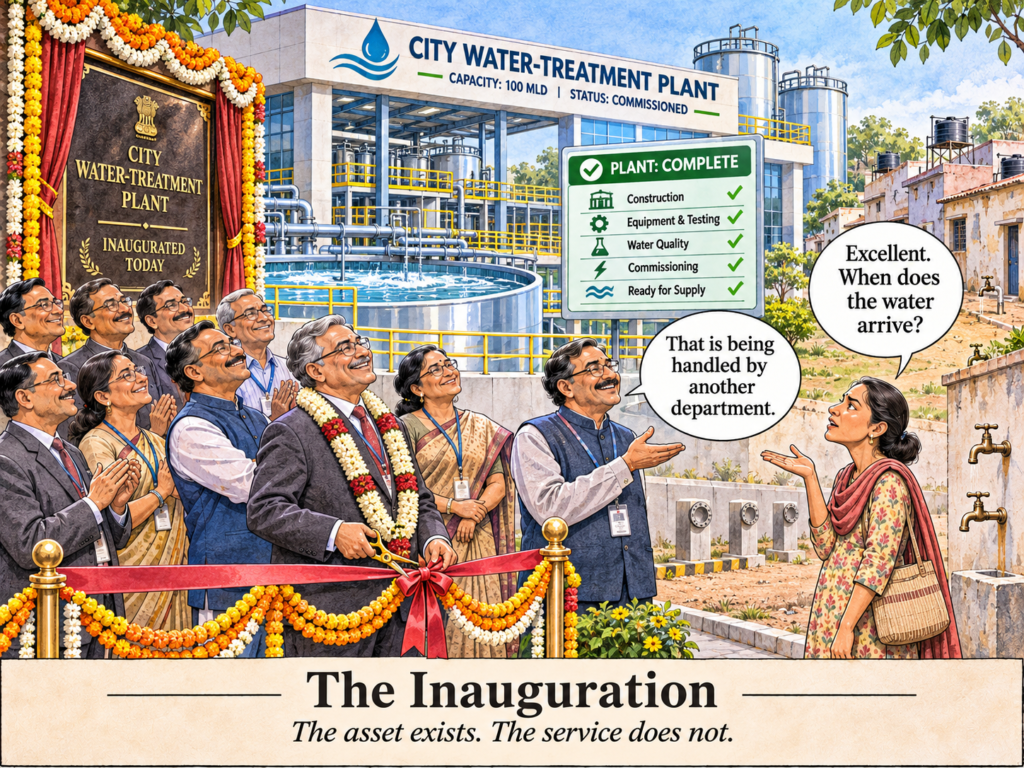
Fictional editorial cartoon inspired by a general implementation pattern: a completed asset is not the same thing as a functioning service.
Source: Comptroller and Auditor General of India, Performance Audit on Implementation of AMRUT in Kerala, Chapter IV, para. 4.3.1.1, p. 32; Executive Summary (idle reservoirs).
DEHRADUN: EVEN COORDINATION CAN HAVE A COORDINATION PROBLEM
The CAG performance audit of the Smart Cities Mission in Dehradun found coordination problems among line departments despite formal governance machinery. The audit reported that a high-powered steering structure could not resolve recurring coordination problems. It also found that an inter-departmental task force had been constituted but that the order establishing it did not specify roles and responsibilities. The audit linked coordination failures to delays, disputes over responsibilities and, in some instances, damage to completed work.
This matters because the easy answer to cross-boundary problems is: create a coordination committee.
But representation is not intervention. Attendance is not governability. A meeting can see a problem without possessing the practical architecture to change it.
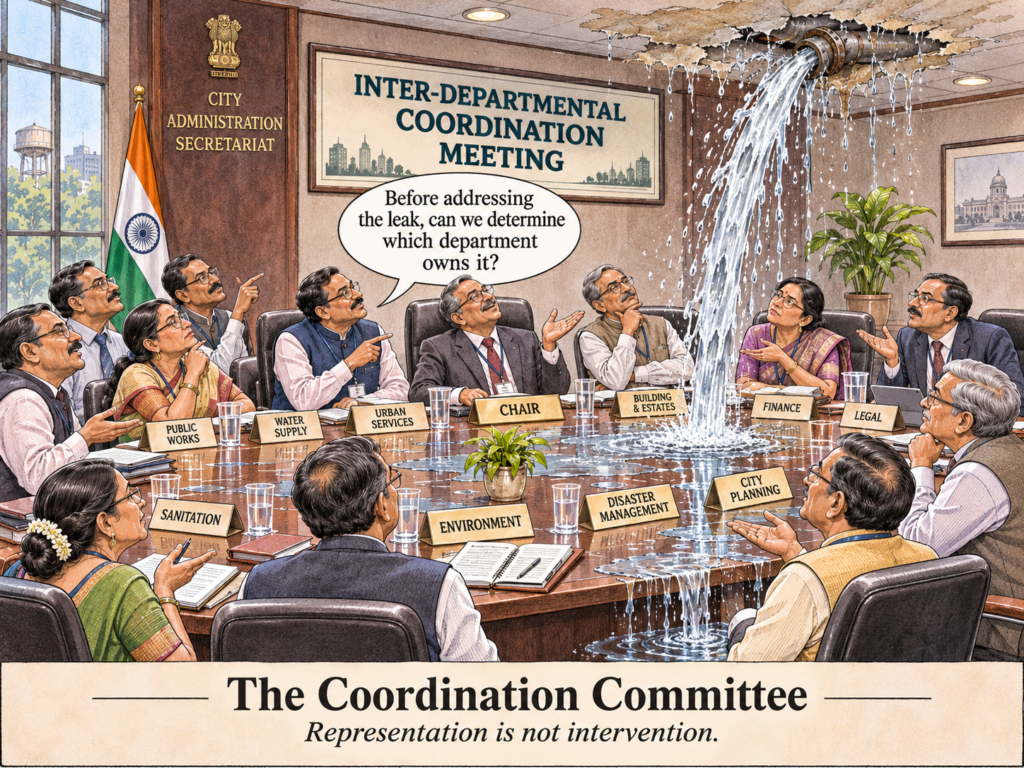
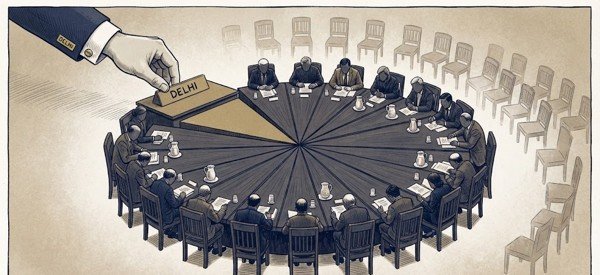
Fictional editorial cartoon: representation is not intervention.
Source: Comptroller and Auditor General of India, Implementation of Smart Cities Mission in Dehradun, Report No. 5 of 2025, Chapter 5, paras. 5.1.1–5.1.2, p. 58; tabled March 2026.
SIKKIM: THE MACHINE EXISTS. THE CAPABILITY DOES NOT.
A CAG performance audit of selected district hospitals in Sikkim documented equipment at New STNM Hospital remaining idle for reasons including non-availability of surgeons and technical personnel, lack of repairs and other utilisation constraints. The audit warned that equipment could lose warranty or guarantee life before use and criticised weak planning and internal control around procurement and utilisation.
Buying a machine is not the same as creating a capability. Capability appears only when equipment, people, consumables, maintenance, workflow, authority and timing are present together.
Source: Comptroller and Auditor General of India, Performance Audit of Select District Hospitals in Sikkim, Chapter III, para. 3.4.3, pp. 24–26.
NAMAMI GANGE: AN UMBRELLA PROGRAMME STILL NEEDS AN EXECUTION SYSTEM
The CAG’s 2017 performance audit of Namami Gange examined funding, planning, implementation, human resources, monitoring and evaluation. It identified deficiencies across those areas and reported delays in milestones and planned targets. The programme itself had been designed as an umbrella effort to integrate initiatives and create more comprehensive, coordinated intervention.
The lesson is not that coordination was ignored, nor that this interaction lens uniquely explains the audit findings. The narrower point is that intending coordination and sustaining governable execution are different things.
Source: Comptroller and Auditor General of India, Report No. 39 of 2017, Performance Audit of Rejuvenation of River Ganga (Namami Gange).
NOT EVERY FAILURE LIVES BETWEEN THE BOXES
Calling the parts competent is a diagnostic hypothesis, not a courtesy assumption. If Engineering builds an isolated asset because basic planning failed, call it bad planning. If Procurement is corrupt, call it corruption. If staffing is inadequate, call it a capacity failure. A department may lack technical capability, a design may be poor, contract management may be weak, or straightforward human error may dominate the result. In those cases, searching for a hidden interaction problem can obscure the real cause.
Other constraints sit partly outside administrative design: political and electoral incentives, transfer and vigilance exposure, land and utility disputes, contractor behaviour, information asymmetry, judicial timelines, fiscal rules, staffing constraints, and differences in state or municipal capacity. These forces can alter what intervention is lawful, feasible and timely.
The interaction lens is therefore not a universal substitute for ordinary diagnosis. It is useful when cross-boundary conditions materially shape the trajectory. A serious review should test that proposition against competing explanations rather than assume it in advance.
5. INDIA ALREADY KNOWS THE OUTCOME IS BIGGER THAN THE PACKAGE
This argument does not begin from the premise that Indian government has overlooked cross-boundary execution. India has extensive machinery precisely because it has not.
The Cabinet Secretariat explicitly supports inter-ministerial coordination, including removing difficulties and differences, overcoming delays and coordinating administrative action. India also uses implementation-monitoring mechanisms such as eSamikSha, while PRAGATI was built around proactive governance and timely implementation across ministries, departments and states.
At the 53rd PRAGATI meeting in August 2026, Prime Minister Narendra Modi emphasized that infrastructure projects should be viewed as an integrated whole rather than as isolated sections or packages. The official account stressed timelines, inter-agency coordination, pending issues, end-to-end implementation and the need for progress in individual packages to translate into completion and operationalisation of the whole project.
| A package can succeed while the project fails. A department can succeed while the outcome fails. |
The remaining question is narrower and operational: within these existing mechanisms, what must remain governable for the integrated whole to keep producing the intended trajectory?
That need not mean creating a new committee. In practice it can mean using an existing review forum to identify a critical dependency, define the evidence that triggers escalation, name the official or body already empowered to act, and specify the date after which the intervention loses value. Where current law, financial rules or contract conditions do not confer the needed authority, the answer is formal amendment or higher-level approval—not an informal override.
The design also has to respect local capacity. A mechanism that works in a well-staffed state agency may not transfer unchanged to a smaller municipality with thin technical staff, different contractor markets or more limited fiscal room.
WHY THE SILO CAN BE RATIONAL
The departmental box is not merely a bureaucratic habit. It can be a protection mechanism. Public officials operate within delegated financial powers, procurement rules, contract terms, audit scrutiny, vigilance processes and political accountability. Acting across a boundary without clear authority can create personal as well as institutional exposure. Staying inside a defined mandate can therefore be rational even when the combined outcome suffers.
Local metrics also serve legitimate functions: they certify progress, support expenditure decisions, document compliance and create an auditable record. Visible package completion and green indicators may carry administrative or political value. The mistake is not having departmental metrics; it is treating them as proof that the end-to-end outcome is healthy.
Cross-boundary intervention therefore has to be rule-aware. A useful review identifies the existing lawful authority, the contract clause or financial delegation that permits action, and the escalation route when no actor currently holds it. It also tests the frontline reality: whether engineers, inspectors, clerks, operators and programme staff have enough capacity and time to execute the handoff. Where vacancies, multiple charges, land disputes, utility constraints, court orders, vendor incentives or fiscal rules dominate the problem, those constraints belong in the system map rather than outside it.
This is also why making the interaction visible does not automatically make it governable. Visibility can reveal that the next required action is legally unavailable, financially unfunded, contractually constrained or operationally impossible. In those cases the value of the diagnosis is to identify the true structural barrier and the level of authority required to change it.
Rule-aware context: Government of India, Department of Expenditure, General Financial Rules 2017 (updated through 31 January 2026) and Manual for Procurement of Works, Second Edition 2025.
Sources: Cabinet Secretariat, Government of India, Functions; Prime Minister’s Office, 53rd PRAGATI Meeting, 25 August 2026.
6. MEERA CHANGES THE MEETING
At the next Samanvaya review, Meera removes the departmental presentations.
Arvind: “What will Finance present?”
Meera: “Nothing.”
Arvind: “Nothing?”
Meera: “Not today.”
Nandita raises an eyebrow. Neha closes the dashboard. The meeting is becoming highly irregular.
Meera places one sentence on the screen: RELIABLE WATER TO 80,000 HOUSEHOLDS.
Meera: “That is today’s agenda. What can prevent this outcome?”
Now the answers are different: raw-water supply, power, pumping capacity, distribution, land, utility relocation, contractor mobilisation, site clearance, commissioning standards, evidence about leakage, approval deadlines, escalation authority.
The departments have not disappeared. They are simply no longer the organising principle. The outcome-producing system is.
Meera: “So this is what we have actually been managing?”
Ramesh: “No. We have been managing our pieces.”
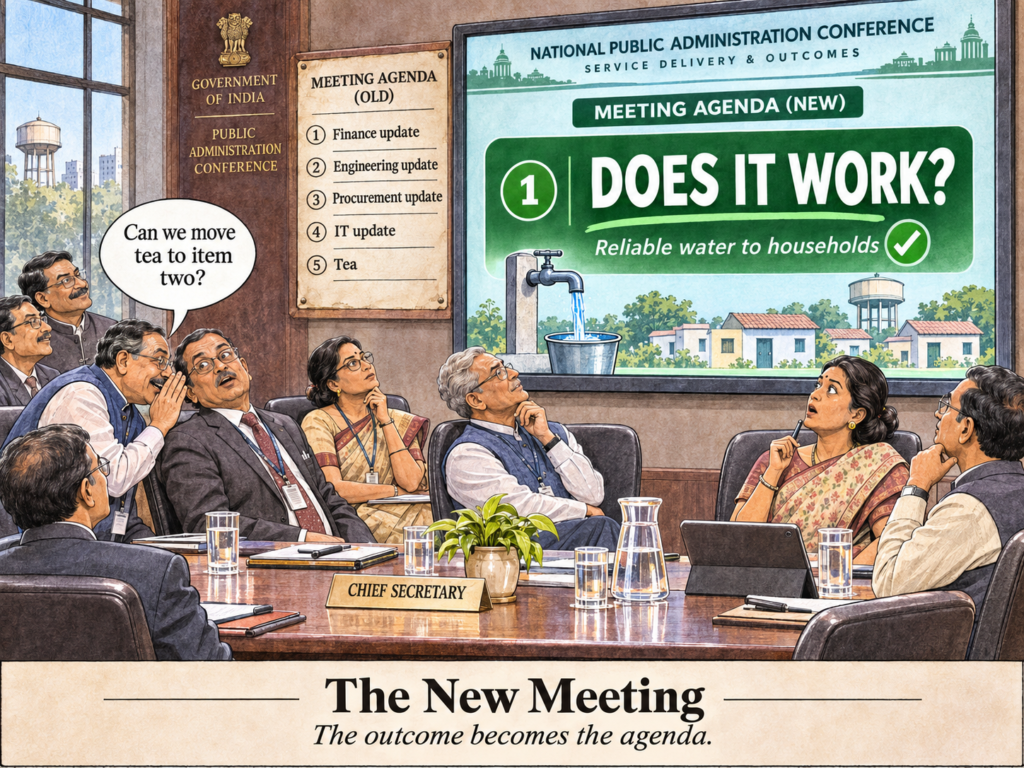
Fictional editorial cartoon: the outcome becomes the agenda.
7. GOVERNANCE IS NOT REPORTING
Modern institutions can know enormous amounts: dashboards, sensors, audit trails, exception reports and analytics. But knowing and governing are different.
A warning appears. Who receives it? Can that person interpret it? Does that person possess authority? Can the authority be exercised? Does another actor control the dependency? Is intervention contractually or legally permitted? How much time remains?
A report produces visibility. Governance requires the capacity to change trajectory.
And governance has an expiration date. At month one, a delayed contractor may be recoverable. At month three, options narrow. At month six, replacement becomes expensive. At month nine, the original deadline may be impossible. At month twelve, the institution may receive an excellent forensic report explaining precisely what happened.
The report may establish accountability. It did not govern that outcome.
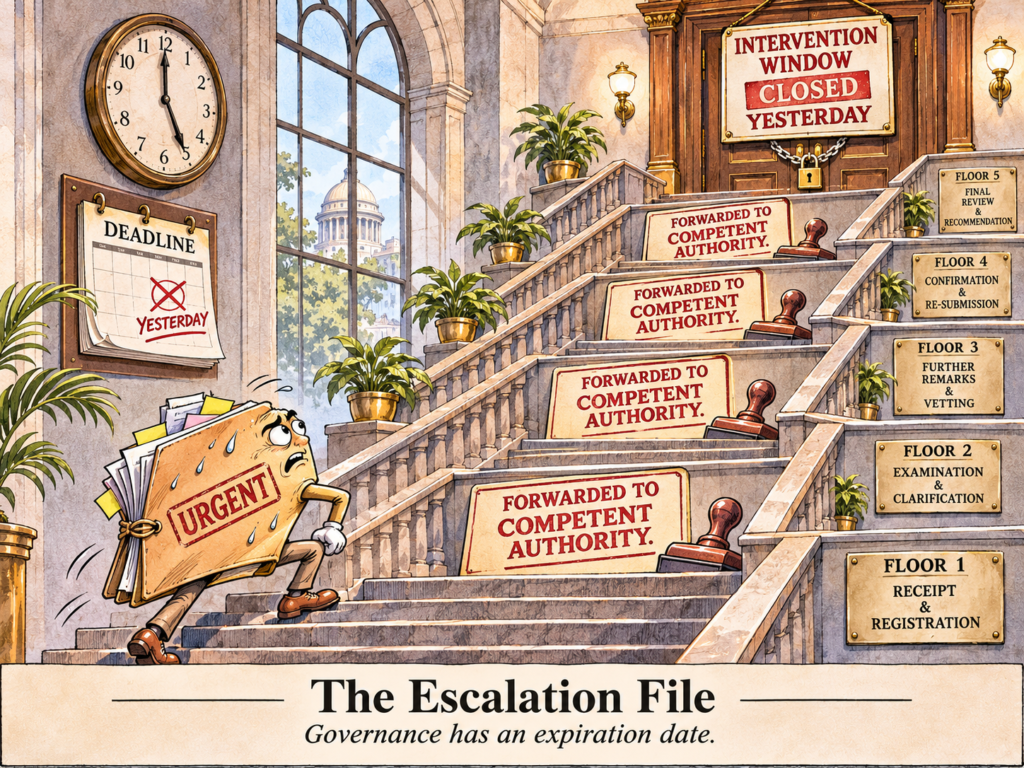
Fictional editorial cartoon: escalation can arrive after the useful intervention window has closed.
8. GOVERNABILITY IS NOT CENTRALISATION
There is an obvious danger in this argument. If cross-boundary execution is difficult, perhaps one powerful authority should control everything. No. That confuses governability with centralisation.
Democratic government deliberately distributes authority. Judicial independence matters. Audit independence matters. Federal arrangements matter. Segregation of duties protects institutions. Professional autonomy may be essential. Veto points can prevent abuse.
Some delay and friction are therefore not defects at all. They may be the price of due process, federalism, scrutiny or legitimate democratic disagreement. The objective is not to eliminate friction; it is to distinguish protective friction from preventable loss of governability.
The problem is not distributed authority. The problem is authority that becomes unclear, disconnected from evidence, or practically unusable when intervention matters.
A distributed system can remain highly governable if participants understand who may act, on what evidence, under which standard, through what escalation pathway, with which intervention rights, and before what consequential deadline. A centralised system can be profoundly ungovernable if evidence is distorted, dissent suppressed or command arrives too late.
9. THE 90-DAY EXPERIMENT
Meera does not reorganise government. She selects one outcome: reliable water service. The 90-day sequence is a bounded diagnostic experiment, not a claim that every institutional problem can be solved—or even fully diagnosed—in three months.
DAYS 1–30: FOLLOW THE OUTCOME
Map the actual consequence-producing pathway. Do not begin with the organisation chart. Identify the actors, evidence, approvals, contractors, technologies and dependencies that can materially change the result. Mark where the outcome crosses boundaries.
DAYS 31–60: TEST GOVERNABILITY
Where does evidence stop? Where is authority ambiguous? Where do standards conflict? Which handoff is chronically late? Who is accountable but unable to intervene? Where are two parties each behaving correctly while producing a combined delay? Do transfer risk, vigilance exposure, political pressure, contractor information advantage or resource scarcity discourage timely action?
DAYS 61–90: CORRECT WHAT CAN BE CORRECTED
Clarify an escalation threshold. Align a definition of complete. Route an exception report to someone who can act. Synchronise dependent milestones. Use existing contract conditions, financial delegations or statutory authority where they already permit intervention. Tie deadlines to the real intervention window. Do not manufacture informal powers that the institution does not lawfully possess.
Some problems will not be solved in 90 days. The exercise cannot create statutory authority, fill a chronic capability gap, undo a court order, rewrite procurement law or manufacture resources that do not exist. It may reveal the need for contract amendment, budget approval, regulatory change, intergovernmental agreement or legislation. Its result is a bounded diagnosis and intervention test—not proof that the method generalises to every programme or domain.
10. THE MONEY ARRIVES LATE
The significance of this problem is not merely organisational. In financially material systems, execution conditions can become balance-sheet conditions.
Delay becomes duration. Duration becomes cost. Rework consumes resources. Idle assets strand capital. Litigation consumes money. Variance becomes volatility. Poor predictability weakens planning and capital allocation. The financial statement records the consequence, but the economic consequence often begins forming much earlier.
The same principle applies to the public balance sheet. A completed asset that cannot deliver service still consumes capital. A delayed project postpones the benefits citizens and businesses were supposed to receive. A corrective action taken after the intervention window may protect accountability while doing little to recover economic value.
The number appears late. The execution trajectory that created it began earlier.
11. THE PRACTICAL TEST
At the next institutional review, place one consequential outcome in the centre of the room. Then ask eight questions:
Before using the eight-condition lens, ask one preliminary question: is this actually an interaction problem? If the dominant cause is poor design, corruption, inadequate staffing, technical error or a single failed function, diagnose that directly.
| Condition | Question |
|---|---|
| Authority | Who can change its trajectory? |
| Evidence | What do we know now that should change execution? |
| Standards | What exactly counts as acceptable? |
| Timing | When does intervention stop being useful? |
| Incentives | What is each participant rewarded for optimising? |
| Dependencies | What must happen elsewhere before this can succeed? |
| Intervention | Who can pause, redirect, refuse or escalate? |
| Accountability | Who carries the consequence—and can that person influence the conditions producing it? |
Do not abolish departments. Do not replace audit, risk, project management, law, finance, safety or professional expertise. Do not centralise everything. Stop assuming that individually governed components automatically produce a governed system. Then test whether making the interaction visible actually adds information or intervention capacity beyond the methods already in place.
12. THE ANSWER TO THE MYSTERY
Meera’s mystery has an answer. Finance did not secretly fail. Engineering was not hiding a catastrophe. Procurement did not forget how to procure. Technology was not the villain.
In this kind of case, the missing object is the interaction through which otherwise legitimate parts become one trajectory. Once that interaction is visible, it becomes difficult to unsee—but visibility is not proof. The practical test is whether governing it adds useful foresight, lawful intervention capacity or consequence traceability beyond governing the parts separately.
| Every part can have an owner while the outcome-producing interaction remains unassigned. |
That is one way a competent institution can generate an incompetent result—and one reason component-level performance alone cannot always explain the outcome.
At the next programme review, remove the departmental scorecards for ten minutes. Put one outcome on the screen and ask:
| If every department performs its assigned task correctly, can the outcome still fail? |
If the answer is yes, another system is operating in the room. Find it. Make it visible. Determine whether it is still governable while intervention can change what happens next.
DISCLOSURE & AUTHOR INFORMATION
Research origin. The terms Unseen Execution System™ and Execution Governance™ originate from research by the author through Quantum Competitive Intelligence™ (QCI). They are proprietary formulations disclosed for attribution. The article asks readers to evaluate the public audit evidence, systems literature and practical questions on their own merits, whether or not they adopt those labels.
Domain implementation. QCI has selected workers’ compensation as its first domain implementation and empirical proving ground, including bounded live pilot work. No claim is made that domain-specific instrumentation developed there transfers unchanged to Indian public administration; adaptation and independent validation would be required in any new domain.
Editorial independence. The CAG findings, Government of India mechanisms and scholarly sources cited in this article stand independently of QCI’s proprietary terminology. The article presents one analytical lens alongside established explanations; it is not evidence that the proprietary architecture uniquely explains the cited cases.
Visual disclosure. The cartoon panels are AI-generated editorial illustrations produced under author direction. They are fictional/composite and are not intended to depict actual officials, institutions or events. The real cases are separately identified and sourced in the text.
SELECTED SOURCES & FURTHER READING
1. Comptroller and Auditor General of India. Performance Audit on Implementation of Atal Mission for Rejuvenation and Urban Transformation (AMRUT) in Kerala, 2025, Executive Summary and Chapter IV, para. 4.3.1.1, p. 32. https://cag.gov.in/uploads/download_audit_report/2025/Print-version-english_AMRUT_Kerala_10.12.25-with-legislature-date-0699d302521f715.11884185.pdf
2. Comptroller and Auditor General of India. Implementation of Smart Cities Mission in Dehradun, Report No. 5 of 2025, Chapter 5, paras. 5.1.1–5.1.2, p. 58; tabled 10 March 2026. https://cag.gov.in/uploads/download_audit_report/2025/Report-No.-05-Smart-Cities-UK—19-11-2025-signed-069b02aa24e1a16.54541284.pdf
3. Comptroller and Auditor General of India. Performance Audit of Select District Hospitals in Sikkim, Report No. 1 of 2021, Chapter III, para. 3.4.3, pp. 24–26. https://www.cag.gov.in/uploads/download_audit_report/2019/Chapter%20III%20English-0606c1d5f447952.56961771.pdf
4. Comptroller and Auditor General of India. Report No. 39 of 2017 – Performance Audit of Rejuvenation of River Ganga (Namami Gange), Executive Summary and relevant chapters on planning, human resources, monitoring and evaluation. https://cag.gov.in/en/audit-report/details/34506
5. Prime Minister’s Office, Government of India. PM chairs 53rd PRAGATI Meeting, 25 August 2026. https://www.pmindia.gov.in/en/news_updates/pm-chairs-53rd-pragati-meeting/
6. Cabinet Secretariat, Government of India. Functions of the Cabinet Secretariat. https://cabsec.gov.in/about-us/functions
7. Government of India, Ministry of Finance, Department of Expenditure. General Financial Rules, 2017, updated through 31 January 2026. https://doe.gov.in/acts-rules
8. Government of India, Ministry of Finance, Department of Expenditure. Manual for Procurement of Works, Second Edition, 2025. https://doe.gov.in/en/manuals
9. Deming, W. Edwards. Out of the Crisis. MIT Press, 1986.
10. Forrester, Jay W. Industrial Dynamics. MIT Press, 1961.
11. Pressman, Jeffrey L., and Aaron Wildavsky. Implementation. University of California Press, 1973.
12. Rasmussen, Jens. “Risk management in a dynamic society: A modelling problem.” Safety Science 27(2–3), 1997.
13. Reason, James. Managing the Risks of Organizational Accidents. Ashgate, 1997.
14. Leveson, Nancy G. Engineering a Safer World: Systems Thinking Applied to Safety. MIT Press, 2012.
15. Weick, Karl E., and Kathleen M. Sutcliffe. Managing the Unexpected. Jossey-Bass, 2015.

Jay VonSpreck
| Name:Jay VonSpreck Current position:Founder, Quantum Competitive Intelligence™ Education & professional development:Professional education in business, systems, governance and organizational performance has been primarily self-directed, supplemented by college coursework in communications and extensive independent study over many years. Professional experience:Career experience includes executive, risk-architecture and consulting leadership across workers’ compensation and enterprise-risk environments. Research focus:Execution governance, institutional intelligence, risk architecture, the Unseen Execution System™, and governed execution across distributed human, technological and institutional environments. Current domain implementation:Workers’ compensation is the first empirical proving ground, including bounded live pilot work. Contact:LinkedIn: https://www.linkedin.com/in/jayvonspreck | QCI: https://metainteldynamics.com/ |


Leave a comment