





























Modernization of a million strong Army is a complex and dynamic process impacted by operational challenges, emerging technologies and budgetary support. Review of modernization of the Indian Army is a periodic institutional exercise wherein force levels, and gestation periods as well as lifetime support of equipment are assessed against the desired capabilities. The resultant outputs form the basis for formulation of the Long Term Perspective Plans (covering 15 years), Service Capital Acquisition Plans (five-year plans) and Annual Acquisition Plans. Currently, the 10th modernization plan of the Army is under preparation. Its priorities are to maintain capability to deal with the entire spectrum of conflict, build strategic nuclear deterrence, the capability to secure the island territories, maintain out-of-area capability and provide assistance to UN troops. The 11th Defence Plan has earmarked a substantial component of the budget for modernization. The focus is on precision firepower, air defence, aviation, Future Infantry Soldier as a System, infrastructure development, network-centricity and achieving battlefield transparency through improved surveillance, night vision and target acquisition.
The government has repeatedly assured that an enhanced defence outlay will be available to achieve modernization goals. With the formulation of the Defence Procurement Procedure (DPP) 2008 and reforms in procurement procedures, the pace of capital procurement has increased, resulting in overall enhanced combat effectiveness and utilization of allocated financial outlay.
In the prevailing era of strategic uncertainty, while terrorism has become the primary threat, the external and internal threats and challenges faced by India are such that a large Army is still required to be maintained. Also, a high degree of preparation and operational readiness remains necessary as conventional war, though improbable, cannot be categorically ruled out. The nature of warfare is changing and evolving rapidly. There is a significant overlap today between external threats, proxy war, counterinsurgency and counterterrorism operations. Internal and external security have become inextricably linked.
Our defence capability planning is based on a ‘threat-cum-capability’ approach with focus on upgradation of operations capability through modernization, force restructuring, technology absorption and commensurate infrastructure development in a phased manner
The Army is fully alive to this transition. It, therefore, needs to remain prepared and trained to fight across the spectrum of conflict. We also need to build credible “out-of-area contingency” capabilities to protect our interests and render military assistance to friendly countries, including humanitarian assistance or disaster relief, when mandated. Accordingly, our defence capability planning is based on a “threat-cum-capability” approach with focus on upgradation of our operations capability through modernization, force restructuring, technology absorption and commensurate infrastructure development in a phased manner. Concurrently, human resource development is being given a renewed focus to facilitate induction of quality manpower to support a technology-oriented army. We are also consciously working towards preparing our leadership to acquire skills to be able to respond dynamically to the changing security paradigm.
Our modernization programme has envisaged having an appropriate mix of weapons/equipment, comprising 30 per cent state-of-the-art technology, 40 per cent current technology and 30 per cent nearing obsolescence, which can be upgraded
Induction and modernization of equipment/weapon system in a large army like ours has to be organized in a pragmatic manner. Considering the receding span of the technological cycle, the right balance has to be maintained between state-of-the-art, current and obsolescent technologies. To ensure this, our modernization programme has envisaged having an appropriate mix of weapons/equipment, comprising 30 per cent state-of-the-art technology, 40 per cent current technology and 30 per cent nearing obsolescence, which can be upgraded.
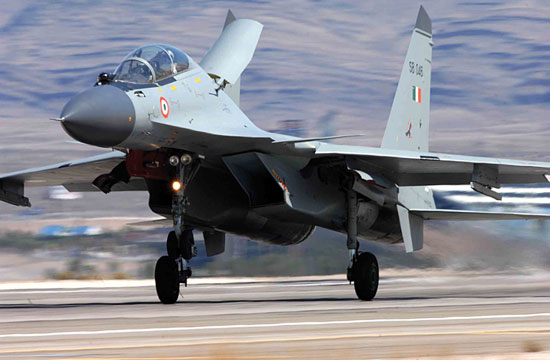
In order to modernize with hi-tech weapons, artillery systems, unmanned aerial vehicles (UAVs) and other advanced systems and munitions, a multi-billion dollar induction plan has been chalked out. These high-technology platforms, systems and other assets will accentuate the Army’s capabilities when integrated with Command, Control, Communications, Computers, Intelligence, Surveillance and Reconnaissance (C4ISR) systems. The Army aims to be equipped with this state-of-the-art weaponry and platforms in the next five to seven years.
The Army is extensively engaged in ongoing Internal Security (IS) and counterinsurgency operations (CI) and simultaneously needs to prepare for a future border conflict that may spill over to a larger conventional war in the plains. In keeping with these twin requirements, it has decided to upgrade the IS and CI capabilities of infantry battalions as well as enhance their firepower-mobility-EW (electronic warfare) punch for a possible war in the plains or mountains. The Army Chief’s modernization vision is to “adapt to high-end technology, improve night-fighting capability, information technology, information warfare and network-centric warfare”.
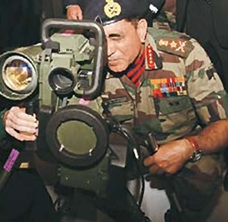
While Kornet-E anti-tank guided missiles (ATGMs) with thermal imaging sights have substantially increased the anti-tank capability of infantry battalions, most efforts to modernize the equipment held by infantry and Rashtriya Rifles (RR) units are aimed at enhancing capability for surveillance and target acquisition at night and boosting their firepower for precise retaliation against infiltrating columns and terrorists holed up in built-up areas. About 200 hand-held thermal imaging devices (HHTIs) with ranges up to 2,000 m for observation at night and stand-alone infra-red, seismic and acoustic sensors with varying capabilities have enabled infantrymen to dominate the Line of Control so completely that infiltration has reduced to almost a trickle.
The newly acquired weapons, which complement these surveillance and observation devices, include 1,500 X 84 mm rocket launchers, including some disposable ones; 1,000 AMRs (anti-material rifles); 8,000 UBGLs (under-barrel grenade launchers); 4,000 new generation carbines; 300 bulletproof vehicles; and several hundred accurate sniper rifles. However, the numbers acquired and the ammunition stocks are still inadequate and need to be made up more rapidly. New 5.56 mm assault rifles of bull-pup design with an integrated laser range finder and grenade launcher are under development. Efforts are also being made to provide infantry platoons and sections with integrated GPS-based navigation system, secure lightweight walkie-talkie radio sets, and better protective gear with a helmet that incorporates a built-in head-up display. The Army’s infantry battalions also need their own mini or micro UAVs like Elbit’s Skylark or Rafael’s Skylite, among others, to improve their surveillance capability during conflicts. These UAVs should have a range of about 10 to 15 km, should be lightweight (less than 10 kg), hand launched, carry a single payload like a daylight video camera or infra-red camera for night operations, and should be inexpensive enough to be dispensable. Project F-INSAS would greatly empower the soldier and must be accorded the highest strategic priority.
The mechanized infantry is equipped with the BMP-2 ICV Sarath of which over 1,000 have been built since 1987. A new variant is the 81 mm Carrier Mortar Tracked Vehicle (CMTV) that is based on the chassis of the Sarath ICV and has been indigenously developed to enhance the integral firepower available to mechanized infantry battalions. Other variants include a command post, an ambulance, armoured dozer and engineer reconnaissance vehicles. Mechanized reconnaissance and support battalions need better surveillance radars, fire-and-forget ATGMs and effective night-fighting capability. However, their capabilities can be upgraded on a lower priority compared with infantry battalions that are engaged in border management and IS/CI operations.
As part of the modernization, Special Forces will be equipped with lightweight weaponry to enable them to take swift action during close combat operations. Apart from Travor assault rifles, they will get helmets fixed with night vision binoculars and headphones for communications. Their body armour will comprise lightweight bulletproof vests. During his recent visit to Agra, the COAS mentioned that Special Forces would form our spearhead in Fourth Generation Warfare (4GW).
In addition, elaborate modernization is underway for Sappers, Signals and Army Aviation.
The only area in which the Army is lacking is its air defence systems. The Kvadrat missile system that has been the backbone of AD for strike formations since the early 1970s are aging and need urgent change. Replacement of all AD weapons approaching obsolescence is not financially viable due to the high cost of such systems. A dual track approach is thus being followed to upgrade selected weapon systems and replace others.
Enhancing night-fighting capability is a priority of the Army. Concerted efforts are being made to eradicate night blindness of the Infantry, mechanized forces and other combat support units. Intelligence, surveillance and reconnaissance capabilities are also being enhanced in a phased manner. The Army is hopeful of achieving requisite capabilities during the 11th Plan period.
The operational logistics of the Army is another success story. Tremendous enhancement has been achieved in infrastructure, force mobilization, repair and overhaul of equipment, ordnance depots, ammunition management, medical support and the like. These will reflect positively on the force capability and morale of troops.
To counter the recent media reports, which suggested that operational preparedness of the Army had suffered as its modernization drive had slowed, the Army reiterated on December 4, 2009 that it is fully prepared, battleworthy and capable of countering any challenge at very short notice. It clarified that modernization is a deliberate process and is progressive in nature. The shortfall of military hardware is reviewed at regular intervals and projected after deliberations based on operational requirements, to keep pace with its modernization efforts.
Lt Gen PC Bhardwaj, VCOAS, who oversees the Army’s modernization, has stressed that a number of measures have been taken to ensure optimum realization of modernization plans with maximum utilization of budget allocations. Evolution of Annual Acquisition Plans after detailed deliberations and their periodic reviews have helped in monitoring progress and lending impetus to the modernization plan. Streamlining of procurement processes as related to formulation of General Staff Qualitative Requirements, scaling, categorization, Request for Proposal, trials and Transfer of Technology is reviewed regularly.